Posted in Life

Too many choices?

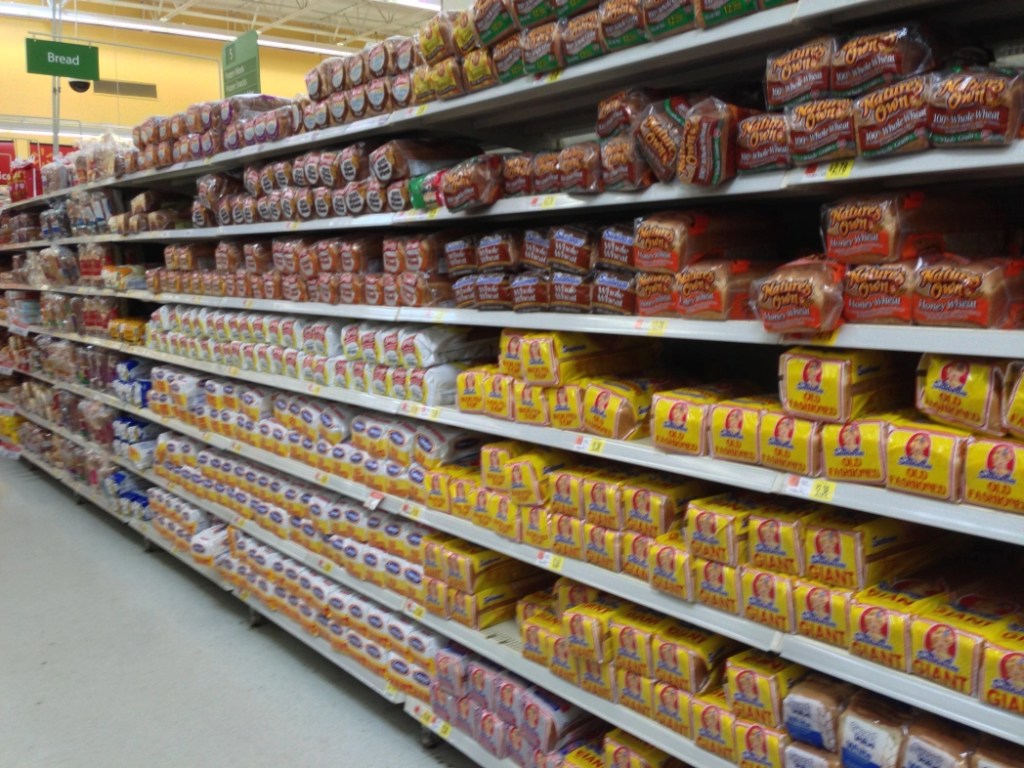
All I wanted was one jar of peanut butter. But the peanut butter section was all the way at the other end of the bread aisle in Walmart. In between me and that one jar were people pondering the hundred foot selection of bread. Everything was in stock that day: white bread, wheat bread, raisin bread, double fiber bread, butter top, sour dough, marble rye, high protein, low carb, and gluten free.

Blocking my way down the aisle were two types of people. The first couldn’t find what they wanted. The second couldn’t decide what they wanted. As I circled around an adjacent aisle to get to the peanut butter, I wondered, “Is it good or bad to have so many choices?”

On the one hand, it’s great. No matter what  flavor, texture, shape or nutrients you prefer, there is something for you. Want to try something different? No problem. There is always something new. On a tight budget? There are lower priced items on the bottom shelf. Counting calories? Some loaves have thinner slices.

On the other hand, it can be paralyzing. You only wrote the word bread on your shopping list. Will the store brand taste the same as name brand? Will the kids eat it if they see the word wheat on the wrapper? High fiber is good for you, right? Cracked wheat sounds good, but isn’t all bread made from wheat? I didn’t know they made oatmeal bread! Oh, wow, I haven’t had pumpernickel in ages. Look, there’s a buy one get one free. Before you know it, you’ve spent ten minutes pondering your bread purchase.

I am not one of those people. I know what I want, I’ve got a list, and I get in and out of the store as quickly as I can. I squeeze my way past many just wandering through the store overwhelmed by the selection.
Posted in Life

Seeing with our eyes

“When did we stop seeing with our eyes?”

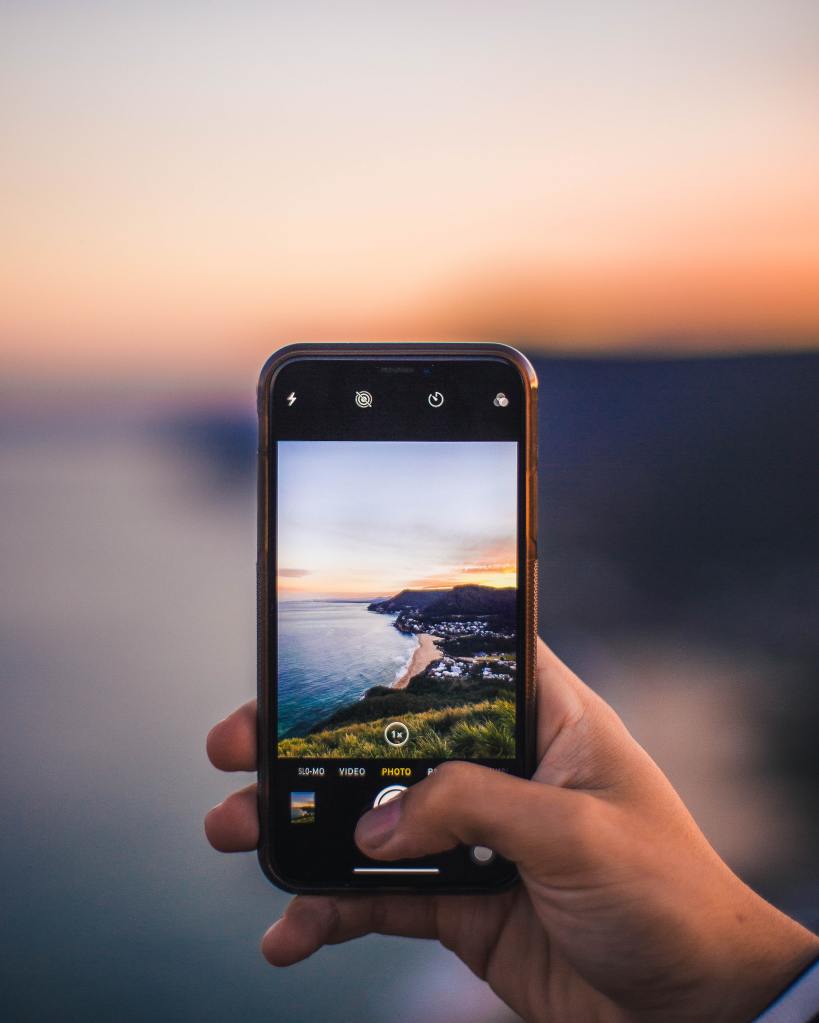
This is a quote from Lisa Unger’s murder mystery Under My Skin. “It’s been a year since Poppy’s husband Jack was brutally murdered during his morning run.” The story takes us through her journey to find out what really happened to her husband and to her. She’s a photographer who prefers to view the world through the lens of a camera.

In a number of places she explains why that is. She has forgotten some of the things that happened to her. To remember she sifts through photos. If she can capture it on film or in a camera memory, then it’s real. “If I can capture the image on my phone, then it’s real.”

With a camera in front of her face, she can blend into a scene and not be noticed. She can watch people, observe their faces and feelings, and actually see more than if she were looking at them face to face. “People are more knowable when they think they’re unobserved.” Rather than being what others expect, they are more like themselves.

With a camera, you can also freeze a moment. With each second, the light changes, expressions change, people come and go, things move in the breeze. Those moments come and go. A camera captures an instant.

While pondering this preference, she wonders, “When did we stop seeing with our eyes?” That’s a profound question for our time. We attempt to capture every moment of our lives with the camera on our phones. If you are watching through a lens of a camera, are you really watching the person, the place, or the thing? What about the lens of your eye?

With our eyes, we see a bigger picture. We see the rest of the team, not just our grandchild taking a shot. We see other people watching, reacting, crying, laughing, and cheering. We see what’s on the periphery, on the edges, not just in the center. We see the raw, untouched, naturally lighted sight in front of us, rather than a perfect and flawless image. With our eyes, we see what is real, not a fictional photoshopped image of a person who doesn’t even exist.

With our eyes, we miss a lot, too. We don’t notice that person over on the side that we later see in a photograph. We blink and a moment is gone. An illusionist distracts us so that we don’t see what he is really doing with the cards.

How many photos have we taken in which we no longer know who the people are, no longer remember when or where we took the picture, or remember why we took that picture?

When we see with our eyes, we can then share our description of what we saw, which will include what captured our attention, sparked an emotion, and made us linger to watch for more than just a moment.

Posted in Life

Barbershop irony

“I’m going to get my haircut.”

“What time is your appointment?”

Someone who doesn’t frequent barber shops might ask that question. But that’s not how it works. You walk in, have a seat, take note of the guys already sitting there, and head for an empty chair when it’s your turn. You might wait four minutes or forty minutes. It just depends on how many barbers are working that day and how many are waiting ahead of you. You watch a little ESPN  on the TV, maybe page through an old magazine, check email on your phone or read whatever you brought with you. It’s all part of the experience.

One of the ironies of the barbershop is that no matter how little or how much hair you have a haircut costs the same for every one. From my dark brown-haired youth to my present silver gray, I’ve always had a full head of hair. But my haircut is $15 just like the guy ahead of me who’s only got a little bit of hair above his neckline stretching from ear to ear. I believe seniors get a $1 discount and a flattop costs a few bucks more, but those are the only variations.

All three chairs were filled up when I arrived yesterday and there were two guys waiting ahead of me. It looked to me like two of the barbers were almost done, so I was pretty sure I would get the third. I’ve been coming here for a while and have gotten haircuts from all three in the past. Plus, the guy in the third chair didn’t have a whole lot of hair.

For some reason, that third chair never opened up. Barber number three was experienced, but taking his time, and it looked like they were having  an involved conversation. The other two guys finished before him so I got the “next” from one of them. The last I glanced over, the third barber was precisely trimming individual isolated hairs sticking up from the top of that customer’s head.

Maybe it’s actually easier to cut a full head of hair like mine, because you don’t have to be precise. There’s plenty of margin for error. Not so when you’re down to your last few follicles.

Posted in Life

Engage

As I sat enjoying my coffee, I noticed a man just a few feet away busily tapping on a phone screen. He was seated at a larger table, one with four chairs. In each of the chairs was a bulging backpack. A pile of books was stacked on the table in front of him, along with a tote bag overflowing with plastic bags.

At first, I thought the backpacks belonged to friends of his who had stepped away from the table to use the restroom or pick up coffee. But no one ever came to the table. When the gentleman stepped away, once to buy a coffee, and again to buy a bag of chips, he took the tote bag with him.

Suddenly, he stood up and methodically moved each backpack, his books and his tote bag to a smaller table, one with room for just too chairs.

I never got a chance to see what the books were or what he was looking at on his phone. I didn’t want him to think I was being nosy, although that’s exactly what I was.

Homeless? Perhaps, but I’m not certain. Nowhere to go that afternoon? I guess.

So now I’m wondering, why didn’t I just get up and get a look at what he was working on? Why didn’t I ask him about one of his books? Why did I hesitate to engage him in conversation? He clearly wasn’t a threat. The worst that could happen? He could give me a dirty look. Or tell me to mind my own business.

So maybe that will be my resolution for this year. Engage the people I notice or walk by.

Like the gentleman with a prosthetic leg sitting in the parking lot in a lawn chair with a sign “Had hard times, living in a truck.” He was just sitting there (not near a truck) with his wife. I look with curiosity. I wonder what the story is. But I didn’t engage that day.

But next time I will.

Posted in Moments of grace

A box of rocks

So this post is both a product review and a story of unexpected grace.

On our way to fast food for lunch and the community center playground to burn off some energy, my wife and I took our grandson to Hobby Lobby for craft supplies. We had spent the morning creating art with uncooked rice and penne pasta glued to cardstock. We wandered down a craft kit aisle hoping to level up for the afternoon.

He decided on Sea Life Rock Art distributed by the Horizon Group USA out of Warren, NJ. The painted rock on the box with a dolphin caught his eye and that’s what he wanted to make. The box promises everything you need, including two pounds of premium stones, paint (even some that glows in the dark!), a paint brush, and easy-to-follow instructions. We couldn’t wait to get started.

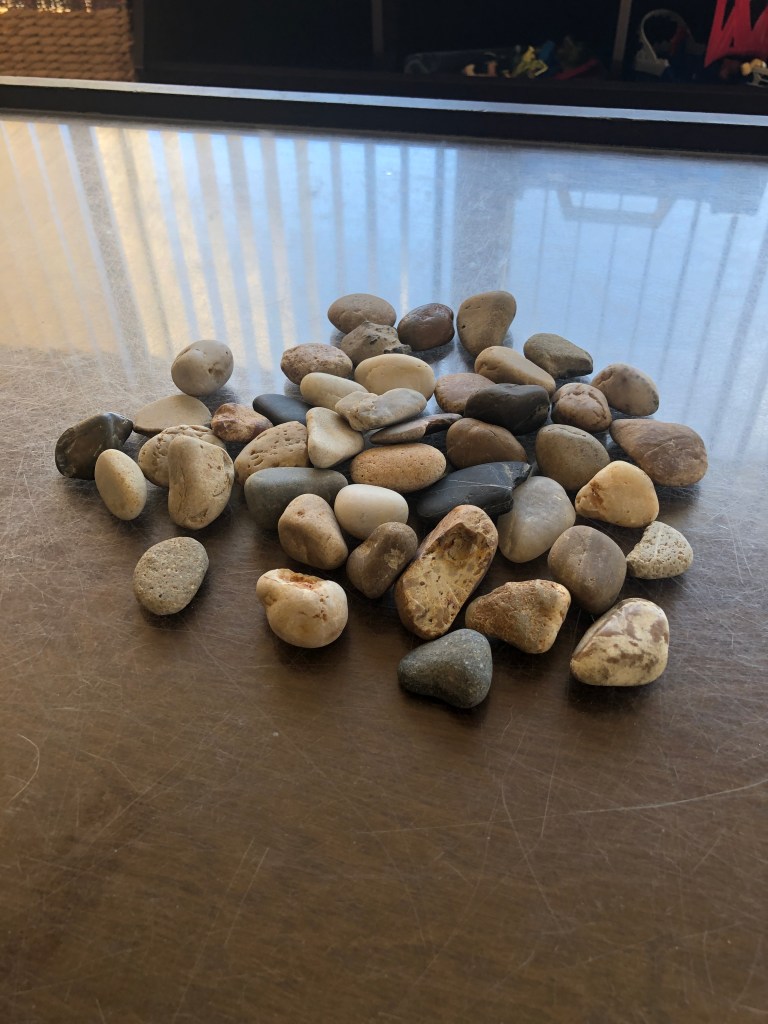
We did get a nice bag of rocks, but they looked pretty average to me. No matter, we were going to paint them anyway.

When I pulled out the paint pots, I realized we weren’t going to be able to paint a dolphin. We didn’t have any black to mix with the white to make gray or paint an outline. But we could paint the rock in a background color first. I scooped out some blue onto a mixing tray and tried to add some red to make purple, but it had already dried up in its little pot. No problem, we’ll just paint the rock blue. It took a while using the world’s smallest brush, but we got it done. But we used all the blue we had to barely cover one medium-sized premium rock.

While the first rock dried, we tried to paint another rock glow-in-the-dark green. 4.4 ml is not a lot of paint. And it didn’t really cover the rock. We did what we could and set it aside to dry.

Okay, maybe it’s me. Maybe I should read the instructions. I looked in the box and found a small piece of paper. No pictures, no patterns, no diagrams. Just these instructions:

  • Work on a flat surface.
  • Paint the rocks with the brush.
  • Let the paint dry overnight.
  • Show your creation to your friends and family.

By this time, I realized we weren’t really going to make any sea life rock art today.

But here’s the moment of unexpected grace. My grandson was enamored by the rocks. He picked out his favorites and set them aside. He sorted them by size, by color, and by shape. He gathered up his favs and took them outside to play with in the yard. Then he brought them inside to play with alongside Pokemon characters. Just a few premium rocks kept him busy all afternoon. Now that’s a win!

I’m going to get some actual acrylic craft paint and some sealer and we will make sea life rock art next week, including a dolphin, sea turtle, and starfish.

Every hear someone say, “Dumber than a box of rocks?” Don’t believe it. A box of rocks turned out to be pretty clever way to spend the afternoon.

By the way, the box had this tiny invitation. I’m going to contact them and give them some feedback. I’ll let you know how it goes.

Posted in Life

Real conversation, real relationships

In Lisa Unger’s mystery novel Under My Skin, the protagonist Poppy glances at her phone and reflects on what has happened to her relationships because of texting. “Relationships scrolling out in bubbles, text disembodied from voice and body, language pared down to barest meaning” is “far less meaningful than actual conversation.”

Even though these words are fictional, they ring true. They resonate. We have replaced real conversation and real relationships with a poor digital imitation. They are like products with artificial flavoring or colorized movies or cheap laminated furniture materials.

In the Star Trek series and movies, the replicator made it possible to enjoy any food or drink you wanted from any planet or culture or era. But space travelers treasured real ale from some alien race or a real apple from planet earth. There was nothing like the real thing.

No one says, “I wanted to see your words.” We say, “I just wanted to hear your voice.” We save and replay voice messages again and again.

Bubble relationships are convenient, but two-dimensional. The words have no actual feelings though we try to extract emotion from them. Text messages may be adorned with emoji, but they lack the hint of a smile, shifting of an eye, the furrow of a brow, or a subtle chuckle. Most texting is quick and efficient, with little thought to grammar, vocabulary, or spelling. (Unless it is a lengthy text, and who reads all the way through those?)

In an actual conversation, eyes tear up. Legs nervously bounce. Fingernails have been chewed. Breath smells like alcohol. Some words come quickly. Other sentences are punctuated with long pauses. Lips purse. Fingers drum on the table. Hands fold.

What has happened to our relationships?

Posted in Life

Three and counting

“So, are you down to one vehicle now?”

“Three.”

Okay, that caught me completely off guard. My wife and I had been talking about when we might downsize from two cars in the driveway to one. How often did we go two different places at the same time? Not as often as we did when we were both working. Wouldn’t it be sweet to only have to fuel up, insure, and maintain a single car?

He had retired a few years before and his wife was newly retired. Now they traveled together to visit family, run errands, and meet friends (like us) for lunch. They told inspiring stories of how they frugally learned to live simply yet richly in this new chapter of their life.

The fall colors were peaking on a warmish fall day as we walked around a lake. I should have remembered I was venturing onto dangerously thin ice when I assumed, “You must be down to one vehicle.”

“Three. And I think I’m going to buy a tractor.”

We’ve owned three cars in the past. We live in a town with no public transportation, so we had no choice but to drive everywhere. My wife and I would both head out in our cars for work, after saying, “Goodbye” to our children as one of them drove off to high school.

Three cars? One was a small pickup truck he had owned for nearly twenty years. That wasn’t going anywhere. Another smaller sedan was fine for running around town, but certainly wasn’t reliable enough for longer trips. So they needed a newer car as well.

A tractor? They lived on an acreage in western North Carolina. They had to maintain their own half-mile gravel driveway. They were also tearing down some old dog kennels, moving firewood closer to the house as winter approached, and dragging a gazebo to a different spot in the yard. Besides, he might have to dig a hole one day. Of course he needed a tractor.

My next-door neighbor and his wife have two Corvettes in their garage and two smaller cars parked in the driveway. Another neighbor has two vans and an SUV for the two of them. Two houses up from us, four SUVs are parked in the driveway.

I’m pretty sure my family only owned one car for years. My dad traveled to work in Philadelphia on the train, so we only needed one station wagon to haul everyone around. When my dad got a new job, he bought a second car for his commute. It was a yellow Ford Maverick with distinctive rusty trim. Once we three kids were grown and gone, they downsized to one Ford (my dad was a Ford fan) Tempo station wagon. They drove so few miles they changed the oil based on the calendar rather than the odometer.

One day we’ll decide one car or SUV or truck is enough. We’ll just have to decide what to own. Maybe we need something big enough to cart a lot of grandkids around in. Or maybe a sporty-two seater to zip around in. An electric vehicle? Something autonomous? We’ll see.

Posted in Life

“Welcome in!”

I guess I noticed it at Starbucks the other day. One of the barista’s greeted me and then every other customer who walked through the door with a bright, “Welcome in!”

“Welcome to Moe’s!” began in 2000. I’ve only been in that restaurant a few times, but I’ve seen it on TV commercials, too.

It’s trending everywhere. A person at the register of the pet supply store I frequent never fails to greet me. They used to say, “Welcome to Pet Supermarket.” But now it’s, “Welcome in!” I might not see the person who is working behind some boxes or shelves, but they always see me.

I hear it at Ace Hardware, Dollar General, ABC Wine and Liquors, the UPS Store, Racetrack and Circle K convenience stores, Subway, the dry cleaners, and the Chinese takeout restaurant.

Now I notice it when I don’t hear that greeting. The always straight-faced guy at the Pack and Ship simply points to the place you’re to put your package. At the post office, you get a straightforward, “I can help you.” At the barbershop, it’s a familiar, “Hey, how’s it going?” At the Honda dealership where I’ve been taking cars for service for many years, I hear, “Good morning, Mr. Douthwaite.” Employees at big box stores are few and far between, so don’t expect to be greeted there. And I rarely am.

Since it seems like no one has enough help, you may not find someone at the front of the store when you walk in. They may be stocking shelves or helping other customers. It’s a way of letting you know someone’s here in the store.

Maybe they’re just being friendly. Maybe they want you to know someone sees you. Maybe it’s just a phrase that has worked its way into everyday conversation, offered up without much thought.

Posted in Life

“I’ll watch it for you.”

At the top step of the old hospital entrance, a woman asked me, “Do you think it will be safe to leave this here while I go get the car?” Next to her on the curb of pick up entrance was a wagon full of clothes, a child car seat, and take-out food.

This city boy thought to himself, ” I wouldn’t leave anything out of my sight around here.” We weren’t too far away from the emergency room entrance, a gathering place for people without homes. I said, “I’ll stay here and watch it for you.”

“Oh, thank you! I’ll be back in a minute.” She ran off towards the parking lot as I stood guard for a moment. It was indeed just a minute and she pulled into the circular driveway. As she did, a young woman walked out of the hospital carrying a newborn. The family packed up all their stuff as I headed to the information desk to get my visitor ID. Even though no one eyed the contents of the wagon, I’m glad I waited there.

On the way home, I sat in a coffee shop, I saw an open laptop computer, textbooks, and a cell phone  on an unoccupied table. Again I thought, “I wouldn’t take my eyes off of anything around here.” Anyone could walk out the door with those things in just a few seconds.

But no one touched or looked at anything on the table. Everyone just went about their business. The owner stepped out of the restroom, sat down, and got back to work.

I would never do that. I would take all my stuff with me. Every time. Am I overly cautious? Are others naive? Should I be more trusting? Or does unattended stuff usually disappear?

I’ve seen purses sitting atop unattended shopping carts, cell phones hanging from back pockets, and unoccupied running cars (yes, people still do that).

Don’t worry. I’ll keep an eye on your stuff. But someone else is probably eyeing it, too.