…someone lost a bet and had to put the fuzzy flamingoes in their front yard this year.
…someone cleaned out their attic and found some long lost yard decorations. “Hey, remember these? Everyone said we had the best yard in the neighborhood!”
…the HOA went belly-up so anything goes.
…someone up the street died. Whoever cleaned out her house left stuff like this out on the curb. One person’s trash…
…my neighbor put out the first decorations on our block. While some are still trying to coax a few more days from Halloween pumpkins, many have started their Christmas festivities. Less than 25 yards from my house, I have the pleasure of seeing these fuzzy flamingoes every day. This is their first year along this neighbor’s driveway. They are an omen of what’s to come. Soon this neighbor will fill his yard with a hideous hodgepodge of lights, trees, ornaments, snowmen, and other Christmas characters.
To his parents, who had been searching for him for three days, Jesus said, “Why were you searching for me? Didn’t you know I had to be in my Father’s house?” (Luke 2:49).
Something has changed. After Passover, the family was on their way home from Jerusalem to Nazareth. But now as a young man, Jesus refers to the temple as his father’s house. He has begun to understand his unique relationship with God the Father.
All the fullness of God may have been in Christ, but he also had to grow up. Just like you and I, he learned language, customs, and a trade from his parents. On this trip to Jerusalem he began to understand that he was here for something more than carpentry.
As we grow, we continually learn what it means to be a child of God. Our perspective changes when we become parents and grandparents. Seeing the next generations helps us understand our relationship with a heavenly Father. Just like us in every way, Jesus learned what it meant to be the Son of God.
I love hearing people talk about the house where they grew up. That location occupies a treasured spot in our hearts. Jesus had two of those, a home in Nazareth and the temple in Jerusalem.
After Jesus touches a man full of leprosy, he tells him, “Go and show yourself to the priest and make an offering for your cleansing as Moses commanded” (Luke 5:13,14).
I’ll bet this didn’t happen very often. In fact, I’ll bet that few if any people recovered from leprosy or any other skin disease that word refers to. I could be wrong, but the priest may have never had anyone come to him to be proclaimed healed.
I imagine the priest had to get out the scroll which included Leviticus 14. That’s where the Lord told Moses exactly what needed to be done for a leprous person on the day of his cleansing.
If the priest observed healing, the person would bring two live clean birds, some cedarwood, scarlet yarn, and hyssop,.
The person then kills one of the birds in a jar filled with fresh water.
The priest ties up the other bird with the yarn, cedarwood, and hyssop, dips it in the water in the jar. The priest then sprinkles the water on the person seven times, and releases the bird.
The healed person washes his clothes, shaves all his hair, and takes a bath, clean and restored.
But there’s more.
Eight days later, the person offers up two males lambs, a ewe lamb, some grain mixed with oil, and some more oil.
The priest takes some of the blood of the killed lamb and puts it on the right earlobe, right thumb, and right big toe, followed by oil in those same places.
The whole process was involved and took more than a week to complete.
I was once invited to do a memorial service at someone’s home. After some readings and prayers, we went into the back yard which abutted some freshwater marshland. A family member handed me a cardboard box and said, “Do what you usually do.”
I had never held a box of remains before, much less performed a ritual scattering. I had to rubric to consult, so I made one up. I did learn this: always make sure you’re standing upwind.
That wasn’t the only time I improvised.
I did a quinceañera for a teenager whose family had Puerta Rican roots. I made phone calls to local churches with Hispanic ministry to find the ceremony.
People asked me to bless bibles and cross necklaces. I usually prayed for the people who read or wore them.
Visiting someone in the hospital with Covid-19 involved gearing up with personal protection equipment. I don’t remember taking that class in seminary.
On my big dog walk the other day, the idea of God’s omniscience popped into my mind. (Don’t ask me why. It’s not like I’m omniscient!) He has total knowledge of everything. He knows the past, present, and future, every detail about me and his entire creation. In other words, “God knows everything” (1 John 3:20).
In some ways, we used to know more than we do now. For instance, I used to know phone numbers. Since they are stored by name in my phone, those digits don’t have a place in my mind. At church recently, the youth director wanted the students to check in digitally. Unfortunately, the parents used their own phone number to register the family. None of the youth could recall that number.
I used to be pretty good with directions. Now I need a talking GPS to tell me where to go. I like the fact that my maps app gets me to my destination on the shorted possible route. But if the internet is down, I have no idea where I’m going.
I used to know geography. Stamp collecting helped me identify countries all over the world. Many have changed their names, and that knowledge is slipping.
I used to be very good at remembering birthdays. Then my family grew exponentially, and I had to make a chart.
I had locker combinations memorized in high school. Now, most schools don’t even let the students use lockers.
I read that our minds weren’t designed to remember everything. Our brain sorts out what is important, storing away what it thinks you’ll need to recall. I like to use mnemonic tools and tricks to make my brain retain more data than it normally would. Plus, I write out lists for myself.
God knows everything. The number of hairs on your head. What you’re going to say. How long you’ll live. Everything.
Except a believer’s sin. God says, “I will be merciful toward their iniquities, and I will remember their sins no more” (Hebrews 8:12). The eternal God isn’t starting to forget things. It’s just that the blood of Christ covers up our sin. I might have a hard time forgetting and forgiving myself, but God’s never going to bring it up again.
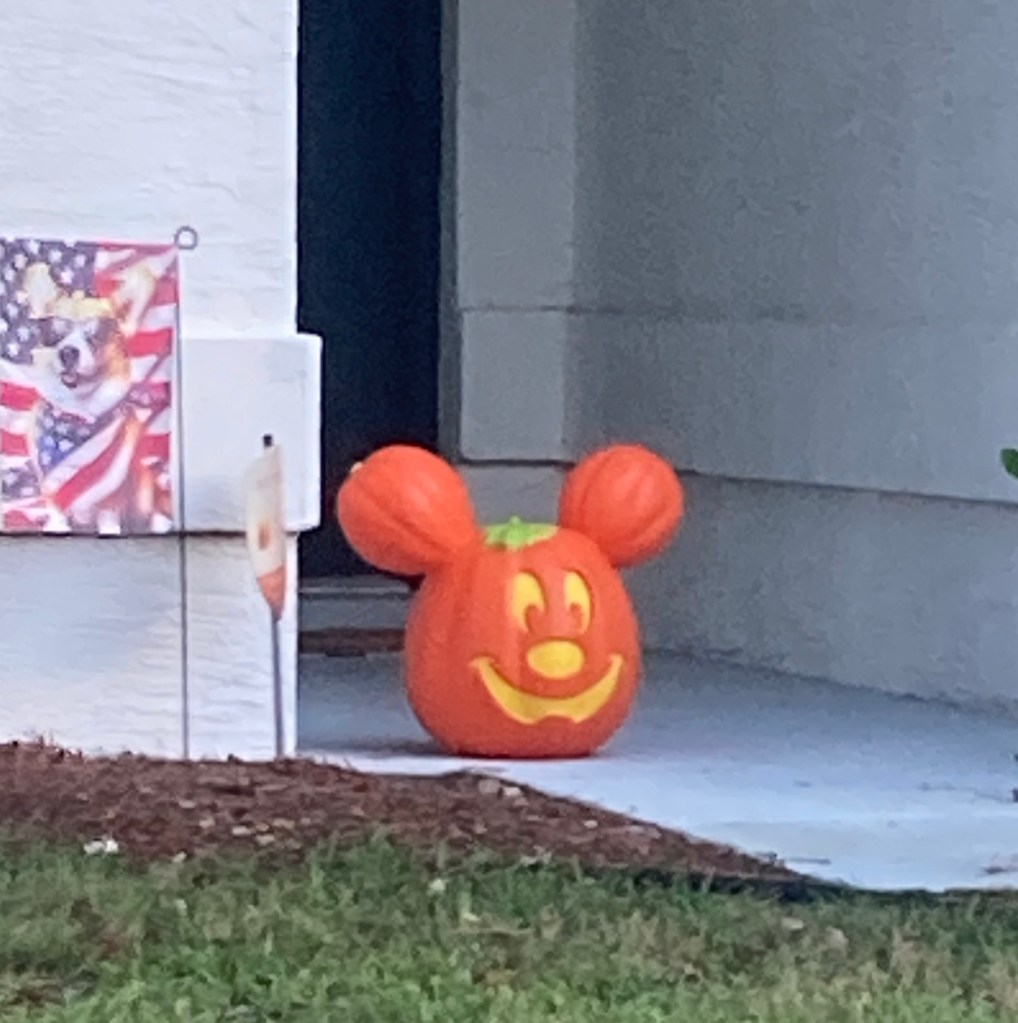
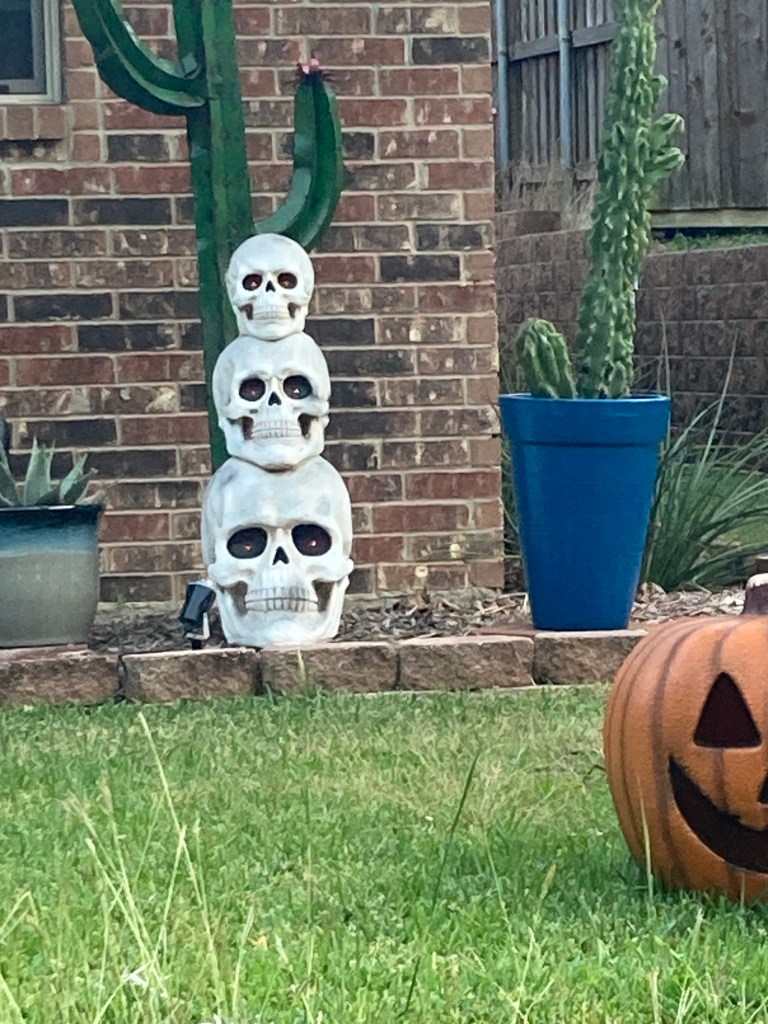
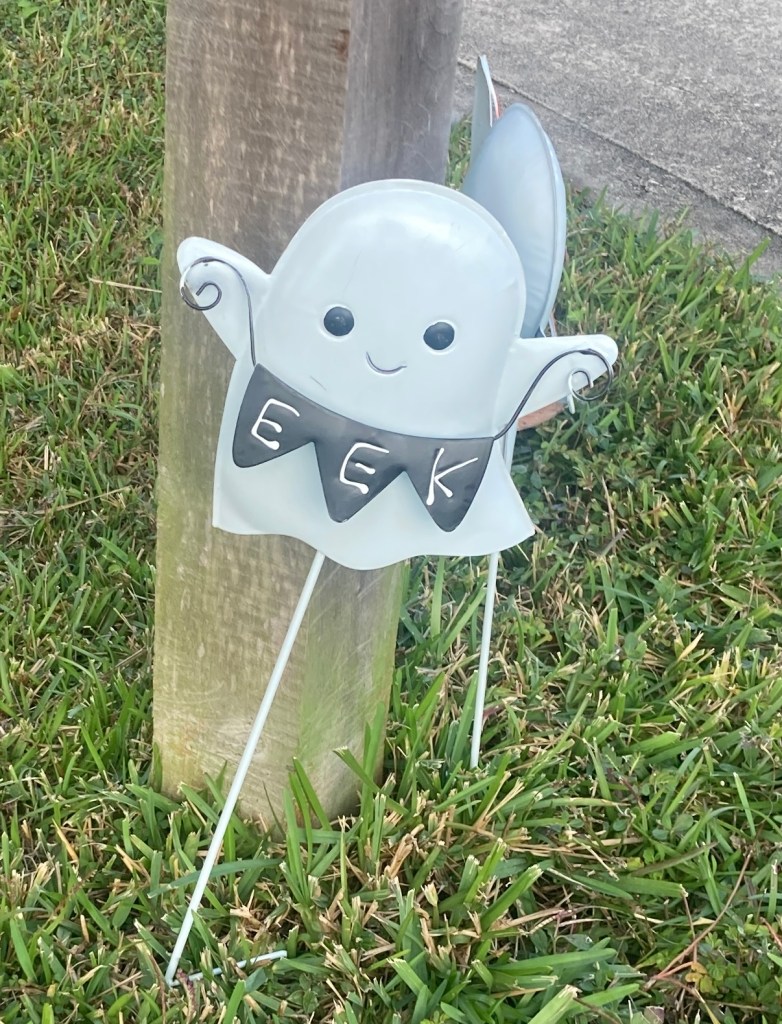
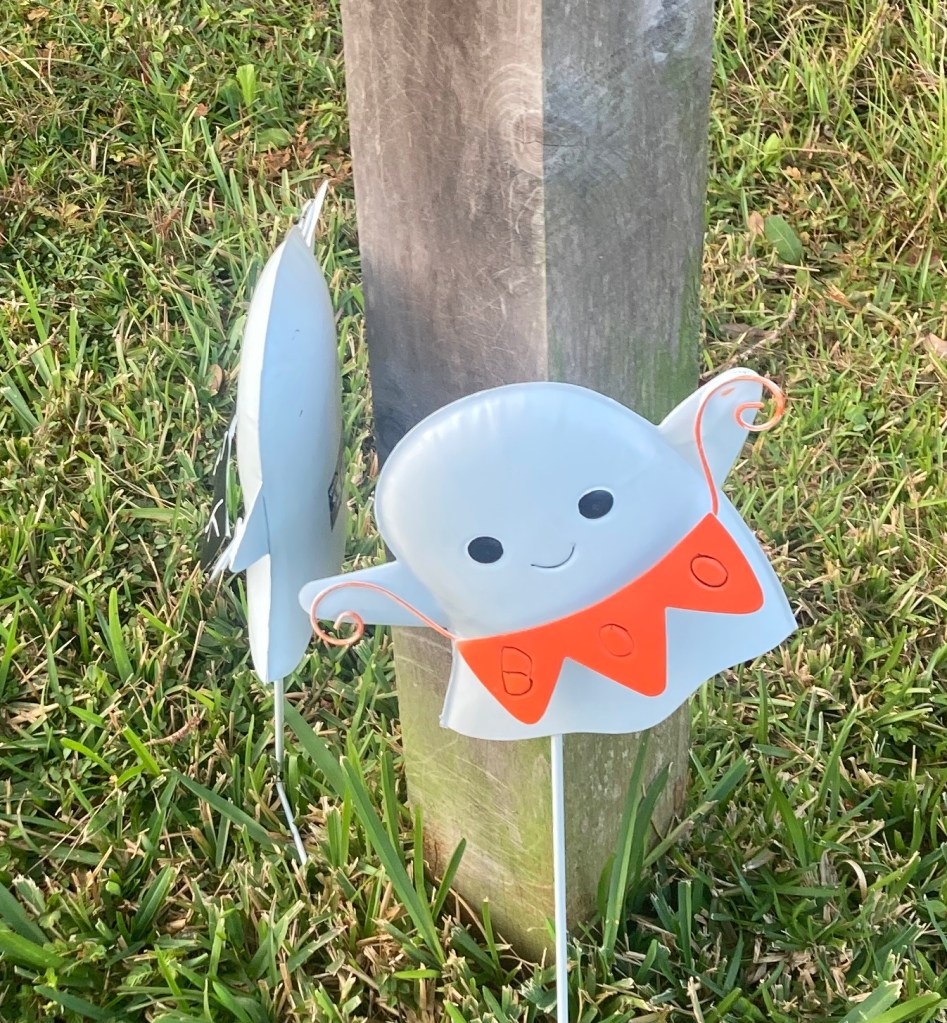
On my many walks around the neighborhood, I captured the variety of Halloween yard decorations. Here are a few observations:
Pumpkins ruled this year. Creative jack-o-lanterns abound. Most are happy, some are scared, and of course, some are cats.
Creepy decorations include the scary clown, a floating hand, zombies, and a giant skeleton trying to control a couple of dog skeletons. (Skeletons were a close second to pumpkins this year.)
Cute ghosts and Buc-ee round out this year’s decorations near us and around our son’s Texas neighborhood.
So where do you store all this stuff the other eleven months of the year?
“Jesus, full of the Holy Spirit, returned from the Jordan and was led by the Spirit in the wilderness for forty days, being tempted by the devil” (Luke 4:1,2). During that time, Jesus ate nothing, so he was in very dire circumstances when tempted. In contrast, we’re often tempted when we’re blessed, when things are going well, and when we have few worries.
The thing about temptation is you rarely see it coming. It looks good, sounds appealing, promises to be beneficial, and is within reach. After the fact is when you think, “I wish I hadn’t done that,” “I shouldn’t have said that,” and “I should have known better.” In these matters, your hindsight is indeed 20/20.
Here something from Enduring Word that I never thought about: “The presence of temptation only relents when we give in.” Until we succumb, temptation from the influences around us, our own desires, and yes, Satan himself, will press in on us.
Jesus is different. He knows exactly what the devil is attempting to do, and heads off each temptation at the pass with guidelines from God’s word. After several failed attempts, the devil gives up until another time. We have a hero who resists temptation, pays the price for every time we’ve given in, and shows us that there is always a way out through faith in him.
In his gospel, Luke mentions a man name Simeon who is waiting to see the Messiah. “It had been revealed to him by the Holy Spirit that he would not see death before he had seen the Lord’s Christ” (Luke 2:26). In faith, he knows he’s immortal until he puts eyes on the Savior. Imagine what you could do with a promise like that!
I’m a math guy, but I never considered that Simeon did the math when he went to the temple on the very same day when Joseph and Mary showed up with Jesus.
The shepherds who saw and heard the angelic announcement and praises about the Christ’s birth had told everyone what they had experienced (Luke 2:17). News like that spreads quickly.
Simeon was righteous and devout (2:25). He knew the Old Testament statute that after circumcision, a woman would come to the temple with her son in thirty-three days for purification (Leviticus 12). The Spirit of God, working through the Word, gave Simeon a good idea of when the Messiah would show up at the temple. This was not an accidental encounter. God had arranged for this meet-up a long time ago.
I’m smiling as I write this. My undergraduate degree was liberal arts, but I majored in math. Years later, God led me to the seminary to prepare for pastoral ministry. To some, math and ministry appear to be thousands of miles apart. For me, they are next door neighbors!
I cut my math teeth on algebra in eighth grade. I helped all my friends get through ninth grade geometry. Functions, trigonometry, and calculus all made sense to me in high school. From statistics to topology, God prepared me for graduate study in theology. By God’s grace, I love numbers almost as much as I love him!
I know enough about math to know that you can’t calculate when Jesus will return. I also can’t assume that the little bit you have won’t go a long way, as it did with the feeding of the five thousand. My age may be a finite number, but nothing about God is. The concept of infinity simply leads me to worship the eternal God and look forward to eternal life.
Math got me some awards and college scholarships in high school. Math prepared me to help my daughter excel in high school calculus. Math gives me the chance to tutor my home-schooled grandsons. Math gives me perspective when people try to use statistics to their advantage. Math reveals a creator who numbers my days, knows the how many hairs I have on my head, and constantly gives more than I ask for or imagine.
A trip to Sykes Family Farm in Elkton, Florida wasn’t cheap, but it was a fun way to spend a cooler-than-usual, perfectly sunny, post-Halloween, last-weekend-of-the-season Saturday afternoon with three granddaughters.
Seventeen bucks person was okay, I guess, with a few bucks off for my senior citizen ticket and a freebie for the two-year-old. A few St. John’s county sheriff’s deputies were on hand to guide us into the parking area, which was already full fifteen minutes after opening.
We started at the two huge inflatable bounce pads filled with energetic kids.
A good-sized turkey wasn’t very happy that it was November, but he was a good sport and posed by the fence for pictures.
A corn pit? What’s a corn pit? The girls loved the circular bin filled with dried corn. Who wouldn’t like to be buried under corn and make corn angels?
The hayride was okay. The tractor took us out through the sorghum fields and and acres of sunflowers. Longer than many I’ve experienced.
The food was pretty reasonable. Our lunch was three orders of fried mozzarella sticks, a hamburger, pepper and onion smothered hot dog, a bag of Fritos, and some bottle of water. Thirty bucks.
Rows of picnic tables adjacent to the food vendors was next to giant connect-four, plinko, and tetris tumble games. The kids loved these. (We’re going to try to find some online.)
Next, we went to the bubble barn. Sticks with ropes dipped into suds produced impressive giant bubbles drifting across the field. So much fun!
A ride on the “cow train” was a string of cars pulled by a small John Deere tractor. Thrilling for the littles!
We gave the girls a choice: something from the store or face-painting. the two youngers chose a stuffed unicorn wearing a Sykes Farm T-shirt. The older opted for very nicely done purple pixie face-painting.
We climbed on a spider web, slid down some dark irrigation tubes, pumped water for duck races down half-pipe PVC, and passed on the corn maze, pumpkin painting, and take-home sunflower.
At just about every activity, the operator offered the kids candy. It’s the last weekend; lots to get rid of! We accepted, but pocketed it for later. Face painting, pumpkin painting, and s’mores cost extra. Cash only, but a few ATMs were onsite.
I asked the guy at the drink booth how things were going. He said it was a slow day so far. They had only been rained out one day in October, so it was a good year.
The event was supported by several corporate sponsors. I’ll bet this is their biggest money-making event of the year.
And [Jesus] sat down opposite the treasury and watched the people putting money into the offering box. Many rich people put in large sums.And a poor widow came and put in two small copper coins, which make a penny.And he called his disciples to him and said to them, “Truly, I say to you, this poor widow has put in more than all those who are contributing to the offering box.For they all contributed out of their abundance, but she out of her poverty has put in everything she had, all she had to live on.” (Mark 12:41-44)
This woman gave “all she had to live on” (12:44). Really? Why?
I get it. Jesus’s point? Her offering was huge. It was everything she had. It was a ridiculous sacrifice. God doesn’t require this. He never asks for this. He doesn’t love her more because of her offering.
So what’s going on here? Who gives everything they have to God? Or to anyone else?
I might do that in a moment. I may have five bucks in my pocket. I’ll give that away. Does that count? It’s not everything I have. I’ve got more in the bank. I can always resupply my cash at the ATM.
At what point would giving everything be a virtue? What about your responsibilities to feeding your family, mortgage payments, credit card payments, insurance premiums, utility bills, taxes, pets, cell phone carrier, prescription medications, gas for the car, semi-annual air conditioner maintenance, doctor co-pays, haircuts, and Chick-fil-A?
God never asks for everything. He requires ten percent in the Old Testament. Sacrifices might have been one bull, one lamb, two pigeons, or some other prescribed offering. Something substantial, but never your whole portfolio.
This woman’s gift put the rich people’s contributions to shame. Fair enough. Is that what we aspire to, or is that simply a lesson in humility? Only one gave up everything, even his life for us. Jesus did that so we would be free from any obligations to God. How great is that?



















 Waite for it...