As I continue digitizing my old journals, I came across an entry from Monday, December 26, 2016. I wrote that I received a hate comment in the candle collection bin after the Christmas Eve service. I wish I had saved it or taken a picture of it. The person was so offended by my political comments that she wrote down her objections on a prayer request card, threw it into the box, and walked out.
You’re curious, aren’t you? So am I. You won’t find much politics in my sermons. So I went back and found that sermon.
It was the time when fake news was the rage. In contrast the good news Christmas was real news or great joy. Here’s what I said:
“Here’s a few [headlines] that may have fooled you. Every one of these was out there and seen by millions of people, and every one is fake.”
FBI Agent Suspected in Hillary Email Leaks Found Dead in Apparent Murder-Suicide.
Donald Trump Protester Speaks Out: “I Was Paid $3,500 to Protest Trump’s Rally”
Pope Francis Shocks World, Endorses Donald Trump for President, Releases Statement
Donald Trump Sent His Own Plane to Transport 200 Stranded Marines
FBI Director Comie Just Put a Trump Sign On His Front Lawn
“I repeat: these are all fake headlines! Yet 2/3 or more of those surveyed said they thought they were true.”
These were the top five believed fake headlines according to Buzzfeed. It was my critic’s first visit to our church, and she was appalled at what she heard. She wrote that she wouldn’t be back. She did not leave her name, just the note.
I thought they were all pretty funny. But I guess not everyone appreciates my humor. I didn’t get that much backlash from pro-life sermons. I always reminded folks (and myself) that no one ever gets a one hundred percent approval rating. I’ve gotten called out for using words in a sermon that some thought was inappropriate. But that’s a story for another day.
If I hadn’t been paging through old journals, I never would have remembered this. Here’s the sermon, in case you wanted to listen:
In the men’s bible class I attended last night, we worked through Mark 14 and in to part of chapter 15. I know, that’s way too much ground to cover in a night, so we couldn’t spend too much time on any one scene of Mark’s account of the passion of Christ.
We did spend a few minutes discussing the woman who anointed Jesus’ head with expensive perfume (Mark 14:3-9). This scene appears in all the gospels but with enough variation to say that Jesus was anointed three different times. Matthew’s account is almost the same as Mark’s. In Luke’s account (Luke 7:36-50), the woman pours perfume on Jesus’s feet and Jesus includes a parable about love and forgiveness. In John’s gospel (John 12:1-8), Jesus is at Lazarus’s house, the woman who pours the perfume on Jesus’s feet is Lazarus’s sister Mary.
Whether or not we harmonize the accounts, the reactions are the same. Jesus loves it and calls it a beautiful expression of faith. The disciples think it’s a waste of a precious resource. For us, it begs the question, “What place, if any, does extravagance have in our worship?”
The heading for these verses is “Jesus anointed…” This moment is not just a random act of kindness but a proclamation of who Jesus is. The label Messiah means “anointed one.” Who is anointed in the Old Testament? Kings, priests, and prophets. This jar of fragrant perfume is properly applied to Jesus, the king of kings, our great high priest, and the Word made flesh.
Jesus is also the promised anointed servant of God (Isaiah 61:1; Luke 4:18). This servant comes to suffer for his people, to die, and then be raised on the third day. The aroma filling the room proclaims that truth.
We Christians use a variety of labels to describe ourselves: followers, disciples, ambassadors, witnesses. No matter which one you choose, you know that it will cost you something. The time and resources we spend in worship, prayer, devotion, witness, and service is worth it, right?
But what if it becomes extravagant?
Jesus made a point of making sure his disciples noticed the woman who only put two small coins in the offering gave more than everyone else. She gave everything she had. Isn’t that extravagant?
A widow in Zarephath used everything she had, a handful of flour and a bit of oil, to make one last small cake for the prophet, herself, and her son. In that time of severe famine, isn’t that extravagant?
When a man assured Jesus he had kept every commandment necessary for life, Jesus told him to sell everything he had, give to the poor, and follow him. Isn’t that extravagant?
When the ark of the covenant returned to Israel, David danced with all his might (2 Samuel 6:14). He held nothing back that day, much to the dismay of his wife.
And if Jesus empties himself of his divinity, takes the form of a servant, and goes to the cross, couldn’t you say that he spent everything, his very life, on us? I would call that extravagant.
When Jesus’s disciples objected to the woman’s, it was because it could have been sold and the proceeds used to feed the poor. That’s a good point, but that’s not what the disciples did with their money. They had some money before Jesus fed the five thousand. They had a money bag that Judas stole from. They didn’t give it all away to help the poor or anyone else. Nice try, guys.
When you think about it, a lot of money has been spent feeding the hungry. And yet there are still hungry people. A lot of resources have been poured into the homeless, and there are still homeless. We’ve invested a lot of money into church buildings, and there are more unbelievers than ever. The economics of God’s kingdom aren’t simple, are they?
So I’m not going to pretend to have this all figured out. It’s one of those things we all have to figure out along the way. Extravagance looks a little different for each person, on any given day, in any number of circumstances. Plus, whatever looks extravagant to us is minuscule compared to what God gives.
Extravagance that feeds our own passions makes it hard to follow God. No one can serve two masters. Extravagance that expresses faith and love preaches a powerful message about Jesus. Extravagance can make us feel guilty, lull us into complacency, or tempt us to feel self-sufficient. It can also be worship, witness, and sacrificial love.
In a sense, the notion of extravagance goes away if your eyes are on Jesus. Whatever you do in word or deed won’t be too much or too little, but an expression of gratitude for his inexpressible (and extravagant) love for us.
It was a rainy weekend, so my daily walks with the dogs were wet. I didn’t hear any thunder and there weren’t any downpours, but I was glad I wore my rain jacket. I needed a few towels to dry off the beasts when we returned home.
As we walked, I noticed how quiet rainy walks are. We didn’t encounter anyone else in the morning or the evening. Only a couple of cars drove by. No birds were singing. No squirrels were chittering. It’s just us, a cool breeze, and the gentle background noise of raindrops.
Both dogs are reluctant to go out at first, but enjoy it once we get going. Every once in a while, they pause to shake off the water, starting from the head and working to the tail. Thirsty? There’s always a puddle to sample. Mud along the side of the road? They don’t even notice it as they walk through.
I used to run with Labrador retrievers. Cold and rainy? They loved it. We called it “Labrador weather.” The more inclement, the better. Driving rain? Bring it on. Freezing rain? Better watch your step. It’s pouring. Their look said, “Can we go outside?”
Some of my best runs and road races were on rainy days. The rain is a cooling agent against the heat running generates. So I could push a little harder and go a little long with a gentle shower. I ran some of my best training and race times in the rain. Running in the rain is empowering. Nothing can stop you, not even the elements.
When we adopted our Westie, the previous owners had bought him a monogrammed raincoat. A raincoat for a dog? Nope. Not for my dog. I never wore anything special to run in. If it’s raining, you’re going to get wet. Get used to it. Savor it. Enjoy it.
I’ve been digitizing my old journals and came across this note from January 7, 2012: “What do you do when you can’t do it all?” There’s not much context to go with that, other than another line, “My to-do list is huge.”
In other entries I wrote down that my to-do list was more than a page long! I know I rarely got everything on my list done. In fact, some things on the list never got done. Not every day was like that, but enough were that I became of student of productivity.
There are two ways to tackle an overwhelming to-do list. One, just work on the first thing until it’s done. Then work on the next thing. And so on. Or, cross off a bunch of items until the list is manageable.
Actually, it wasn’t that hard to get a handle my daily tasks. I adopted a system of 1-3-5 and Kanban. I reduced my to-do list to one important thing, three less important tasks, and a few less-than-urgent activities. When a to-do list is just one important task, it isn’t overwhelming at all.
In the process, I learned that many of the things on my to-do list didn’t need to be done. I guess they needed to be done at some point, but the world didn’t come to an end if I handled them some other day. Other to-dos were done by someone else. Those tasks were on others’ to-do lists, too. And some things just never got done. Oh well.
Now I’m curious. What things on my to-do lists did I never actually do? I’ll keep an eye out and let you know what I find.
While walking the dogs on a drizzly Saturday afternoon, I had a conversation with a house-shopping couple from Canada who pulled up along side of us. They wondered if this neighborhood ever flooded. (It doesn’t.) They were also surprised at the cost of living here. I thought it was affordable, but with current prices, taxes, interest rates, and the exchange rate, it’s more expensive than it used to be.
As I walked away, I realized how blessed we were to have built our house nearly thirty years ago. I’m not sure we could afford to do it in today’s market.
After my wife and I got married, our first home was a one-bedroom, one-bathroom upstairs apartment on Spy Run in Ft. Wayne, Indiana, which we rented for $200 per month. The kitchen was five-foot by five-foot square, barely big enough for one person to stand. We only lived there for about four months, before packing up and moving to Baltimore for my vicarage (internship).
In Baltimore, the churches sponsoring us put us up in a three-story inner city row home. It was at the end of the row, so it had a little bit of a side yard between us and one of the churches we worked at. It was a run-down, falling-apart, and patched-together affair than probably should have been condemned. Living here for a year taught us we could live anywhere. No matter where in the world we went, from earthquake-shaken Haiti to remote villages in Kenya to single-wide trailers in rural Florida, we would say, “Well, it’s not as bad a Baltimore.”
After a year in the inner city, we moved back to Ft. Wayne for my last year of studies and rented a small house owned by a couple heading out for their internship. By the time previous owners had finished adding on a few rooms, there was a thousand feet of living space. (And it was better than Baltimore.) When the brutal winter weather hit, we discovered that the master bedroom, way in the back, had no ductwork for heat. It was chilly until we bought a kerosene heater.
After graduation from seminary, we moved to my first church in Coventry, Connecticut. There we lived in a parsonage, a two-story, five bedroom, 2-1/2 bath home on four acres next door to the church building. We moved in to the 2,700 square foot home with a bed, a crib, a table with two chairs, and maybe a dresser. We never did furnish the entire house the five years we lived there. I mowed the four acre yard, planted a big garden, split piles of logs for the wood burning stove, and let our two Labrador retrievers run freely.
The thing with living in a parsonage is that you don’t build up equity in the property. We didn’t make and didn’t save much in Connecticut, so when we moved to our second church in Iowa, we needed a lot of help finding a place to live. For the next five years I would be one of several pastors on staff at a well off church in Urbandale, a western suburb of Des Moines. We weren’t able to afford a home in that community, but found a small home in West Des Moines, not far away. The church gifted us with most of the downpayment on a 1,000 square foot, $65,000 house, the first we owned.
Five years later, we got the call to serve the church in Palm Coast, Florida. Our Iowa home sold easily, netting enough profit to buy our next home in the south. Rather than rushing into a purchase, we rented a home for the first six months. With three children, we wanted a four-bedroom home. There were few to choose from, so we decided to build. We never thought we’d be able to build a home. But building lots were going for $8,000, construction costs were $50 per square foot, and taxes were low, so we built a 2,000 square foot Palm Coast home for about $100,000.
In the years to come, we were able to refinance. We got into an adjustable rate mortgage that was tied to the prime interest rate during the years it was at zero percent. Our monthly payment and interest was actually lower than a car payment! Homestead laws meant our taxes barely inched up each year. Housing booms enabled us to refinance and remodel our home without increasing the mortgage payment. This was one of the ways God faithfully provided for us over the past forty years.
Having written that last sentence, we would do just fine if we were to start all over again.
The usual morning routine? Forget it. These two just went back to bed.
As usual, Willow’s singing greeted me as soon as I got out of bed at six-ish in the morning. She’s the three-and-a-half-old Great Dane, and I don’t completely trust her yet, so as soon as I open up her crate, I let her into the backyard, where she immediately takes care of business, both numbers one and two.
When we come back inside, we let Winston (the Westie) out of his crate. He would gladly sleep in another few hours, but he doesn’t want to miss anything, so he trots out to see what’s up. Both intently watch me as I get their food and set it out on opposite sides of the gate. I announce, “Okay,” and nothing else matters. In under a minute, the food is gone.
We then head out back so Winston can do his thing in the backyard. From there, the dogs usually wrestle around, chew on some pine cones, fight over stuffed animal toys, play some tug of war with an old rope, and drink water like they’ve just crossed the dessert.
But this morning was different. Fifty-degree temperatures and a light steady rain prompted a new agenda. After a quick breakfast and visit to the backyard, both dogs went back to sleep. Willow curled up in one of her favorite chairs while Winston chose the dog bed up on the patio table.
If you’re going to Sunday, you might as well do it right.
As I was paging through an old journal today, I came across this story from July 20, 2017. I don’t actually remember this day, but I’m glad I took the time to write it down.
Wayne called the church about 10:30 am, wanting to talk to the pastor. I took the call, kind of knowing what to expect. He spent the next ten minutes unfolding his story.
Wayne was from West Hollywood, California. He had just take a train to visit his family in Marathon, Florida. A couple of hospital stays had used up the money for a return trip ticket. Little by little, he had made his way up I-95 to the Econolodge in Palm Coast. A friend had bought him a train ticket home, and he would be leaving tomorrow from Jacksonville. All he needed was one more night at the motel and a little money for food, and he would be on his way.
Wayne assured me that he was a Christian. In fact he was helping to plan an LCMS (Lutheran Church – Missouri Synod) congregation in California. That’s why he called our church and asked to speak to me. I told him I could help him out, and would meet him in at the motel in about an hour.
We sat and talked in the lobby for while, as he added more to his story. He had a home in California, as well as a care-giver. He had AIDS and was on forty-two different kinds of medication. His personal physician said he only had four or five months left. So he planned on using that time to witness.
Was his story true? Was any part of it true? I have no idea. I just helped him out. I paid for one more night at the motel, gave him fifty bucks for food, and prayed for him and his ministry.
In years past I might have asked more questions. But I learned not to overthink it, and just help as best as I could. I wanted to tell them, “You don’t have to tell me the whole story. All you have to do is ask. I’ll help.” But maybe they wanted to talk, tell their story, and be heard. When someone is listening, you are somebody.
Jesus was good at this, wasn’t he? He didn’t just heal people. He talked with them. “What’s going on? How can I help you? What do you need? How come you’re lying here? Let’s go back to your place.”
It’s good to remember that even though he knows what’s on your mind and in your heart, he still likes to hear your story, too.
It’s the height of strawberry season in Florida, but it’s been difficult to find the flats of ripe Plant City strawberries in our area. My wife said, “We probably need to go to the farmers market in Daytona.” That’s where we headed today.
According to their brochure, the Daytona Flea and Farmers Market is the sixth best flea market in the world, with 1,000 booths filled with vendors and food. I haven’t been here in ten years. When we moved to Florida nearly thirty years ago, it was a novel destination. It still is an attraction for the many visitors who are in town for the big events like speed weeks and bike week.
As we wandered through the endless maze of booths, we noticed that not much has changed since the last time we were here a decade ago. There is no end to the tables filled with t-shirts and hats, cheap jewelry, toys, leather vests, belts, and wallets, and miscellaneous household items for sale. Some booths offer an extensive selection of nuts, dried fruit, spices, seasonings, pickles, and hot sauces. Others sold golf carts and electric scooters. I saw an impressive selection of swords, knives, and martial arts weapons. At the intersection of the main aisles, you can buy hot dogs, sandwiches, french fries, popcorn, beer, soft drinks, and ice cream.
One young man had a hot dog covered in ketchup in one hand and a vanilla soft-serve cone in the other. He took turns eating from each hand, enjoying an interesting combination of flavors.
There were a few produce stands, but not as many as I remember from the past. We did find big ripe strawberries from Plant City, but they were pricey: $40 for a flat (12 pints). Ouch.
As we wandered through the maze of booths, I wondered, “Who buys this stuff?” I suppose if you’re here for an event, this is a good place for t-shirts and other merch. If you brought the kids along, they’ll talk you into buying them cheap toys and a treat. Do people really buy jewelry here? Given the huge displays of rings and necklaces, I guess many do. The market has been here for forty-two years, so lots of people must shop here.
We left with a half-flat of strawberries and three huge Roma tomatoes. That’s enough flea market for this decade.
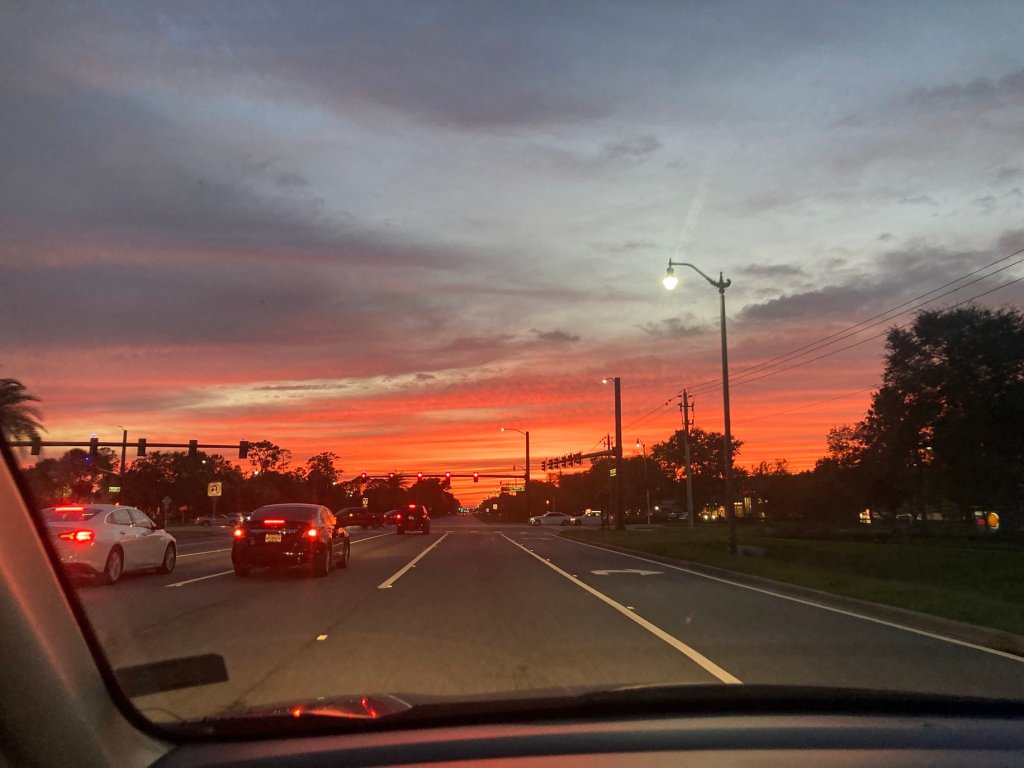
At certain times of the year, as the sun sets, it almost looks like the sky is on fire.
I usually have my phone in my pocket while I am driving. But on this occasion I placed it on the center console so I could plug it in to charge it. So when I turned onto this road and saw the fiery sky, I could quickly get a picture.
A photo can’t capture the palette of colors on the horizon. Who knew there could be so many oranges, reds, and yellows? If kept driving west, would I eventually reach a blazing fire lighting up the sky? Would I reach an active volcano, glowing with molten lava? Is someone smelting steel in a giant blast furnace off in the distance?
It’s a good thing I got the picture when I did. Those colors only last a moment. By the time I crossed the intersection, they had faded. The clouds had moved. The moment was gone forever, except in my mind and in my phone.
New crayons are essential at the beginning of an elementary school year. A box of twenty-four is all you really need. There’s a box of forty-eight that doubles down on all the different colors. But the best is the box of sixty-four. The assortment of oranges, yellows, and reds challenges all you thought you knew about color. Who knew that orange-red was different than red-orange? With hues like tangerine, pumpkin, and carrot in your hand, your sunset sky might look just like this one!





 Waite for it...