As I approached three years of working at Bell Labs, a colleague, Fred H. came to me and asked if I would come with him to Austin, TX, and be a part of a startup company. We had worked together on some projects and he wanted me to come and be his programmer.
I was flattered, the offer was more than I was making, and I was bored with R&D that had no deadlines, few priorities, and from my point of view, not many goals. I was encouraged to get my master’s degree electrical engineering so I could be promoted to the next level. But after I took a few classes at Rutgers, I knew my heart wasn’t in it.
At this new company, I would work with engineers who were making deep oil well pressure monitors. I would be programming in 8086 assembly language. The challenge of a new project and traveling to a new place to live appealed to me, and I accepted the job.
Looking back, this decision changed the whole trajectory of my life. Just two months after moving to Texas in January 1982, the company went out of business. The founders had found better places to invest their money. I worked another job at Houston Instruments for a few months, but most of my time in Texas was getting ready to go to seminary in Fort Wayne, IN that fall. Three and a half-years in the real world showed me that I enjoyed my work with the church more than any of my programming work. I was young and single with enough money to live, so I enjoyed my eight months in Austin.
I wasn’t journaling during this chapter of my life, other than to keep track of my running mileage. So these past four blog posts have all been from memory, which in some moments is vivid, and others foggy. My other career served me well in pastoral ministry, giving me insights into the working world of church members. However, once the congregation found out I had been a computer programmer, I got more questions about tech than about theology. My phone rang about everything from, “My printer won’t print” to “My screen is frozen” to “How do you change the font?”
And once a tech guy, always a tech guy. Even in retirement after thirty-six years of full time ministry, I still get questions about bluetooth, wifi, printers, fonts and formatting. The blessings of my first career still echo in my life today.
The Bell Labs office in Holmdel, NJ was stunning, designed by architect Eero Saarinen. There’s a joke about an employee who brought a guest to show them their officed. Wowed by the structure, the guest asked, “How many people work here?”
“About ten percent.”
About six thousand people worked at that labs location. But I worked at an overflow location in West Long Branch, NJ, not far from Asbury Park and the Jersey shore. As I reflect on the three years I worked there, there were times when we really didn’t work that hard.
The loosely-defined work day was 9 am to 5 pm. However, upon arriving, getting coffee was a priority, enjoyed while reading the newspaper in the cafeteria or at your desk. The New York Times was the go to paper, but the Asbury Park Press showed up on a regular basis.
There was plenty of time for chit-chat about current events, family, past and upcoming meetings, hobbies and other interests. Typically, I had run a program before leaving the night before. Upon arriving, I had to get the printout from the computer lab and see what bugs I needed to work on. On the way, I would stop by and chat with others in my group and department. I would get to meet their colleagues from other departments. Before you knew it, it was time for lunch.
Sometimes I brought a light lunch since I often went out for a run during the lunch hour. The cafeteria was pretty good, and sometimes we would go out. The Western Electric guys were a little rougher around the edges, and liked to frequent some of the bars on the boardwalk. I remember one place they took me, the Blue Dolphin in Long Branch. It was a dive on the ocean, complete with go-go girls, pool tables, and a juke box. The dancers weren’t naked, but they were ugly. The food (mostly burgers) was edible, and a few beers later, we were ready to go back to work.
After lunch, I’d run another iteration of a program and visit with other coworkers while I waited for the printout. Later in the afternoon, I’d run the program one more time, and head home.
We had to turn in a weekly time card, but that was just to track paid time off. No one really paid much attention to our coming and going. Apparently in research and development, at least in the early 1980s, productivity wasn’t a big deal. As long as someone in the organization produced something, it was all good. Bell Labs had the reputation of producing one patent per day. A lot of engineers, scientists, mathematicians, and programmers, could ride that wave with ease. And we did.
One of the reasons I left the labs was that I wasn’t doing much and what I did didn’t matter much. That was my perspective from the bottom of the food chain.
The early 80s was ground zero for the running boom. I ran a lot in my twenties, as did a lot of my coworkers. Since our office building had showers, I would run during lunch hour. A high school track across the street was the perfect place to run 220 and 440 intervals. Just beyond that was a hill that I ran repeat sprints on. I would meet up with a lot of running coworkers at races up and down the Jersey shore every Saturday.
A few of us really got into biking, too. I rode my bike (ten miles one way) to work on good weather days. I met a few other bikers at work and we planned and completed a century ride (100 miles) through central New Jersey. It’s amazing how much time you can spend talking about bikes, gears, derailleurs, and wheels.
In one of my offices in West Long Branch, there was a wall sized chalk board. Instead of being covered in mathematical formulas, my coworkers and I used colored chalk to create a fantasy world of buildings, people, plants, and scenery. Everyone would stop by to add something to the mural. Somebody somewhere has a picture of our masterpiece.
While I don’t remember too much about my actual work at Bell Labs, I remember much about the people I met and all the time I spent not working!
I began working for Bell Laboratories in February 1979. My department was titled Network Modeling. At the time, AT&T had a monopoly on long distance telephone service in the United States. Just about every call was made on their equipment on their networks. Network modeling involved coming up with algorithms to figure out how much equipment was needed to handle long distance demand and how much it would cost. Since every call traveled over copper wire through switching offices, a lot of equipment was involved. Remember, this was long before the days of cell phones, wireless carriers, fiber networks, and unlimited calls and data.
Since every phone call traveled through AT&T equipment, the justice department had filed a lawsuit to break up the monopoly. The purpose of my department’s network modeling was to show that breaking up the Bell system would make long distance calls unaffordable for most people, and therefore was not in the best interest of the nation.
Engineers and mathematicians in my department would come up with ways to determine and present how much equipment was needed and how much it cost to handle all the telephone calls being made across the country. Then people like me would code computer programs to analyze this information.
Since I was totally new to this, I really appreciate the time the others in my department took to explain how it all worked. Every explanation began with, “You have two wires…” Every phone had two wires that would connect to a local switching office to connect with other switching offices to the two wires of the other person’s phone.
When hired, I thought I would be working for Gerd Printz, but when I arrived, I was put in Ron Skoog’s group. I had a title: Senior Technical Associate. It sounds impressive, but it’s only one level above the lowest tier of employees. There were plenty of levels above me, all those with masters and Ph.D degrees.
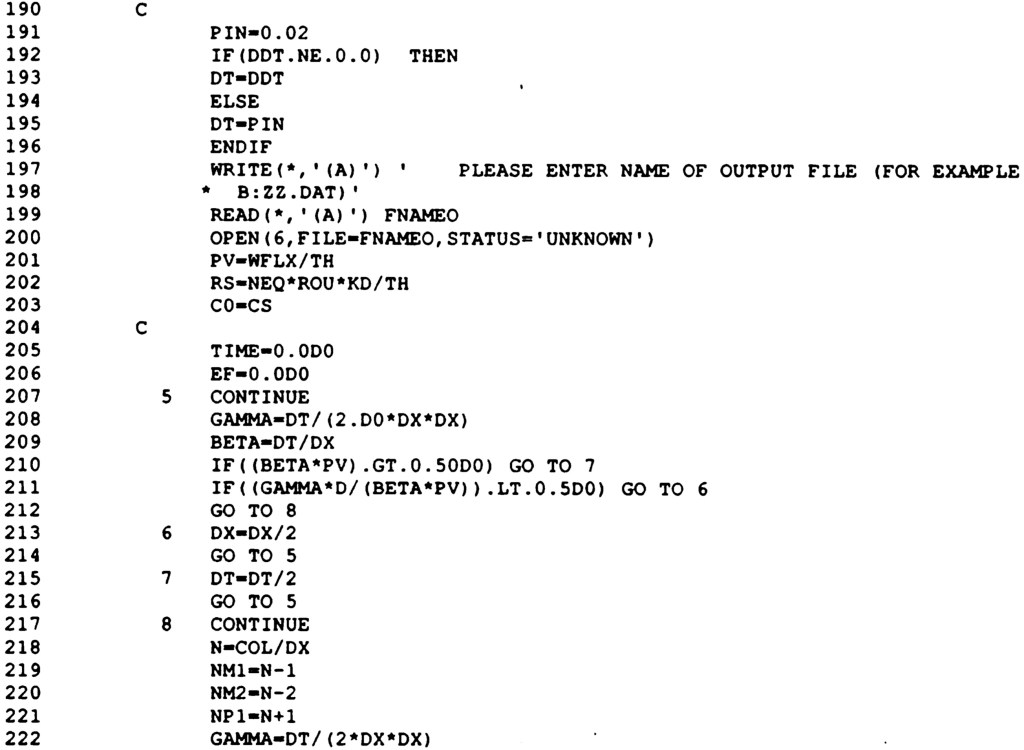
They handed me half-inch thick printout on 11×17 tractor feed printer paper filled with thousands of lines of Fortran code. It was my job to finish the coding, test it, and write it up. I worked alongside many group members who were level higher than me. I’m amazed I remember so many of their names: Joan Bazely, Pam Turner, Ted Ahern, George Askance, Joe Scholl, Gina Langlois, Lachsman Sinha, Eric Grimmelman. A few guys from Western Electric who knew a lot about equipment in the field were around the office a lot, too.
I had an office, a CRT terminal to work on, and shelves filled with IBM manuals. I would work on the code, test parts of it, and then have to go down to the computer room to pick up printouts of what I had worked on.
Once I had the program up and running, I wrote it up for internal publication and made a presentation to some who were higher up the organization who were preparing to go up against the justice department.
Our network model was a stepping stone for my next assignment. Now we began to look at how solar flares and electromagnetic pulses (EMP) would affect telecommunications. If an enemy detonated an EMP device over the United States, it could disrupt communication. But how much? And for how long? Some of this project must have had a connection with the Department of Defense, because I had to get top secret clearance. I felt pretty important for a moment, until I realized no one was going to tell me any secrets.
Anyway, to study this, we found a long distance cable between Aurora, IL and Clinton, IA that was perfectly east and west. I programmed an HP minicomputer in Basic that we installed in Aurora. The staff there would send us a cassette tape filled with data every week that we would analyze along with solar flare activity. I don’t remember what we learned from the whole effort, but it was a fun project to work on.
While I was working on those projects, I go to see other Bell Labs facilities in Holmdel and Murray Hill, both in New Jersey. Those are the places where engineers and scientists invented transistors and lasers, and developed digital communication. I also got to go the main switching office in Manhattan to see all kinds of different phone switches in action. For three years I was a beneficiary of the massive amount of money AT&T poured into it’s research arm. I met a lot of brilliant people and learned so much from them.
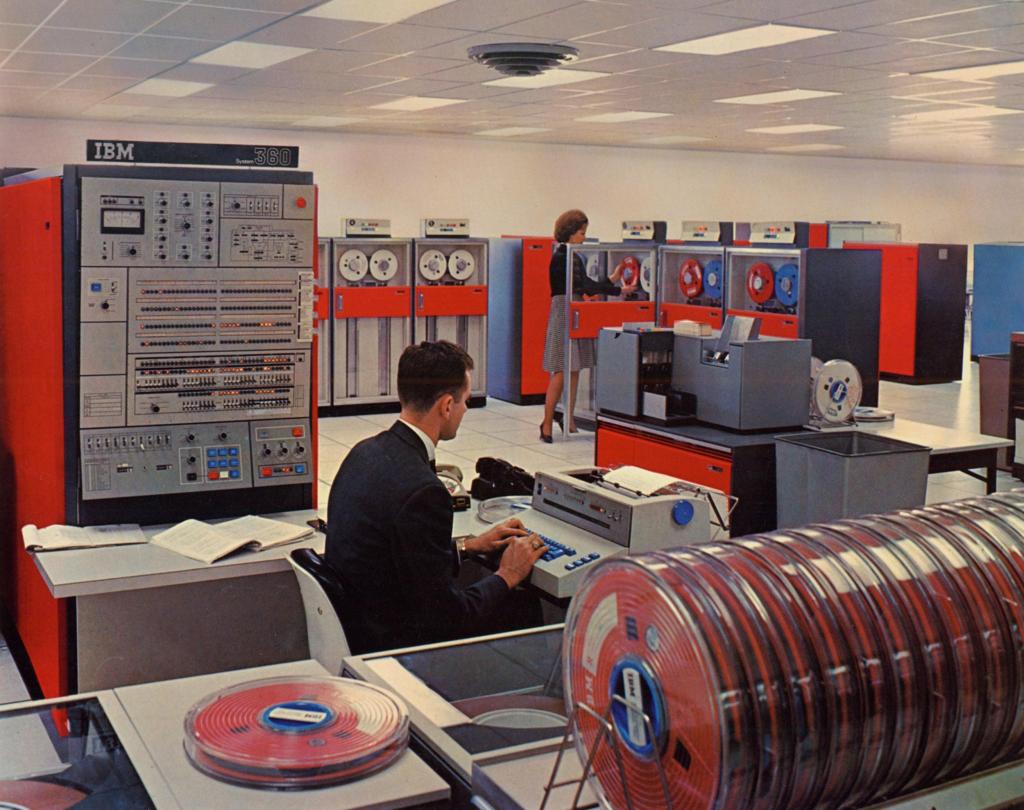
My West Long Branch Bell Labs location looked something like thisIBM 360s – check out the size of the hard drive disks!
I was sitting eating supper with some of the men in my small group when Jim, across the table from me, asked, “You’re from south Florida, right?”
I chuckled, “Almost. Not south Florida. I grew up in south Philly.”
Knowing that I’m a retired pastor, he asked, “Did you serve a church in that area?”
“No, I left there after high school to go to college in Lancaster. Then I worked for Bell Labs in New Jersey for a few years before I found my way to the seminary.”
The mention of Bell Labs sparked interest at the table. “What did you do there?”
I explained, “I was a programmer, working with a bunch of people who were way smarter than me. Like the guy up the hall who developed digital voice communication for Apollo 8. I worked on some projects for the antitrust case against AT&T, and then some telephone network survivability studies.”
One of the guys asked, “Whatever happened to Bell Labs?”
“AT&T lost the antitrust case and had to spin off Western Electric, a bunch of Baby Bells, and Bell Labs, later renamed Lucent Technologies. But that was after I had left them for another job.”
That brief discussion brought back memories of my first career at Bell Labs after graduating from Franklin and Marshall College in 1979. At the time I did not realize how prestigious the labs were. I was an overconfident graduate from a small liberal arts college with a degree in math and experience in programming in an organization filled with geniuses.
Keep in mind that programming in the early 80’s was Fortran, Cobol, and PL/1 on big old IBM 360s and 370s, with disk storage the size of forty-five pound barbell plates and long term tape drive memory. (IBM’s first desktop computers were released in August of 1981.) I could also program in Basic, which would come in handy a little later on.
My programming portfolio included compiling some survey data a friend of mine collected for the college radio station, some statistics for the basketball team, and some numerical analysis for some math classes. In retrospect, that doesn’t seem like much. But it was more than many of my classmates could do.
I only had to take three classes in the fall of 1978 to finish up my degree a semester early. I spent most of that fall applying for jobs. With just a manual typewriter, I cranked out dozens of cover letters to send out with my resume. I don’t remember how I found out where to apply for jobs. I must have found opportunities in math and science journals. I really swung for the fences, applying to Sandia Labs in Albuquerque, Lawrence Livermore in California, Bell Laboratories in New Jersey, New Jersey Bell, and a load of other places I can’t remember. I think I also sent away for master’s programs at universities all over the country. I had a pretty impressive collection of college catalogues. I had no idea how I would get there or pay for more education, but I would worry about that later.
I finished up my course work and moved back home in December of 1978. The next six weeks dragged on as I waited to hear from someone, anyone. Finally, at the end of January, I got a call from New Jersey Bell and Bell Labs in the same week, inviting me to come and interview.
My interview with New Jersey Bell came first. I drove up the NJ turnpike from south Philly to Newark. First, I took a test of general knowledge, simply math problems, vocabulary and grammar, and current events. After talking with a few people, I was taken to a room with about a dozen other interviewees to work on a test problem. The problem was a math and physics exercise about telephone poles and lines and cables. Wrote up my answer and headed home.
The Bell Labs interview was much different, lasting two days, talking to people from four different departments. They offered to put me up in a hotel in the area, but it was less than an hour away, so I elected to drive up each day. The first day of interviews was at the Holmdel, NJ location. It was impressive inside and out. I don’t remember much about the first day of interviews since I didn’t go to work at that location. The second day of interviews was in the Holmdel overflow location in West Long Branch, NJ.
I interviewed with two different groups in a department called Network Modeling. Just so you know, I had no idea what that meant. I interviewed with Gerd Printz and Ron Skoog, two group supervisors. They brought along Ted Ahern and Pam Turner, two of the group members I would be working with. I also talked with Bill Ross, the head of that department. As I sit here writing this, I am amazed that I remember these names from forty-four years ago!
Could I actually land a job there? I had no idea. But a couple of weeks later, a offer letter came in the mail and I had my first post-college job. I was on my way to Monmouth County New Jersey, my first apartment and life on my own.
Now that I’ve written this much, I think I’ll write about working at Bell Labs and leaving there in two subsequent parts.



 Waite for it...