Posted in Through the Bible Devotions

Free admission

Some “through the bible” thoughts from Luke 18.

“Truly, I say to you, whoever does not receive the kingdom of God like a child shall not enter it” (Luke 18:17).

With grandchildren in tow, we pay a lot of attention to admission prices. Free admission for some of them varies from place to place. Sometimes we pay nothing for two and under. Other places there no fee until you turn five. Once place didn’t charge for twelve and under.

One of the great things about the kingdom of God is that admission is free. Well, at least for us. Jesus paid for our ticket with his life, sacrificed on the cross. Kingdom entrance is free for the children of God!

That’s an easy truth to forget. As we get older, we expect more from ourselves and others. We beat ourselves up for failure and congratulate ourselves for success. We look down on those who don’t have it together, and aspire to be like those who have accomplished much. As we age, we begin to think and act like there’s a buy-in.

There’s not. (If there was, you couldn’t afford it anyway.) If he’s your Father, then you’re his child. Come on in. It’s free.

Posted in Through the Bible Devotions

Olive shoots and children

A “through the bible” devotion from Psalm 128.

Your children will be like olive shoots
    around your table (Psalm 128:3).

When we went to Israel in 2019, our tour guide’s husband owned an olive grove. Since olives are mentioned often in scripture, we took a side trip one day to see a real olive farm.

Our guide made sure we saw shoots growing up from the base of an olive tree. They would soon be trimmed away. But she said, “Look, it’s just like the psalm: olive shoots around the table.”

I loved that moment when ancient words suddenly came to life before my eyes. All of my children have children, olive shoots around their table. And now I understand what a blessing that is. Who knew grand parenting would be such a blessing?

Posted in Through the Bible Devotions

Acting out

Photo by Jure Širić on pexels

A “through the bible” devotion from 2 Samuel 14.

I can tell when my dogs feel like they aren’t getting enough attention. They go out of their way to find a grandkid’s toy to chew on, one of my socks to drag into the backyard, or a stick to bring into the house from the backyard. One of the dogs will “spite pee” on a bathroom rug if he’s feeling ignored. They know how to get our attention!

They’re just like kids, only furrier. Children know they’ll get plenty of attention if they misbehave, make a mess, or ignore you when you are talking to them.

It’s a tale as old as time.

David and his son Absalom are estranged after some family drama. David’s oldest son Amnon rapes his half-sister Tamar. Two years later, Absalom, her brother, avenges her by having a drunk Amnon murdered at a feast. It is three years before David summons Absalom back to Jerusalem. But they don’t actually meet face-to-face. Guess what message that sends?

Two years later, Absalom wants Joab, David’s general, to arrange a meeting. Joab ignores him twice, so Absalom sets fire to Joab’s barley field. That gets his attention and an audience with his father, the king.

I know, that is extreme. But it makes me wonder, what have I done because I wanted or needed attention? Complain? Say a long, long prayer? Ignore someone? Say something inflammatory? Speak loudly? Or proudly?

In those moments, I need to remember that God always pays attention. As soon as I begin to pray, he’s listening. Sometimes he’ll say, “Cut it out!” (Repent!). Other times he’ll say, “Sounds good. Here you go.” Still other times He’ll just listen. My prayer goes on and on. He just listens.

He doesn’t notice me because I act out or accomplish something. He’s my God. He’s my Father. And I will always be his dearly loved child.

Posted in Through the Bible Devotions

More than a memory

A “through the bible” devotion from Judges 2.

It only took one generation. The people were serious when they promised, “We will serve the Lord” and got rid of their foreign gods (Joshua 24:22,23).

I turn one page in the bible and read, “There arose another generation after them who did not know the Lord or the work that he had done for Israel. The sons of Israel did evil in the sight of the Lord and served the Baals” (Judges 2:10,11).

How could that happen? Did no one tell them? Or weren’t they listening? It was probably a combination of both. The powerful accounts of crossing the Jordan on dry ground and watching the wall of Jericho fall were interesting and inspiring. But it wasn’t their experience.

I don’t fully understand my father’s experience of being away from home in the South Pacific for eighteen months during World War II. In a similar way, my grandchildren will never know what it felt like to watch the Twin Trade Towers collapse on September 11, 2001. The youngest of my grandchildren will look at pictures one day and ask, “What were you wearing a mask?” They didn’t live through the uncertain times of a pandemic.

That reality sounds sad until I remember that His story is different than history. The biblical accounts of God at work open our eyes to see him at work in our lives. As we gather for worship and live out our faith in the world, it becomes our experience, too. It is our story.

Someone is always watching you, learning from you. They might be related. They might not. Let them see someone affected by the God who was, and is, and always will be. Let them see someone who loves because they’ve been loved.

Posted in Devotions, Through the Bible Devotions

Deja vu all over again

A “through the bible” devotion from Genesis 26.

Well, it’s a classic “the apple doesn’t fall far from the tree” episode in the life of Isaac (Genesis 26:6-11). Isaac lies and tells the residents of Gerar that Rebekah is his sister so they won’t kill him. Abraham did the exact same thing in chapters 12 and 20. In fact, Abraham did this very same thing when he was living in Gerar before Isaac was born. Does anyone sense a pattern here?

One day we’ll all pause and realize we sound or act just like our parents. Is that such a bad thing? It depends. Unfortunately, things like addiction or mental illness can be handed down from generation to generation. But so can a good work ethic, honesty, and an active faith life. Our parents are our primary teachers during the most impressionable years of our lives. For better or worse, we are going to be a lot like them.

I am thankful that my wife and I grew up in families where the Christianity was part of the fabric of our lives. We raised our family in the same kind of environment, and watch as our grandchildren grow up in the faith, too.

I’m glad we could pass along our cooking and baking skills to our children and grandchildren. We are beginning to enjoy their culinary efforts. Passing along the gift of music has been a joy, too. I’ll bet a lot of the grandchildren’s silliness can be traced back to me. Caring hearts? That comes from my wife, who has always been generous with her gifts of compassion and mercy.

Adopted by grace into God’s family, don’t be surprised if you’re a lot like him. I doubt we’d be merciful, forgiving, generous, hopeful, and joy-filled on our own. We learn all that from our heavenly father.

Posted in children, Devotions, Through the Bible Devotions

Let’s make a deal

Photo by Artur Kornakov on Unsplash

A “through the bible” devotion from Genesis 25.

When Rebekah gives birth to twins boys, she and Isaac give them names to fit the situation. The oldest has a lot of red hair, so they name him Esau, which means “hairy.” The younger twin is born holding onto his older brother’s heel, so of course they name him Jacob, which either means “follower” or “deceiver,” and sounds a lot like the word for “heel.”

The boys obviously weren’t identical twins. Esau liked to hunt and be out in the field. Jacob could most often be found around their tents, a homebody, I guess.

One day, when Esau comes home exhausted, he asks for some of the red lentil stew that Jacob is cooking. Jacob seizes the opportunity and says, “I’ll make you a deal. I’ll trade you a bowl of stew for your birthright.” I’m not sure if they could legally do that, but Esau couldn’t care less about his status as the primary heir. He’s hungry. He takes an oath and gets the stew. The punchline: “Esau despised his birthright. (Genesis 25:34)

“Despised” is a strong word. Esau and Jacob were doing what brothers do. As kids they no doubt argued, wrestled, and tried to get each other in trouble. It’s quite entertaining to watch my grandchildren try to manipulate and take advantage of each other. We don’t teach our kids how to do that. It just comes naturally.

Paul would write about those who forget who they are, who set their minds on earthly things, “whose god is their appetite” (Philippians 3:18-20). We’re guilty of that when we focus on this life and lose sight of eternity. In a sense we despise our inheritance in heaven. And you know what? It just comes naturally.

So God keeps reminding us that we are his children. “See how great a love the Father has given us, that we would be called children of God; and in fact we are!” (1 John 3:1)

Posted in Devotions, Through the Bible Devotions

What are you babbling about?

Photo by KoolShooters on pexels.com

A “through the bible” devotion from Genesis 11.

When a child is somewhere around eighteen months old, we teach him or her to stack blocks. From there, it’s not long before challenge them: how high can you go? As tall as you? Taller than you! But it’s not long before someone knocks the tower down and it’s time to start over. Those moments can be filled with laughter. But if a sibling knocks over the tower, you might have tears.

Bigger is better, right? A taller tower. A bigger home. A super-sized fast food meal. An extra scoop of ice cream. A larger worshiping congregation.

Not long after the flood, the growing world population decides, “”Let’s build ourselves a city, and a tower whose top will reach into heaven, and let’s make a name for ourselves” (Genesis 11:4). It’s got to be big. It’s got to be tall. It’s got to be noticeable. It going to make us famous!

Something in us wants to be noticed and admired. I guess you could say we want to be worshiped. Ouch. No one likes to admit that. But left to our own devices, our search for significance will edge God out of the picture. Making a name for yourself often leaves God’s name in the dust. (Isn’t there a commandment about that?)

Developers often buy up large tracts of land to build communities. Without regulation, they would pay little attention to the environment, surrounding neighborhoods, and traffic. Someone has to reign them in, right? Building codes, water management districts, and regulations keep them from getting carried away.

God long ago reigned in the Shinar developers before they got carried away. He confused their speech and scattered them abroad. A single, common language no longer empowers them.

These folks in chapter 11 eventually became famous. They are the reason we ask, “What are you babbling about?” (Genesis 11:9)

Thanks for reading this “through-the-bible” devotion.

Posted in children, grandparenting

The sandbox

Photo by Ostap Senyuk on Unsplash

“Grandpa, can you open up the sandbox?”

Now that’s a great idea. And then my three-year-old granddaughter added, “And can you make a volcano?”

“Of course,” I answered. I tilted the wooden sandbox lid up and leaned it against a nearby tree, not sure what I would find inside. I think it’s been six months since I’ve had the cover off. Who knows what I’ll find inside?

The sand was surprisingly clean. I raked out a few pine needles and we were ready to go. The dogs were the first to start digging around in the sand. They were convinced a lizard or frog was in there somewhere. They were probably right, but we didn’t find either that day.

The two older granddaughters (ages five and three) began peppering me with questions.

  • “Can you find us something to sit on?” (I brought out a few step stools.)
  • “Do you have any shovels?” (I got out the bag of sand toys, filled with buckets, shovels, and castle molds.)
  • “Where are you going to sit, Grandpa?” (I just plop down in the sand.)
  • “Why are you in bare feet, Grandpa?” (It’s Florida; I’m often in bare feet. But the girls like to wear socks.)
  • “Can you make a mountain?” (I started shoveling sand in to a big pile in the center of the sandbox.)

The littlest granddaughter, making her sandbox debut, quickly discovered that sand doesn’t taste good. I put her back in the grass with a few toys.

We’ve had a five-by-five foot sand box in our backyard for years. I wondered, “Who came up with the idea of a sandbox? Who invented this?”

The first “sandbox” in America was just a pile of sand in a church yard so children had a safe place to play in Boston’s North End in the late 1800’s. They borrowed the idea from Germany, where Berlin’s kindergarten students had “sand gardens” to play in around the city.

As a child, family vacations to the Jersey shore meant lots of time playing on the beach, digging holes and building castles in the sand. Sand is a medium with infinite possibilities. It is easy to dig, pile, shape, rake, plow, and mold. Add a little water and you can create “dribble” towers of sand or castle moats. If you don’t like what you’ve created, it’s easy to start over.

So why not have a backyard beach, bordered by four pressure treated boards and filled with many bags of play sand? Every mountain I make is quickly crushed by stomping feet. Buried stones become precious gems to mine in the depths of the sandbox. Dribble castles reach higher and higher till they dry out and collapse. Wet dog noses are covered in sand. Time passes quickly in the sandbox. Before you know it, it’s time to wash up for lunch or dinner.

I’ve yet to outgrow the sandbox. When the grandkids are here, that’s where you’ll find me.

Posted in dogs, Life

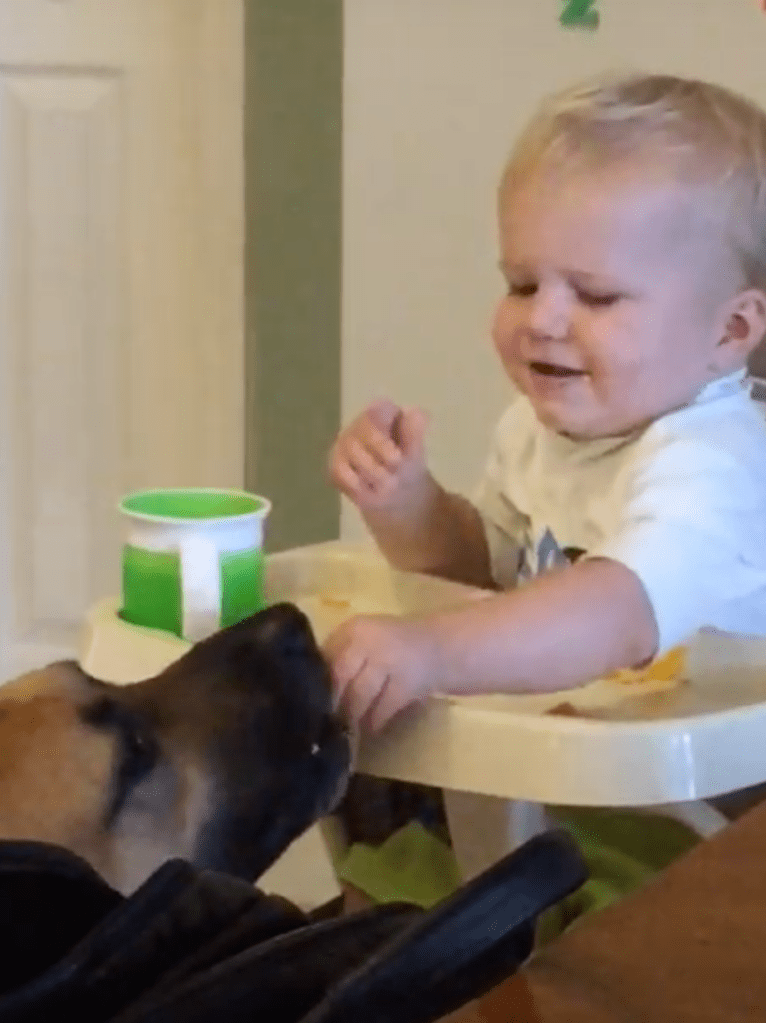
A magical moment: learning to feed the dog

It’s a magical moment when a child learns to feed the family dog. No one teaches this skill to the child or the dog. It comes naturally.

A lot of life precedes that moment. The infant is old enough to sit up by his- or her- self in a high chair. A couple of teeth have appeared on top and bottom so that they can negotiate some solid but soft food. The little one has also mastered the art of grasping a Cheerio, a pea, or a chunk of hot dog.

Not every morsel will make it into the mouth. Some fall to the high chair tray. Others tumble into their lap. Still others drop to the floor.

The observant pup springs into action, eating the crumb and licking the floor clean for good measure. As more pieces of food descend like manna, the dog figures out the source. It’s that little person. Why wait for the food to hit the ground? If you sit in just the right spot, you can catch it on the way down.

The observant child marvels at how quickly the escaped food vanishes without ever touching the floor. And if you reach your hand out towards that black nose, the food will disappear even faster. A tail wags, the giggles begin, and both are delighted!

Dogs know this is their way of helping keep the floors clean. Children remember this trick for the future, when mom or dad prepares food they don’t like. A win-win, right?