On my flight home from Dallas I verified the timeless adage that one ought not judge a book by its cover.
As we like to do, we were the last to board our flight to minimize our time sitting in the economy section. Just ahead of us was a short woman with a substantial carryon bag stuffing popcorn into her mouth from a large bag. While we had the middle and aisle seats in our row, guess who had the window? You are correct, this very woman concealing another carryon bag under one of her jackets.
She couldn’t fit her carryon under the seat in front of her, so we convinced her to put it up in an overhead bin. With one of her jackets against the window, she fell asleep for the next ninety minutes.
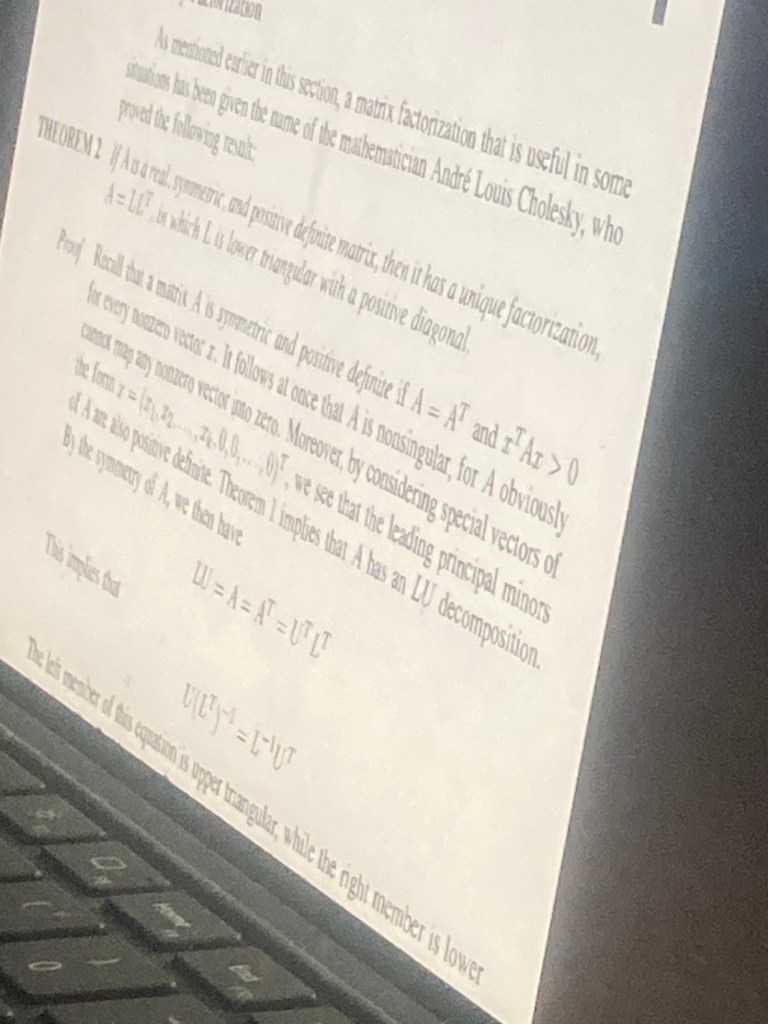
With about an hour to go before arrival, she woke up and got out her laptop. I was reading from the Kindle app on my phone, looking out the corner of my eye to see what she was doing. I immediately recognized mathematic equations, matrices, theorems, and proofs. The article was about Cholesky factorization. This was interesting.
I asked her, “Are you a teacher or a student?”
“I’m a teacher.”
I told her I recognized some of what she was reading, although it had been a long time since I saw anything like this. I told her that I had an undergraduate degree in mathematics, did some programming, and then switched my career trajectory to theology and pastoral ministry.
She asked me, “Why can’t you do both?”
With a chuckle I explained that my studies enabled me to help my daughter through AP calculus and help my grandson through pre-algebra. I told her I had programmed for Bell Laboratories in the early 80’s.
She asked, “Fortran?”
“Yes, and some Cobol.”
She told me that Fortran is a programming language still used in her field, even though most current programmers use some iteration of C or Python. It just works better for some applied math applications.
She added, “See? You can still do that!”
I laughed. It’s been forty-five years since I programmed with Fortran on pre-PC, room-filling IBM mainframe computers.
I asked, “Where do you teach?” It turns out she is from Brazil, has her Ph.D. in applied mathematics from the University of Arizona, and teaches at Texas A&M.
I am so glad I broke the silence and engaged in conversation. Something in me still comes to life when I come across math and mathematicians in this world.
Every morning as I’m walking my dog, I pass a woman walking her dog. She’s memorable because she zig-zags down the street. She walks from one side to the other, effectively doubling the distance they walk each day. She’s also talking to someone every morning through her AirPods.
It’s dark at this time of the year when we pass each other at 6:30 in the morning. My Great Dane shows no interest in her Schnauzer-ish dog, and he’s not interested in us, either. But she always says, “Good morning” to me. I always reply, but she doesn’t always hear me, because someone else’s voice is in her ear. So she’ll turn up the volume and repeat, “Good morning,” and I’ll repeat my reply.
Who does she talk to every morning? I picture someone else, a sister or child walking their dog at the same time, catching up on whatever happened since yesterday. I imagine it to be someone in Eastern Standard Time, since everyone else would still be asleep. But maybe it’s a friend in Europe, where it’s at least six hours later.
By the tone of her voice, it’s intense. A serious conversation. No nonsense. Almost aggressive.
I talk to God and the big dog when I walk. My words are upbeat, light-hearted, and at times, silly. (When you’re talking to a goofy Great Dane, it’s easy to be silly.) I have never had an early morning phone conversation. I don’t know who I’d call. All my friends are still sensibly sleeping at that time of the day.
Before you know it, the conversation between Job and his friends has descended into name calling. From trying to figure out what’s going on in Job’s life, they resort to insulting each other.
Eliphaz calls Job a bag of hot air. “Should a wise man answer with windy knowledge?” (Job 15:2) He labels Job as “abominable and corrupt” (15:16).
He doesn’t pull any punches when he points out, “The wicked man writhes in pain all his days” (15:20). I guess we know what he thinks of Job.
When Job asserts, “I shall not find a wise man among you” (17:10), Bildad responds, “Are you calling us stupid?” (18:3)
Sound familiar? It should. This is the path our conversations take. First we disagree. Then it escalates. Then it gets personal. The other person is stupid. We insult members of their family. Suddenly we’re not friends any more. We’re mortal enemies.
When it gets to that point, we don’t even remember what the original point of disagreement was. It doesn’t even matter. The only thing that matters is adding words like “always” and “never” to the insults. You’re always like that. You never do this. I’m not stupid. If the shoe fits…
Is there anyway to avoid going down that road?
Shut up. You don’t have to respond in kind. You don’t have to fan the flame. You don’t need to add fuel to the fire. Listen, look them in the eye, and be quiet.
Ask questions like, “What do you mean by that?” Let them say more. Listen, look them in the eye, and be quiet. If you make progress, go on to ask, “How do you know that?” and “Why do you believe that?” Those questions shift the focus back to whatever the issue was.
You could say, “You’re right. I’m stupid. I’m an idiot. I’m a jerk.” Own it. Claim it. Absorb it. Chances are the conversation will take a different turn.
So far in reading through the bible there’s only been one talking animal, the serpent in the garden. Now, in response to Balaam’s beating, the donkey asks, “Why are you hitting me? What did I ever do to you? (Numbers 22:28)
This doesn’t seem to surprise Balaam at all, who engages in a conversation with the donkey. It’s not shocking for many readers like myself who often find ourselves talking with animals.
In fact, first thing in the morning, you’ll hear me talking to our Great Dane. “Good morning. How ya doin’? Come on, let’s go outside, then we’ll get you something to eat.” A wagging tail and a little wake up howl lets me know we’re on the same page. At the zoo I catch myself talking to the elephant: “Hey, turn around. I want to get a picture of something besides your butt!” Who hasn’t driven by a pasture with some cows, rolled down the window and let loose a long, “Mooooo”? I’ll engage in a little call and response with the birds singing at sunrise.
I know it’s not exactly the same, but I love communicating with animals. The dogs recognize plenty of words like treat, ball, bone, food, ride, and walk. I know what their different yips and woofs mean, too.
As Balaam learns, it pays to listen to animals. The donkey is the one who first saw the angel of the Lord. If she hadn’t stubbornly resisted Balaam’s leading, he would have died (Numbers 22:33)!
What do animals perceive and understand better than me? My dogs have a wonderful sense of who to trust or not. They hear thunder in the distance before me. They notice bunnies by the side of the road before I do. Somehow they know when someone is walking past the front of the house, and they usually let me know.
In Lisa Unger’s mystery novel Under My Skin, the protagonist Poppy glances at her phone and reflects on what has happened to her relationships because of texting. “Relationships scrolling out in bubbles, text disembodied from voice and body, language pared down to barest meaning” is “far less meaningful than actual conversation.”
Even though these words are fictional, they ring true. They resonate. We have replaced real conversation and real relationships with a poor digital imitation. They are like products with artificial flavoring or colorized movies or cheap laminated furniture materials.
In the Star Trek series and movies, the replicator made it possible to enjoy any food or drink you wanted from any planet or culture or era. But space travelers treasured real ale from some alien race or a real apple from planet earth. There was nothing like the real thing.
No one says, “I wanted to see your words.” We say, “I just wanted to hear your voice.” We save and replay voice messages again and again.
Bubble relationships are convenient, but two-dimensional. The words have no actual feelings though we try to extract emotion from them. Text messages may be adorned with emoji, but they lack the hint of a smile, shifting of an eye, the furrow of a brow, or a subtle chuckle. Most texting is quick and efficient, with little thought to grammar, vocabulary, or spelling. (Unless it is a lengthy text, and who reads all the way through those?)
In an actual conversation, eyes tear up. Legs nervously bounce. Fingernails have been chewed. Breath smells like alcohol. Some words come quickly. Other sentences are punctuated with long pauses. Lips purse. Fingers drum on the table. Hands fold.
We all need to work on being better listeners. There are many resources to help you become a better listener. I’ve read them, practiced and strive to be a better listener.
But I’ve also had to work on being a good interrupter.
I spend time visiting older men and women who don’t get out much, who don’t have many people to talk to, who we classify as “homebound.” We no longer call them “shut-ins.” No one likes that descriptor.
Anyway, when I stop by to visit, it’s a chance for them to talk. Many homebound folks have mastered the art of talking with no periods. That is, every statement, every thought, every story is followed by a comma or semicolon, leading to the next story, thought or statement.
Let me give you an example.
“When my brother came to visit me last week…he’s from Ohio, the town where we grew up…it wasn’t a big town…my mom and dad met there at the church my grandfather built…the church only had five members when they started…my grandfather used to live out in the country but moved into town when the new factory opened…a factory that fabricated sheet metal…it was a real good job…most of my brothers worked there…my one brother met his wife there…she worked in the office, handling orders…the orders would come in from all over…she worked the switchboard, too…until they changed phone companies…I don’t get many phone calls now…my son said we get too many sales calls…I don’t really buy much any more…I remember when my aunt would take me into the city to go shopping…I don’t know if that trolley is running any more…”
You have to listen. Nod and smile. An occasional “oh?” And sometimes, “Really?” They have all the time in the world. You have a few other folks to visit.
What do you do? What will you do?
First, just be patient. Just listen. Someday you will relish those moments when someone comes to visit you. Pay it forward.
Second, be present. Just listen. You’ve gained entrance into a live well-lived. Learn from their experience and narration. You’ll be better for it.
Third, catch a word. “Factory.” “Brother.” “Trolley.” Catch a word and make it part of your own sentence. Step into the conversation. Hop on board.
Their words are the wave you want to catch. You’re listening but also riding the wave. You direct the conversation to the moment, the present and that place.
“I remember my mom taking me to ride the trolley…I’ll bet you miss getting out and around…”
“Tell me about your brother…”
You can ask questions that subtly take control of the conversation and bring a visit to an end. Yes, everything has a beginning and an end. That’s OK.
There is an art to interrupting. Listen carefully. Listen carefully for an opening. Listen carefully for that opening that will fill the emptiness in their lives. Be blessed by the conversations that fill your soul, too.
A few days ago, before I took the long drive to visit one of my members at home, I stopped to pick up some lunch to take to them. Earlier that morning, I ordered a few subs online and indicated when I wanted to pick them up. When I got to the store, I spotted them in the bin with my name on them, paid at the register and I was on my way.
After I arrived at their home, we sat down for lunch and I casually explained how easy it was to pick up the food. I’ve done it often. Another family member there said, “When I order food, I want to talk to a person!” Fair enough. Technology isn’t for everyone. But it got me thinking, when do we want to speak to a living being, and when do we avoid it?
We’ve all been through the frustration of calling to inquire about an account, only to be greeted by layer after layer of automated responses and numbers to press. It would be so much easier if we could just speak to a person.
On the other hand, how often do we text or email or message someone rather than calling or talking to them face to face? It’s so easy to zip off a message and be done with it. They’ll get back to us when they can. In that case we save a lot of time by not talking to a person.
Look at how much you can buy without interacting with a human. Practically everything. And since online shopping grows and grows and grows, obviously we like that method.
Ever been in a store where someone shadows you, waiting for you to pause before an item for a moment, so they can ounce and try to sell it to you? I hate that. Sometimes I just want to look without being sold to. On the other hand, have you ever been in a store and need help finding anything, only to discover that every sales associate has disappeared. That moment when you need assistance, every aisle is deserted like you are in a ghost town.
I’ve learned that talking to a person face to face is always preferable. A phone call is second. Texts, messages and emails come third. I use digital means often, but it’s too easy to miscommunicate or misunderstand. Phone calls, including video, help span the distances you can travel. But nothing beats talking to a person. You can accomplish so much in five minutes when you speak in person!
I mean, I go to visit people all the time. I visit folks who are first time worshipers with us. I visit others who are struggling with problems. I visit some who are recovering, sick or dying. I visit some just because that’s what pastors do. On site pastoral care is part of the job. But sometimes I learn the reason for my visit after I arrive.
I recently thought I was visiting a couple who had decided to join our congregation. Because of travel, hurricanes and family deaths, our meeting had been postponed for a while. We finally got together and had a really good conversation about church, ministry, the future and some of the uncertainties of life.
As often happens, ninety minutes passed like a moment. As I prepared to bring the conversation to a close and head home, something blipped on my radar. We had both lost a father in past three months. Her brief comment about grief, stress and sadness made me pause. I believe the Holy Spirit nudged me to stay, inquire, and listen to my friends talk about their loss. That’s the reason I was there.
Everything else we talked about, everything else on the agenda faded away as we shared stories about the last days of our fathers. She needed to speak. I needed to listen. Stories needed to be told. Stories needed to be heard.
I am thankful that I decided to simply listen. I wasn’t there to process a new member. Or answer their questions about our church. Or find out how they wanted to be a part of their ministry. I was there to listen to a grieving daughter mourn, remember and thank God for her father.
And I was there to mourn, remember and give God thanks for my father, too. Sometimes I forget that I am still processing this life-changing event from just a few months ago. Life moves on at such a fast pace that it’s easy to forget that we need time to figure all this out.
So, was this visit more for me or for them? Who knows? Probably both.
Before long, AI will be making phone calls for us. Google demonstrated this reality a few weeks ago when Google Assistant called and made an appointment with a human stylist. The typical stilted electronic sounding voice of automation has been refined to sound just like a real person, complete with pauses, “ums” and “ahs.”
This opens up so many possibilities and challenges. Previously, we would ask, “With whom am I speaking,” to get a name to refer to later. Now we ask, “Where are you calling from?” knowing that we may be talking to someone in a call center on the other side of the earth. In the future we’ll wonder, “Is this a real person or a computer?”
I can think of a few future scenarios in my own line of work. In the not too far off future, the guest sign in book at church will be an iPad. I won’t have to try and decipher the handwriting anymore since you’ll type in or speak your name and email. Later that afternoon or evening, you’ll get a phone call that sounds like me, but will actually be my digital assistant who has found your phone number and contacted you. On Monday morning when I check my calendar, I’ll have an appointment with that’s week’s visitors, all arranged by AI. I’ll be able to glance over information about you and your family gleaned from your social media accounts, fuel for our conversation. (And yes, my self-driving car will take me to your home so I can download my computer-generated sermon on the way.)
I know, that scenario is out there, but it made me wonder about our pursuit of avoiding human contact. Just think of all the ways we no longer have to talk to a person.
I get my cash from an ATM, no longer interacting with a teller inside the bank.
I order food or coffee with an app or at a kiosk in the restaurant, and then grab it off a shelf.
I do the majority of my shopping online. I rarely see anyone drop packages off at my door. They just magically appear!
I ask my phone for directions instead of a person. It routes me around accidents and traffics snarls, too.
I wonder what percentage of my human interactions take place via text or email? Honestly, I’d guess more than half.
My experiences only scratch this reality that isolates us more and more each day.
Virtual schools now replace some brick and mortar classrooms and flesh and blood teachers.
Your resume or application has been vetted by AI long before someone in human resources or a loan officer ever lays eyes on it.
How many people diagnose their own ailments and treat their own diseases by consulting online resources rather than going to the doctor?
You no longer have to go to the store for groceries, dealing with all those annoying people who clog up the aisles and make you wait in line. Your digital order will arrive later this afternoon.
I love the possibilities of AI, am fascinated by the technology, and love to discover what I can do. But how many have adopted these technologies to avoid human contact? Do those who don’t like or fear their classmates, teachers, and coworkers find refuge in a virtual world? No doubt. What about those seeking to avoid illness, judgment, conflict, prejudice or hatred? Probably. Or if you just want your own way, without having to persuade, convince or compromise, it can be quite satisfying, I guess.
Well, it’s not going to go away. It’s going to infiltrate just about every area of our lives. And even though I tend to be a private person who enjoys alone time, I can’t stay there. Not for too long, anyway.
I get so much more accomplished when I actually talk to a person. A few minutes of conversation can be so much more productive than an endless volley of texts or emails over several hours or days.
Talking to someone in person is the best. Whether it’s a difficult visit or one I’ve looked forward to, face-to-face is always better than my anticipations. I think we’re wired that way.
Laughter, sorrow, anger, enthusiasm, inspiration, and calmness all seem to be contagious. Catching emotion from those around us makes me feel something. It makes me feel alive.
I enjoy teaching. Which means I like being with someone or a room full of students, asking questions, giving examples, sharing experiences, listening to ideas and conveying understanding. Classrooms are alive!
I love music, too. I can sit and play for hours. But it’s so much more fun to play in a band or sing with a group!
I know too many widows and widowers who now have to eat alone. It’s no fun. I know too many young people whose human interaction has been so limited they have a hard time with conversation. That’s frustrating. Too many have surrendered to abusive behavior because they had no one to tell, and no one to teach them differently. That’s tragic. Too many have turned to violence because they knew no other way to relate to the world around them. That is frightening.
Don’t worry, you won’t become obsolete in a digital world. There’s someone who needs you to talk to them. Someone real. Someone just like you.


 Waite for it...