Posted in Through the Bible Devotions

I see you

Photo by Edi Libedinsky on Unsplash

Some “through the bible” thoughts from Acts 3.

“Now Peter and John were going up to the temple at the hour of prayer, the ninth hour. And a man lame from birth was being carried, whom they laid daily at the gate of the temple that is called the Beautiful Gate to ask alms of those entering the temple. Seeing Peter and John about to go into the temple, he asked to receive alms. And Peter directed his gaze at him, as did John, and said, “Look at us.” (Acts 3:1-4)

I’ve had conversations with people who would not make eye contact with me. It was one-to-one conversation with people I knew well. Yet, they looked at the ground, to the side, and over my head. Anywhere but my eyes.

One of them knew I noticed. She said, “I never make eye contact. I don’t let anyone see inside of me.”

I avoid eye contact. I’ll bet you do, too. When I’m looking at someone, I look away as soon as they make eye contact with me. They do the same.

It’s a learned behavior. I say that because I’ve watched my youngest grandchildren. The twos and threes will stand there and look at someone with nothing but curiosity. In a few years, they will learn to avert their gaze.

Why?

It’s a powerful moment when Peter and John make contact with a beggar who cannot walk. It’s the last day someone will carry him to the temple gate. It’s the last day he’ll beg. It’s the first day in his life he’ll be able to walk.

What a day!

So I wondered, “What if I intentionally made eye contact with people?” What would happen if I kept looking rather than looking away? What if I smiled at them?

If I keep looking at them, they usually look away. If I look and smile, they usually smile back. Most often, they aren’t looking at me. They are talking to someone else, looking beyond me, or looking beyond me to where they are headed.

When Peter and John make eye contact with a lame man, they change his life. They give what they have: healing from Jesus!

Can I bring life to someone by making eye contact? I don’t know. But I’m going to make eye contact. They might look away. They might smile back. They might look past me to something else.

Or maybe I’ll make their day. They will know that someone sees them.
Posted in Through the Bible Devotions

How can I help?

Photo from Gospelimages

These “through the bible” thoughts are from Luke 18.

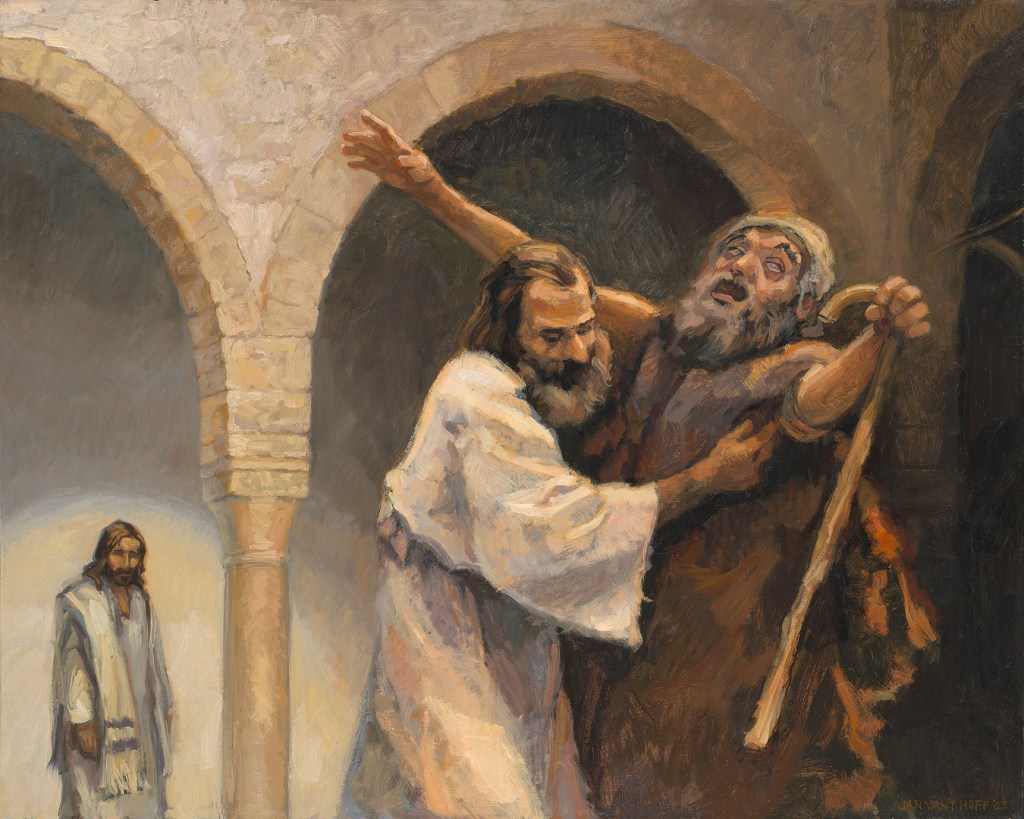
As Jesus approaches Jericho, a blind beggar cries out, “Jesus, Son of David, have mercy on me!” (Luke 18:38)

Jesus stops and asks the man, “What do you want me to do for you?” (18:41) In other words, “How can I help you ?”

I believe that’s an interesting moment. And it’s also a very good question. What does mercy look like in that context?

Beggars beg for money. Spare change. A couple of bucks. Anything helps, right?

But this is three years into Jesus’s public ministry. The talk on the street is that Jesus of Nazareth can teach, can heal, and might be the Christ. As the man cries out, “Jesus, Son of David,” he acknowledges Jesus’s claim to the throne. There’s a new king in town, someone who can make things happen.

“What do you want me to do for you?”

A blank check? Three wishes from a genie? A “What do you want for Christmas?” moment on Santa’s lap? Or a moment of complete faith and trust?

“Lord, let me recover my sight.”

That’s a big ask. Huge. Had the man prayed for that in the past? Perhaps. But it’s one thing to ask the unseen all-powerful God for a miracle. It’s another to ask it of a man named Jesus.

Do your prayers consist of huge favors or small requests? Are you bold enough to pray for the miraculous? Or do you only petition for what you think God will give?

Jesus said, “Ask…seek…knock” (Luke 11:9). We might as well go big. To do so not only acknowledges our need but also God’s ability to provide. It’s an expression of faith and trust in a Father who is able to do more than we ask or imagine. Who knows? You might get a miracle. You might get something better.

Posted in Through the Bible Devotions

A first time for everything

Some “through the bible” thoughts from Luke 5.

After Jesus touches a man full of leprosy, he tells him, “Go and show yourself to the priest and make an offering for your cleansing as Moses commanded” (Luke 5:13,14).

I’ll bet this didn’t happen very often. In fact, I’ll bet that few if any people recovered from leprosy or any other skin disease that word refers to. I could be wrong, but the priest may have never had anyone come to him to be proclaimed healed.

I imagine the priest had to get out the scroll which included Leviticus 14. That’s where the Lord told Moses exactly what needed to be done for a leprous person on the day of his cleansing.

  • If the priest observed healing, the person would bring two live clean birds, some cedarwood, scarlet yarn, and hyssop,.

The person then kills one of the birds in a jar filled with fresh water.

  • The priest ties up the other bird with the yarn, cedarwood, and hyssop, dips it in the water in the jar. The priest then sprinkles the water on the person seven times, and releases the bird.
  • The healed person washes his clothes, shaves all his hair, and takes a bath, clean and restored.

But there’s more.

  • Eight days later, the person offers up two males lambs, a ewe lamb, some grain mixed with oil, and some more oil.
  • The priest takes some of the blood of the killed lamb and puts it on the right earlobe, right thumb, and right big toe, followed by oil in those same places.

The whole process was involved and took more than a week to complete.

I was once invited to do a memorial service at someone’s home. After some readings and prayers, we went into the back yard which abutted some freshwater marshland. A family member handed me a cardboard box and said, “Do what you usually do.”

I had never held a box of remains before, much less performed a ritual scattering. I had to rubric to consult, so I made one up. I did learn this: always make sure you’re standing upwind.

That wasn’t the only time I improvised.

  • I did a quinceañera for a teenager whose family had Puerta Rican roots. I made phone calls to local churches with Hispanic ministry to find the ceremony.
  • People asked me to bless bibles and cross necklaces. I usually prayed for the people who read or wore them.
  • Visiting someone in the hospital with Covid-19 involved gearing up with personal protection equipment. I don’t remember taking that class in seminary.

Posted in Through the Bible Devotions

This time he uses spit

Some “through the bible” thoughts from Mark 7 and 8.

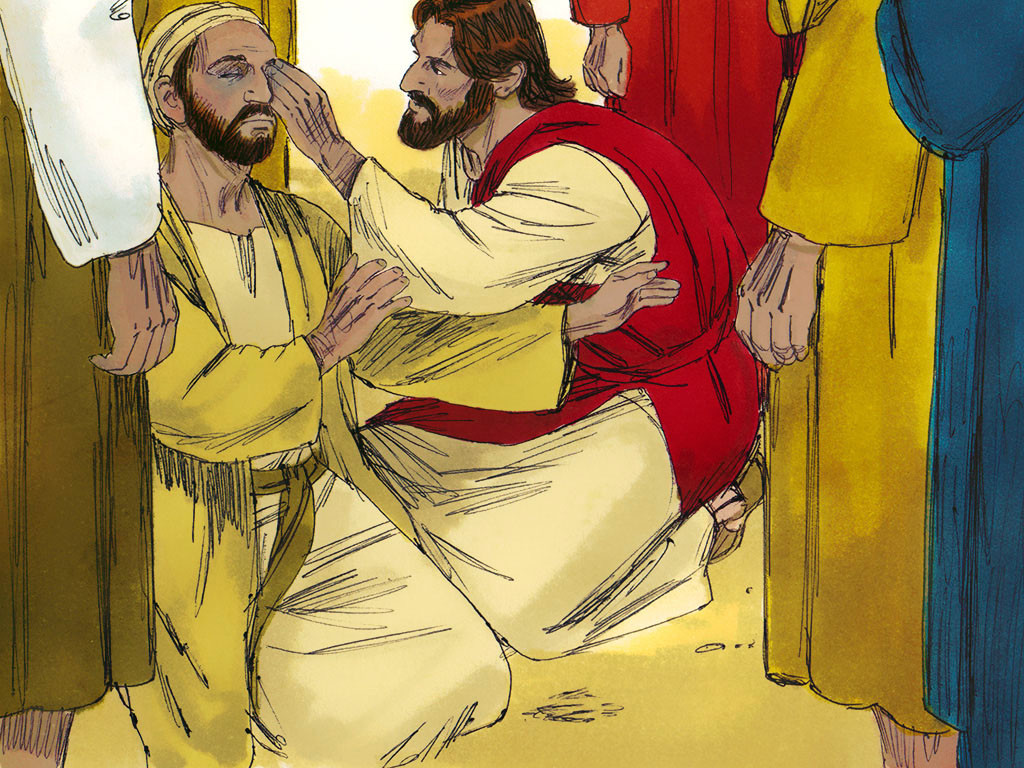
“And taking [a man who was deaf and had a speech impediment] aside from the crowd privately, Jesus put his fingers into his ears, and after spitting touched his tongue” (Mark 7:33).

“[Jesus] took the blind man by the hand and led him out of the village, and when he had spit on his eyes and laid his hands on him…his sight was restored” (Mark 8:23-25).

So far in Mark’s gospel Jesus healed with his voice and his touch. Why does Jesus use his spit in these two healings?

Some commentators say that Jesus did miracles in a number of ways to avoid leaving any kind of formula for others to copy. Others write of diseased eyelids stuck together and dry tongues, loosened in part by saliva.

Or maybe Jesus turned the custom of spitting from an insult to a blessing. When arrested, Jesus would be spit on and mocked, but also turned that a blessing as taking our shame and guilt upon himself.

When do you spit? Infants spit out that first taste of pureed green beans. I spit out a bug that flies into my mouth. Toothpaste after brushing. Mouthwashing after rinsing. Whatever that junk was you coughed up. A little spit might get a small spot off your shirt. Ever get so angry you could spit? Lukewarm church members make God want to spit you out like old, warm coffee.

God created you with salivary glands so you’d have plenty of spit for digestion, dental hygiene, and talking. Fully human just like us, Jesus put his spit to good use, healing like no one ever has.

Posted in Through the Bible Devotions

Through the roof

Photo by Elina Volkova: https://www.pexels.com

Some more “through the bible” thoughts from Mark 2.

“When Jesus saw their faith…” (Mark 2:5).

There is so much going on as Jesus preaches to a crowd crammed into his house in Capernaum. Four men carry a paralyzed man to Jesus, but can’t even get in the door. They take him up on the roof, open up a hole, and let him down to where Jesus is. “And when Jesus saw their faith…” he responds with spiritual and physical healing. The man walks away forgiven!

I’ve heard it said that faith is personal, but it is never private. What does faith look like on the outside? Faithful church attendance? Helping to feed or clothe someone who needs the basics? Going on a mission trip to share the gospel? Financially supporting Christian ministry? Yes to all of the above.

The faith of these five men looks like confidence, persistence, and creativity. No crowd, roof, or disability was going to keep their friend from Jesus. Their efforts reflect Paul’s words, “I am convinced that neither death nor life, neither angels nor demons, neither the present nor the future, nor any powers, neither height nor depth, nor anything else in all creation, will be able to separate us from the love of God that is in Christ Jesus our Lord” (Romans 8:38,39).

Sometimes it seems like those we love are so far away from God. If we could just get them to Jesus, they would get it. But maybe you’re not the one who will do it. Maybe it will be a friend or coworker who will bring them. Pray that the right one will come along who will get them through the roof to Jesus!

Posted in Through the Bible Devotions

Imagine the possibilities

Jesus went throughout all the cities and villages, teaching in their synagogues and proclaiming the gospel of the kingdom and healing every disease and every affliction. When he saw the crowds, he had compassion for them, because they were harassed and helpless, like sheep without a shepherd. Then he said to his disciples, “The harvest is plentiful, but the laborers are few; therefore pray earnestly to the Lord of the harvest to send out laborers into his harvest.” (Matthew 9:35-38)

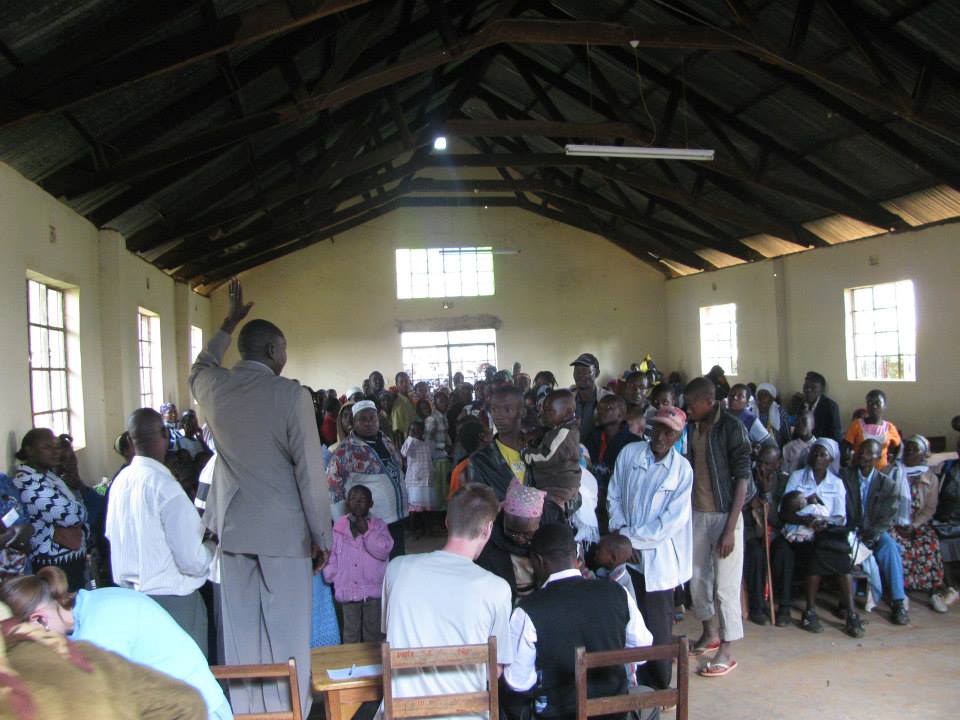
One of my most vivid memories from our medical mission trips was encountering a sea of people every place we set up a clinic. We would leave the guest house early in the morning to drive on highways, narrow city streets, back roads, dirt roads, and across shallow streams. Our driver would successfully navigate steep rutted hills, mountainside roads with no guardrails, and insist his way through standstill traffic in the middle of towns with no traffic lights.

When we finally arrived at a school, church, or tent, a crowd of men, women, children, were waiting for us. Everyone showed up in remote places where there was no medical. Some had walked miles through the night to get from their town to the place where they heard the clinic would be. From nursing newborns to grandparents with canes, lines filled makeshift waiting rooms.

Every day was a full day. The providers, nurses, and pharmacists saw three to four hundred patients a day and gave out as much medication as we could bring with us. Each day a new crowd was a new challenge.

When Jesus saw similar crowds in the cities and villages of Galilee, he saw an opportunity. He saw people who desperately needed teaching, compassion, healing, and a shepherd. Jesus saw beyond people and problems to a harvest ready to be gathered.

What would it be like to see the world like Jesus did? Sometimes I feel compassion. More often I’m amazed and annoyed at the number of people who appear harassed and helpless. My eyes see impossibility rather than possibilities.

Lord, help me see people like you do.

Posted in Through the Bible Devotions

Therapeutic touch

Some “through the bible” thoughts from Matthew 8.

A leper came to [Jesus] and knelt before him, saying, “Lord, if you will, you can make me clean.” And Jesus stretched out his hand and touched him, saying, “I will; be clean.” And immediately his leprosy was cleansed. (Matthew 8:2-3)

Jesus didn’t have to touch this man to heal him. He can heal just by speaking. He can heal at a distance, too. He heals a centurion’s servant without going to his house. Jesus heals other lepers while they are on their way to be pronounced clean by a priest.

But sometimes Jesus touches a person to heal them. He touches the blind and the deaf to restore their lost senses. I’m not sure why he does or doesn’t.

I just remember that no one could come near or touch God in the Old Testament. When God was in the cloud on top of Mount Sinai, no one could get near the mountain except for Moses. If you touched it, you died. That same God, in the flesh, now touches people and gives them life.

How do you think that felt? What would it be like to shake Jesus’s hand? What about a hug? Would that be a powerful moment? Do you imagine Jesus’s hands to be rough and calloused? Was his healing touch gentle or firm?

Some people are very touchy when they talk. They reach out and touch your arm or hand as a natural extension of their words. That doesn’t bother me, but I notice it when someone converses with frequent touch. Maybe it’s their way of connecting, of making sure you’re paying attention.

A touch to my ribs makes me jump. The grasp of a little hand reassures me that a grandchild is safe with me. I’m glad when someone grabs my arm so I don’t bump into someone. I’m annoyed when someone bumps into me.

Touch can mean a lot of different things. I imagine Jesus’s touch to communicate love, life, and security.

Posted in Ministry

In and out of the hospital

I just got back from visiting two of my members who are in the hospital. It’s unusual to have seen them four times; most hospital visits are very short. Thankfully, both are improving and should be home soon.

As I was driving home, I realized that in my get-togethers with my fellow pastors, both locally and denominational conferences, we don’t talk much about hospital and nursing home visits. We talk a lot about vision, attendance, programs, finances, buildings and staff. But we don’t say much about pastoral care. Is pastoral care still a prominent part of pastoral ministry today?

Reviewing one of my call documents, I see that the congregation authorizes and obligates me to, among other things, “visit the sick and the dying.” IOW, it’s part of my job description. This is no surprise to me, of course. It was modeled for me, I was taught to do it, and I’ve always assumed that hospital visits or visits to the sick at home would always be a regular part of my week. In my experience, these visits tend to come in bunches. There may be none for several weeks, then suddenly there are four or five people to visit. And then just as suddenly, everyone is back home and back on their feet again.

I generally enjoy going to the hospital, and always learn something new when I am there. After I return from a visit, I always ask my wife (a nurse practitioner) about what I saw and heard, and she teaches me something more about medicine. I am thankful that my mom (also a nurse) had me volunteer in a local hospital as a teenager. Because of that experience, I’ve never been uncomfortable in any part of a hospital. Plus, I get to see the healing power of God at work through doctors and nurses, treatments and medication, and spiritual care. It’s the same kind of thrill that those who witnessed Jesus’ healing miracles must have felt when someone could walk, see, hear, or speak again. When God’s at work, I don’t want to miss it.

So let me know if you’re in a nearby hospital. I’ll stop by.