To his parents, who had been searching for him for three days, Jesus said, “Why were you searching for me? Didn’t you know I had to be in my Father’s house?” (Luke 2:49).
Something has changed. After Passover, the family was on their way home from Jerusalem to Nazareth. But now as a young man, Jesus refers to the temple as his father’s house. He has begun to understand his unique relationship with God the Father.
All the fullness of God may have been in Christ, but he also had to grow up. Just like you and I, he learned language, customs, and a trade from his parents. On this trip to Jerusalem he began to understand that he was here for something more than carpentry.
As we grow, we continually learn what it means to be a child of God. Our perspective changes when we become parents and grandparents. Seeing the next generations helps us understand our relationship with a heavenly Father. Just like us in every way, Jesus learned what it meant to be the Son of God.
I love hearing people talk about the house where they grew up. That location occupies a treasured spot in our hearts. Jesus had two of those, a home in Nazareth and the temple in Jerusalem.
Some “through the bible” thoughts from the Old Testament book of Haggai.
“Is it a time for you yourselves to dwell in your paneled houses, while this house lies in ruins?” (Haggai 1:4)
In post-exilic Jerusalem, everyone’s time is consumed working on their homes. Of course they need a place to live. But they haven’t gotten around to rebuilding the temple. The focus on day-to-day living left them little energy for their spiritual lives.
Working a job, raising a family, and maintaining a home demands much time and energy. Getting everyone up and out the door for an hour of worship is no simple task. Even when you do it for a living (like a pastor), squeezing God into life is challenging.
God knows this. Ultimately he builds his temple out of people, “a dwelling place for God by the Spirit” (Ephesians 2:22). Instead of waiting for us to make room for him, God makes room for us in his church. Instead of God being a part of what I’m doing, I’m a part of what he’s doing. Rather than waiting for me to invite him into my life, he invites me into his. Pretty clever, huh?
When we moved to Florida, we had the option of building a new house. I never thought we’d be able to do that. By the grace of God we had enough equity to build when startup costs were affordable. Before we move, we looked at lots of houses, but decided we needed to build new. It was the right decision.
David wanted to build. He wanted to build a house for God. A temple. A place of worship.
As usual, God has a better idea. This wouldn’t be David’s project. It would be his son’s. And God’s.
It was more important for God to build David’s house. It was more important for God to insure that David’s descendants would always rule his people. It was more important that God make a house, or dynasty, for David. Our projects are always so small compared to what God has planned.
In the end, we don’t have to do anything for God. He does everything for us. He creates, saves, and blesses us. We can do nothing in return, except to live as those who have been created, delivered, and blessed.
David is a part of our Jesse Tree because one of his descendants, Jesus, will be the king God’s people always needed.
Whenever we’ve gone camping, we’ve taken time to walk through the grounds to see the variety of trailers and coaches set up for the night or for a long stay. We were always the smallest kid on the team, setting up camp in a tent, pop-up camper, or small trailer next to the behemoth rigs. With five slide outs, some of those forty-plus-foot vehicles had almost as much living space as the first house we bought.
Dwarfed by huge coaches at an RV park, I struck up a conversation with one owner who was grilling supper. He told me they had to stay put for a while because he really couldn’t afford the fuel to drive anywhere. That didn’t sound like much fun to me.
One day King David decides that God needs something better than a tent. If he’s living in a nice cedar-walled house, God should have a nice place, too (2 Samuel 7:2).
That’s not God’s style. The Lord says, “Would you build me a house to dwell in? I have not lived in a house since the day I brought up the people of Israel from Egypt to this day, but I have been moving about in a tent for my dwelling” (2 Samuel 7:5,6).
God’s never had a house. His place was a tabernacle, set up wherever his people happened to be. The almighty creator of the universe was comfortable in a tent.
One day a descendant of David would build a house for the Lord. But for now, God has a better idea. “I will build you a house'” (2 Samuel 7:27). Someone from the house and lineage of David will always be on the throne of Israel, a promise that finds ultimate fulfillment in Jesus.
There’s nothing wrong with wanting to do something for the Lord. The magi bring gifts. A woman anoints him with expensive perfume. Tearful friends wrap his body in line and lay him in a tomb. His followers offer themselves up as living sacrifices.
I just need to remember that God’s greatest desire is to do something for me. He wants to give me abundant, eternal life.
While walking the dogs on a drizzly Saturday afternoon, I had a conversation with a house-shopping couple from Canada who pulled up along side of us. They wondered if this neighborhood ever flooded. (It doesn’t.) They were also surprised at the cost of living here. I thought it was affordable, but with current prices, taxes, interest rates, and the exchange rate, it’s more expensive than it used to be.
As I walked away, I realized how blessed we were to have built our house nearly thirty years ago. I’m not sure we could afford to do it in today’s market.
After my wife and I got married, our first home was a one-bedroom, one-bathroom upstairs apartment on Spy Run in Ft. Wayne, Indiana, which we rented for $200 per month. The kitchen was five-foot by five-foot square, barely big enough for one person to stand. We only lived there for about four months, before packing up and moving to Baltimore for my vicarage (internship).
In Baltimore, the churches sponsoring us put us up in a three-story inner city row home. It was at the end of the row, so it had a little bit of a side yard between us and one of the churches we worked at. It was a run-down, falling-apart, and patched-together affair than probably should have been condemned. Living here for a year taught us we could live anywhere. No matter where in the world we went, from earthquake-shaken Haiti to remote villages in Kenya to single-wide trailers in rural Florida, we would say, “Well, it’s not as bad a Baltimore.”
After a year in the inner city, we moved back to Ft. Wayne for my last year of studies and rented a small house owned by a couple heading out for their internship. By the time previous owners had finished adding on a few rooms, there was a thousand feet of living space. (And it was better than Baltimore.) When the brutal winter weather hit, we discovered that the master bedroom, way in the back, had no ductwork for heat. It was chilly until we bought a kerosene heater.
After graduation from seminary, we moved to my first church in Coventry, Connecticut. There we lived in a parsonage, a two-story, five bedroom, 2-1/2 bath home on four acres next door to the church building. We moved in to the 2,700 square foot home with a bed, a crib, a table with two chairs, and maybe a dresser. We never did furnish the entire house the five years we lived there. I mowed the four acre yard, planted a big garden, split piles of logs for the wood burning stove, and let our two Labrador retrievers run freely.
The thing with living in a parsonage is that you don’t build up equity in the property. We didn’t make and didn’t save much in Connecticut, so when we moved to our second church in Iowa, we needed a lot of help finding a place to live. For the next five years I would be one of several pastors on staff at a well off church in Urbandale, a western suburb of Des Moines. We weren’t able to afford a home in that community, but found a small home in West Des Moines, not far away. The church gifted us with most of the downpayment on a 1,000 square foot, $65,000 house, the first we owned.
Five years later, we got the call to serve the church in Palm Coast, Florida. Our Iowa home sold easily, netting enough profit to buy our next home in the south. Rather than rushing into a purchase, we rented a home for the first six months. With three children, we wanted a four-bedroom home. There were few to choose from, so we decided to build. We never thought we’d be able to build a home. But building lots were going for $8,000, construction costs were $50 per square foot, and taxes were low, so we built a 2,000 square foot Palm Coast home for about $100,000.
In the years to come, we were able to refinance. We got into an adjustable rate mortgage that was tied to the prime interest rate during the years it was at zero percent. Our monthly payment and interest was actually lower than a car payment! Homestead laws meant our taxes barely inched up each year. Housing booms enabled us to refinance and remodel our home without increasing the mortgage payment. This was one of the ways God faithfully provided for us over the past forty years.
Having written that last sentence, we would do just fine if we were to start all over again.
The small group we’ve been a part of for the past year meets twice a month, rotating through the members’ homes. Last night, we met at a home I haven’t been to before. I had directions to the H******, but I had no idea who they were. I only know most people first names.
I thought I would be clever. I figured that I’d be able to pick up clues at the house and figure out who in our group lived there. I pride myself at noticing things, so I was confident it wouldn’t take me long to figure it out.
However, when I arrived and began looking around, the home had none of the usual clues. First there were no pictures of anyone on the walls. No pictures of children or grandchildren. No framed family pictures from an old church directory. No pictures of fishing trips or cruises or other adventures. Absolutely nothing. Nothing on the refrigerator. No calendar on the wall.
Okay, I guess that would have been too easy. If I keep looking around, I’ll pick up on a hobby and be able to connect the dots. While the home was nicely and simply decorated, I didn’t find any sign of their interests. A Willow Tree nativity sat on a shelf high above the television. The table where we ate was decorated with starfish and sea shells. There were no bookshelves in the living room. There was an electric piano in the dining area, but that didn’t help me.
I watched everyone’s body language. Who acted most at home here? It was hard to tell. I let myself in when I arrived, so no one was working the front door. Lots of people were working in the kitchen, arranging food for supper. Several people sat in the very comfortable chairs in the living area. The family dog greeted everyone with the same enthusiasm.
Finally, I resorted to a process of elimination. One couple arrived late, so I knew it wasn’t them. I realized I had been to the homes of three of the other couples. So this was the home of the fifth.
I enjoy playing games like this, gathering enough clues to solve the puzzle.
Dad had cleaned out a lot of things in the house years ago. He had given away clothes, linens, craft and sewing supplies and lots of books after my mom died nine years ago. He moved out of his home of 48 years about six months ago, moving in with my brother. He took most everything of sentimental value with him. With an interested buyer on the line, it was time to finishing emptying out the house and get it ready for sale. By today’s standards, it was a small home, two stories with a full basement. Maybe 1,000 sq. ft. How hard could it be?
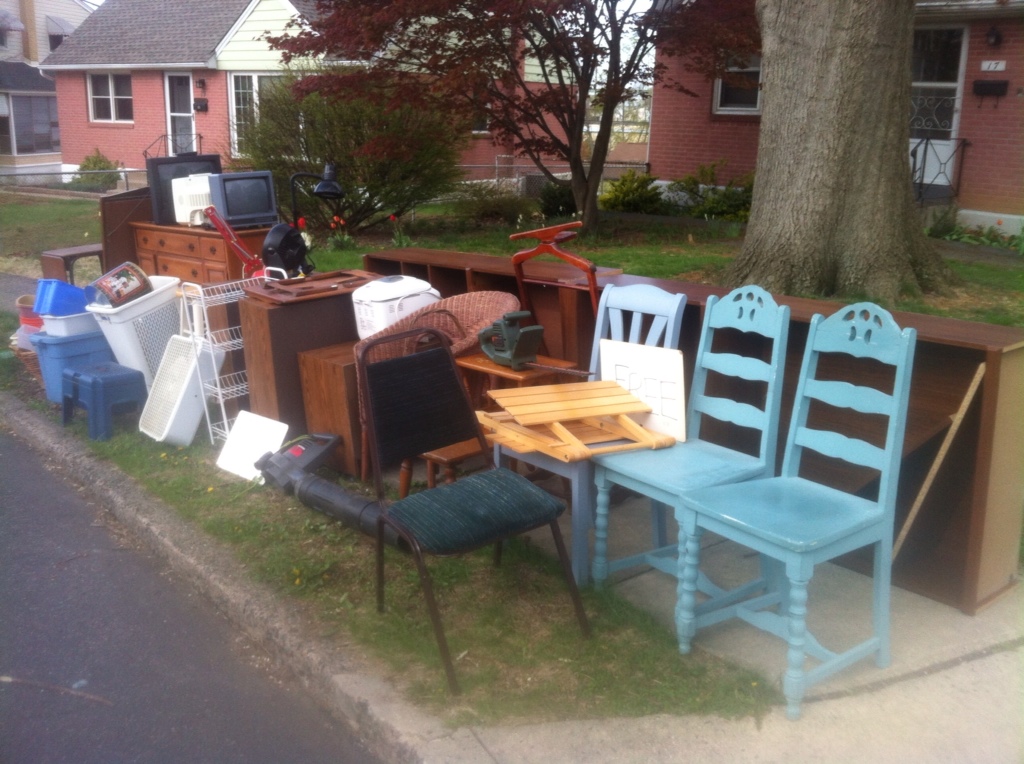
I had no idea. The biggest surprise? The number of bookcases in that little home. The books were mostly gone, but my brother, sister and I must have carried out twenty-five book cases and cabinets of various shapes and sizes. Some were antiques, some were cheap pressboard “some assembly required” pieces, and others were handcrafted by my dad. One-by-one we carried painted, stained, metal, laminate and plastic shelf units to the curb, where many were picked up by folks alerted to our efforts via Craigslist.



 Waite for it...