I chuckled at my wife’s comment as I opened the door for her. I knew she was right. Goodwill stores are filled with row after row of clothing donated from innumerable closets. You can find new items with price tags still on them. You’ll also discover pieces with stains that were never washed out.
We weren’t there in search of clothing. We hoped to find a few vintage plates, cups, and saucers to use as photo props. But we had to walk past aromatic racks of shirts and pants to get to that part of the store.
Later, I thought about other places that always smell. That’s not always a bad thing, is it?
Like a bakery, for instance. It’s hard not to like the smell of freshly baked bread and cookies.
What about a shop that sells leather goods? A store filled with belts, jackets, wallets, and vests has a distinctive and inviting smell.
A coffee shop smells wonderful. Noisy grinders and hissing espresso machines fill the air with the aroma of roasted beans from all over the world.
The smell of barbecue hits me before I walk in the front door of a place with an active pit. You can smell the smoked meat from inside the car as you drive by.
What about cedar? They aren’t common, but it always smells so good when I walk into a cedar closet.
Other great aromas include the ocean, pine trees, freshly cut grass, and a brand new car. It’s amazing how much smell is a part of the places we go and the things we experience.
At the pre-bible study meal on Wednesday night, I sat across from Jason. I’ve sat with him, eaten, and talked with him before, but never asked about his blindness. He faithfully comes to the Wednesday night men’s bible study. After a while you don’t notice the dark glasses and folded up white wooden cane under his chair. He’s just part of the group.
But tonight I said, “Jason, it’s Bill.” I try to identify myself when I sit down with him. And then I asked, “Can I ask you about your blindness? Have you ever had any sight?”
He smiled and told me he had been born blind. “In fact, when I was born, they had to remove one of my eyes. I’ve never been able to see.” He added, “But I really got messed up when I lost my hearing.”
Jason continued, “When I was a teenager, I would put on my headphones and listen to heavy metal music way too loud. My mom could never get my attention. I guess I overdid it. Now I’m paying for it.”
He then told me about a time when a nurse wanted to check his vision. “She wanted me to read a line of letters on the wall. I had to explain to her that I couldn’t see anything. Boy, was she embarrassed!”
One week, Jason made a pot of chili for the Wednesday night meal. It was delicious. He explained, “My mom taught me how to cook.” She was a good teacher. He has won a few chili cook-offs.
I’ve gotten to know a few of the blind who attend this church. Emily sings with the worship team, equipped with braille songsheets on her music stand. Ricky, with just a little bit of peripheral vision, does a lot of long distance running. Billie had her golden retriever assistance dog in church with her. Yes, of course, I stopped by to say hi to both!
Engaging with the blind is a great reminder that this world is not the way it’s supposed to be. It’s also a reminder that God is doing everything needed to restore it. Jesus gave us a taste of that, giving sight to the blind, hearing to the deaf, and getting the lame back up on their feet.
Can you imagine what it will be like when the first thing you see in your life is Jesus?
I was reading Psalm 115 this morning and I was struck by how interactive the Christian faith is. It is not just words on a page. It’s not just stories in a book. It’s not just images of biblical truths on t-shirts or coffee mugs. We experience the truths of the faith because God interacts with us in sensory ways.
The psalmist backs into this by describing idols made by human hands. They don’t say anything, see anything, hear anything, smell anything, feel anything or go anywhere. They are good for nothing. On the other hand, God does all of these things and more. That’s why we can trust him to help, protect, remember and bless us.
It’s not subtle. God is dramatically different than anything else you can fear, love, or trust.
He speaks. He speaks words that create life, hope, and peace. We know that all he has to do is say the word, and something happens.
He sees. He sees what’s going on in the world and in our lives. He looks into our hearts and see what we truly desire. He can also see what we ultimately trust.
He hears. He hears our complaints, laments, questions and cries for help. He hears our praise and thanksgiving. He hears every request, too.
He smells. Prayers and sacrifices wrapped in smoke are a pleasant aroma to him. The stink of death doesn’t deter him from giving us new life.
He feels. He feels the touch of the desperate who need healing, the worship of the thankful, and the pain of the nails that held him to the cross.
He walks. He walks through crowds, on top of the water, and up the hill to a cross.
Created in his image, we see, hear, taste, smell, and feel, too. If we’re paying attention, each of our senses connects us to the Creator. They give us sensory access to his divine power and nature.
So what did I see, hear, touch, smell, and taste today? And how did it remind me of my God, who is so much more than any idol I might craft in my mind or heart?
So after spending 8 days in Israel and simply recording where we went each day, I now have time to stop and reflect on our amazing trip to the Holy Land. From the first moment, our tour guide, Tali, told us to take in our eight days with all our senses. I’ll begin with what I heard.
Twelve hours in the air from Miami to Vienna and then Vienna to Tel Aviv on Austrian Airline meant I had numerous chances to hear German followed by English instructions and updates on the plane. I took two years of German in high school plus two semesters in college. I may not remember much of the vocabulary, but surprisingly I could follow the conversation when the pilot let us know how far we were from our destination or what kind of food might be served next.
It was hard to get to sleep our first night at the hotel on the Sea of Galilee because of a large, loud party on the beach below us that didn’t break up till about midnight. I might not have minded had we been invited!
I sat in the front row of our tour bus, so I got to hear the wide variety of music our driver, Anatoli, played while on crowed city streets and highways between destinations. He switched between Hebrew talk radio, classical, Broadway show tunes, country, and a little techno thrown in for good measure.
From time to time we would be outside to hear a Muslim call to prayer. These were digital, not live. I am not sure I’ve ever heard one before and was surprised at how long a call lasted. Each seemed like a minute or more. We must not have been in Arabic locations, because I did not see many people bow in prayer.
A sea of tour busses surrounded us everywhere we went, filled with visitors from all over the world. As the groups passed, I heard Spanish, Portuguese, French, Russian and English tour guides pointing out the sites and explaining some history behind each. Each person in our group wore a headset, too, and the voice of our tour guide was always in our ear, explaining what we were looking at and where we were headed next.
Sometimes I heard nothing. Silence. Some sites prohibited explanations, so we took it all in with our other senses. At some, reverence for the moment and respect for those praying or meditating dictated quiet. Silence has a way of accentuating the holy. It was very quiet at the Church of the Beatitudes. A nun made sure of that. It was also virtually silent at Mary’s house in the Church of the Annunciation.
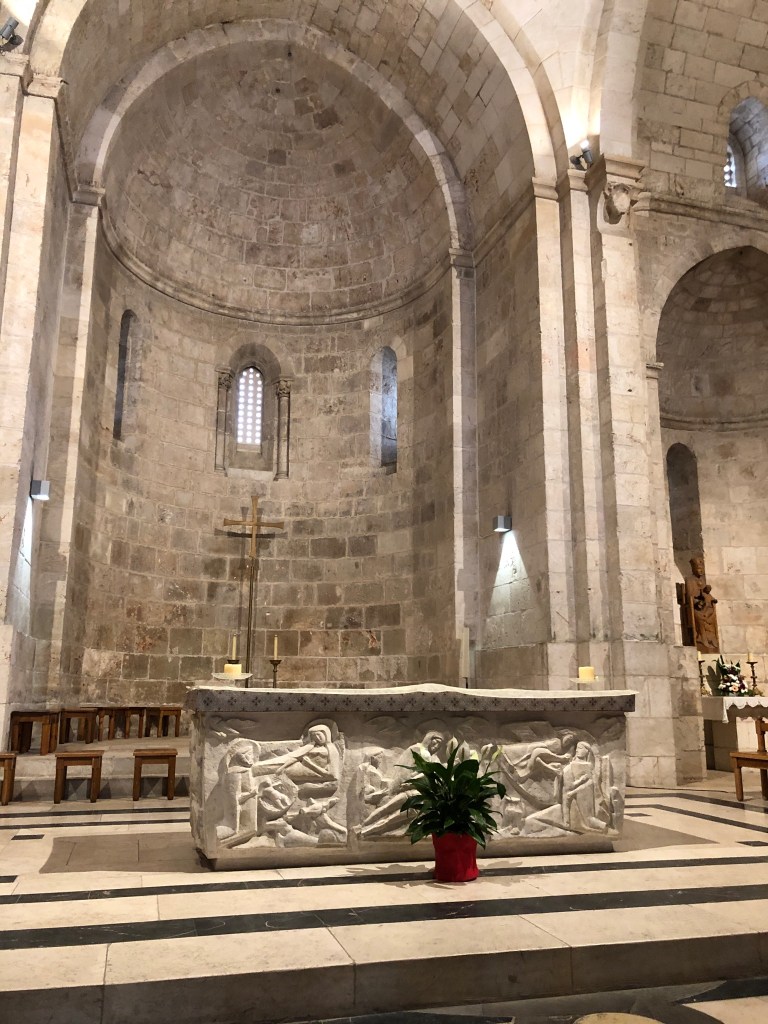
Church of the Beatitudes (See the water flowing from the altar)
It was not quiet at all in the church of the Holy Sepulcher. I thought the place was packed, but our guide said it was only about 60% of what she had seen. Crowds of people in long lines and constant conversation in every conceivable language surrounded us everywhere we went. We did not stay long, but it is a busy, busy place!
Church of the Holy Sepulcher
In some remote places like Qumran, Masada and Caesaria Philippi, I heard the songs of birds. Some where there because our guide brought a few crumbs to feed some of them. Others were just curious or up in the trees.
At the Western wall in Jerusalem I was surrounded by many speaking or singing prayers. They sat in chairs in front of the wall with prayer books or scripture open before them. Many sang psalms at the site of King David’s tomb as well. We didn’t spend a lot of time in those places, but I imagine that some who came spent a large portion of their day there.
The souvenir shop at the Jordan River baptismal sight had a selection of shofar (rams horn trumpets) you could try. I heard these being blown in the store and also several places along the way. I was the only one in our group to blow a few notes.
At Temple Mount, a vigilant voice broke up couples who were simply holding hands or had arms around one another for a picture, warning, “No hug! No touch!” No one had to be warned more than once.
A boat took us out onto the Sea of Galilee. Once out there, the pilot cut the engines, and I heard nothing but the breeze, a few birds and the sound of gentle waves against the side of the boat. I really enjoyed this calm, peaceful moment.
On our way from someplace in Jerusalem to some other place, we came across a family celebrating their three-year-old son’s first haircut. I didn’t know that was a thing. But they beat on drums, sang songs and released blue and white balloons into the air, too.
First haircut celebration
Other sounds included the hiss of the espresso machine at a market coffee shop, the sizzle of an omelette griddle at our second hotel, the enthusiastic description of so many dried fruit mixes at one market stall, and the endless invitations to check out the merchandise at each and every shop in the Arab market.
For me, the best sound was my own voice singing in St. Anne’s church by the pool of Bethesda in Jerusalem. The acoustics were amazing. A sung phrase would linger in the air for five seconds. So I could sing and then listen, sing and listen, and marvel at the rich sounds surrounding me.
St. Anne’s
Unfortunately, my days were peppered by voices in our group complaining about long lines, waits and walks during the day and hotel room problems at night. Each concern was legit, but come on, folks. The opportunity to walk where Jesus walked and see all those places I’ve only read about before is worth a little inconvenience. At least it was for me.
When I began writing this, I had no idea how many sounds I would recall. I suspect I’ll remember more, so there might be a part two.
It’s been an Elijah weekend. We’ve had our one-year-old grandson staying with us since yesterday afternoon.
When you are one, everything goes in your mouth. Food (of course). Toys. Sticks and dirt (I had him out in the backyard with me; please don’t tell his mom!) Suds (Yes, we gave him a bath.) Food. (Did I mention he likes loves to eat?) Grass. (The lawn is greening up nicely.)
As I watched him today, I thought of the Bible verse, “Taste and see that the Lord is good” (Psalm 34:8). Wait a minute. Someone mixed up their senses. How much can you see with your tastebuds? I don’t know. But Elijah does. He sees, he tastes, and he learns about the world around him. Ingenious.
In the Bible, you can “taste” a lot of things. Manna (Exodus 16:31; yum!). God’s Word (Psalm 119:103). Your lover (Song of Solomon 2:3; <blush>). Death (Matthew 16:28). God’s goodness (1 Peter 2:3).
As grownups, we discount the sense of taste. “I heard…” “Do you know what I saw…” “Something smells fishy.” “I feel (fill in the blank).” But how often do we sum up our day with words that relate to taste?
Thanks, Elijah, for reminding me to reflect upon how today tasted. Sweet? Sour? Bitter? Delicious? Bland? Spicy? Complicated? Bold but not pretentious?



 It’s been an Elijah weekend. We’ve had our one-year-old grandson staying with us since yesterday afternoon.
 Waite for it...