Posted in dogs, Life

Breaking in the new folks

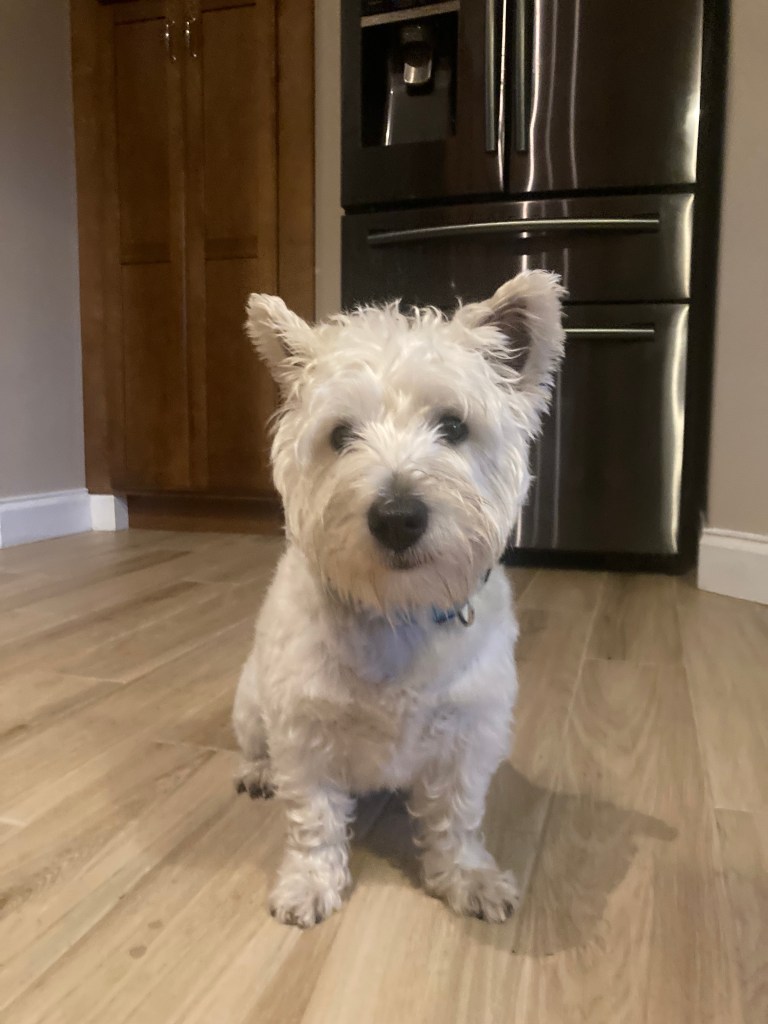
The moment I walked in the door, I knew these two would be a challenge. First of all, this was a big dog household. The dog who already lived there was big. The food and water bowls were big, the collars were big, the leashes were long, the dog bed was huge, the chew toys were enormous. And here I am weighing in at a mere twenty pounds. I had my work cut out for me.

Everything I owned fit in one sack. Rubber toys, chew bones, a couple of stuffed animals, a leash, a raincoat embroidered with my name, a bandana, a few miniature Westie figurines, and a couple of bowls. They found it all very entertaining. “Look how small everything is!”

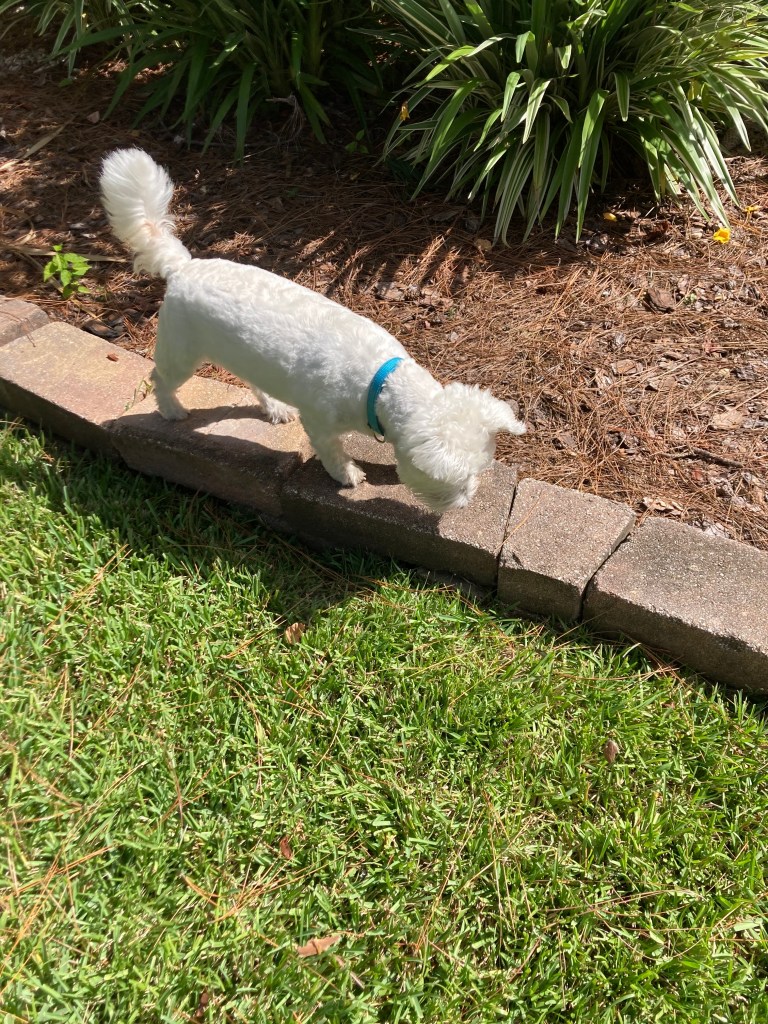
First things first. They carried me out the back door into the yard. I have a yard! I ran and rolled and panted and peed. This was going to be great. But it would be a lot of work to keep my space lizard and squirrel free. Fortunately, I could walk the landscape wall to keep an eye on my domain.
I simply wanted to make the place feel like home, so I sprinkled a few corners and rugs in the house. For some reason that didn’t go over well. Come on, guys, it’s not that much. I got the folks to pay attention to my subtle woof when I needed to go outside.

Checking out the inside of the house was as awesome as the outside. I couldn’t believe how many toys were scattered around. I sank my teeth into a plastic apple, purple Lego brick, miniature Pokemon character, a colored pencil, a sock, and a Hot Wheels car. None of that was well-received either. I got the folks to organize and store up the grandkids toys they didn’t me to chew in plastic totes.

My first few weeks here were amazing. I had so much energy. I just loved zooming around, jumping up on things, barking at dogs walking by on the street, and scattering my toys around the house. I got the folks to take me for nice long walks around the block every morning and evening to meet the neighbors, the neighbors’s dogs, and check out the neighbors’ mailbox posts. It’s my job to keep them active. After all, they aren’t getting any younger.
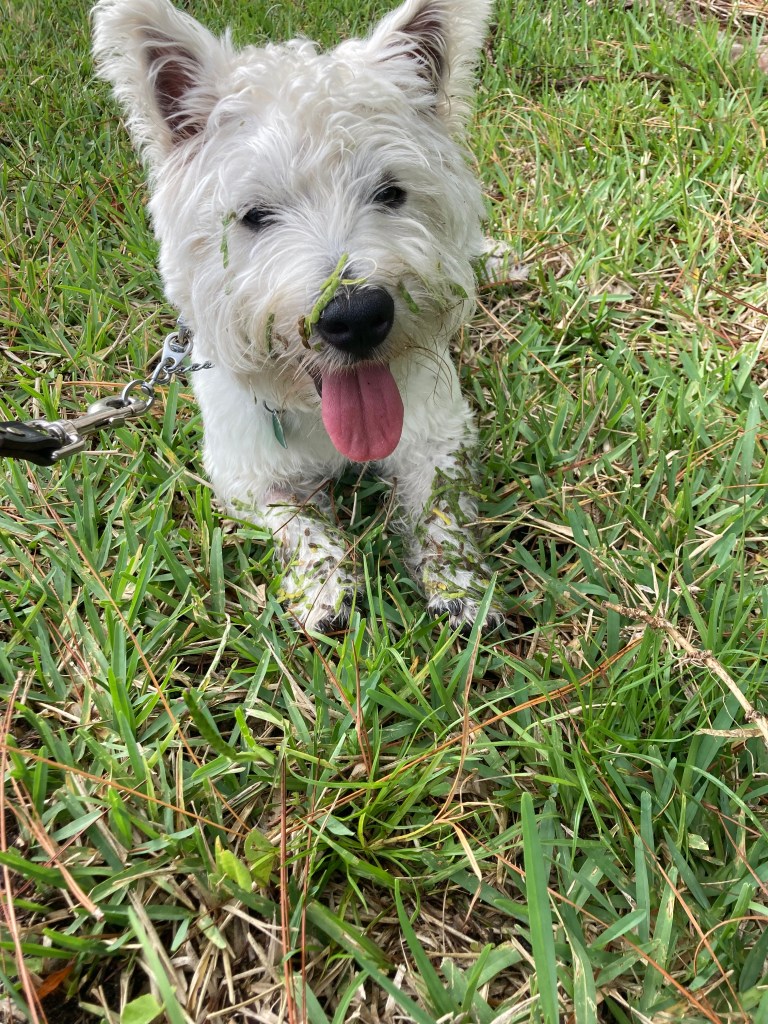
Okay, so just because I’m a white (West Highland Terrier) dog doesn’t mean that’s my favorite color. I like to dig till my snout and feet are brown. I like to sniff around until my face is covered with green hitchhikers. The folks finally figured out that I needed to be combed and brushed every day.

Let me tell you, the food here is great. Kibble? My favorite. They even mix it with some canned food and a little bone broth. Biscuits? There are plenty. Rawhide sticks? As many as I want. Cheese? I always get a bite of the folks’ cheese sticks. I told the folks not to worry. I work off all those calories on my twice daily walks.

Every once in a while, big dogs come over to play. And I mean big. And brown. Kennedy and Rex tower over me. I love to chase them around the yard. The folks don’t worry about me. They know I can handle myself and run with the big boys.

But one day, Brodie came over. He’s a Westie, too. It was like looking in a mirror. Everyone has a Doppelgänger, right? We’ve got a few things to work out, but we’re learning to be good friends. Bailey lives across the street. She’s a little bigger than me, and cute, but she always stays in her own yard. The folks know I can handle myself around the little guys, too.

Speaking of little guys, all these kids come over to the house from time to time. They are so much fun. They scream when I jump on them or chase them or take their toys. They always let food drop to the floor so I can have some. They taught me how to climb up into the play fort and go down the slide. The folks got a gate to keep us apart so they don’t bug me too much. Works for me.

A couple of months after I moved in, the old brown dog who lived here had to leave. I hardly got to know him. But the folks really loved him. They seemed so sad, so I was glad I could cheer them up with cuddles, kisses, and barking.

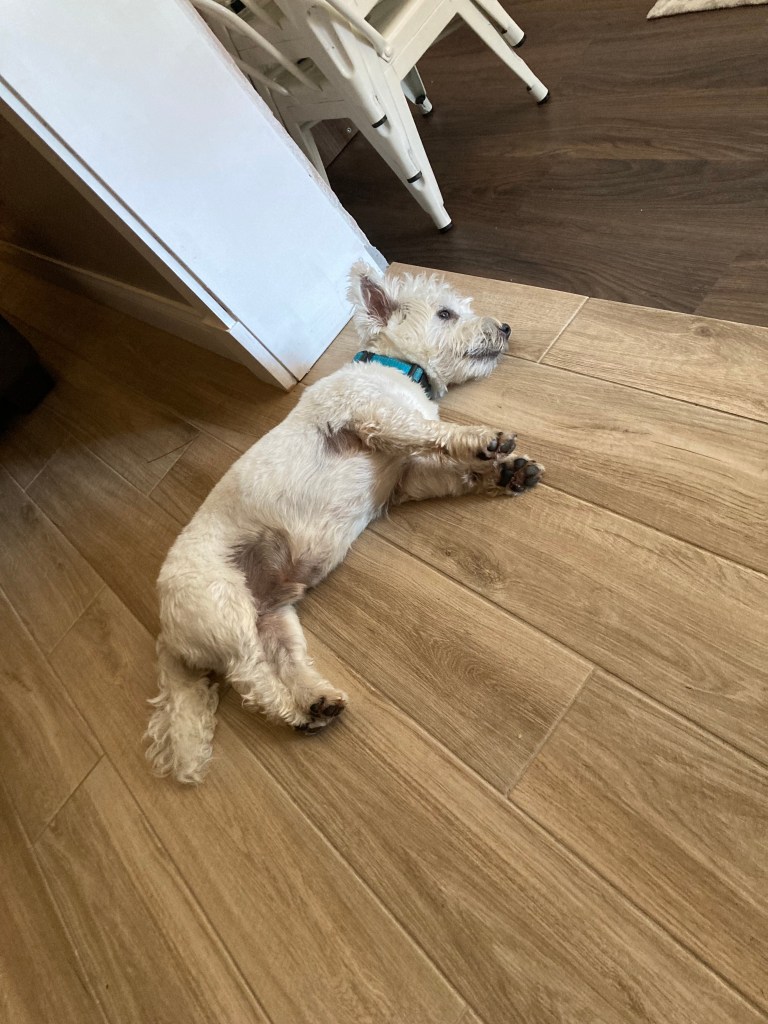
So I’ve lived about half my life here, and the folks are doing well. They know my favorite spot to hang out is in their lap or on one of the love seats. They let me nap with them in the afternoon. They get all my toys out from underneath the furniture. They often leave the back door open so I can come and go as I please. And I get to play with any lizards or snakes who happen to wander into the back porch.

They still have a few things to work on. They wake me up too early in the morning. Come on, I need my sleep. They need more practice combing and brushing all the stuff out of my coat. Come on, that hurts! I’d like to go for a few more rides in the car. Let’s go! It’s one of my favorite things to do.
I’ll tell you, it is a full time job keeping an eye on these two. But hey, that’s my job.
Posted in dogs, Life

Breaking in the new guy

“How would you feel about adopting another dog?”

For me, that question does not require much thought. I immediately answered, “Sure.”

Some friends of ours had just bought a new puppy, a West Highlands White Terrier named Winston. Unfortunately, their physical condition had gone downhill and couldn’t keep up with the demands of a new puppy. My wife heard he needed a new home, I said, “Sure,” and just like that we brought home a second dog.

Our resident dog, Samson, was a shepherd-lab-whatever mix. But at thirteen years of age, he was pretty mellow unless a delivery guy threatened our home. We have long been a big dog family with a few exceptions. Chica the Chihuahua lived here for a while, but she was mostly my son’s dog. Sable the Bassett hound howled around here for years, but she wasn’t a small dog. Especially her ears. The thing is, we never had a dog who needed to be groomed. This would definitely be a first for us.

Winston came with a pretty fancy crate made of wood and metal. He had chewed up a few corners. He also came with a little harness and stretchy leash, a ton of poop bags, a little raincoat embroidered with his name, a stuffed lamb, a stuffed bunny, a few rubber toys, and a collection of tiny Westie figurines.

A raincoat? Not in this family. Stretchy leash? Nope. We immediately got a prong collar to use with our trusty six-foot leather lead. Stuffed toys? We’ll see how long they last. Westie figurines? I listed them on eBay. (No sale so far. Interested?) The crate? Okay for now, but it’ll be in the back bedroom, along with the grandkids bunkbeds and crib.

I believe we’ve got a pretty friendly kid-safe house. A puppy-proof house is a whole different project. Winston loved the soft plastic of play food, little people, Lego bricks, Tinkertoys, and toy dinosaurs. I don’t think he ever ate any. He just left tiny teeth marks in all sorts of toys.

All of the grandkids love dogs. They just weren’t used to this dog. As soon as one of them squealed, Winston was ready to jump, nip, play, run, jump, and have a great time. We installed a baby gate to keep him separate from the squealers when they were here. I had to make a rule. “What’s the one thing you are not allowed to say when Winston comes over to you?” Answer: “AAAAhhhhhhh!”

Winston was mostly housebroken when we brought him home. Unless he wanted to make a point. If I took a sock or a toy or a pair of underwear or a towel or a piece of paper or a dead bug from him, he showed his displeasure by peeing on the bathroom rug. It’s like a little kid acting out to get attention. It got our attention, and it got Winston a little time in the cage.

A lot has changed in the last seven months. By putting all the kids’ toys out of reach and buying a nice selection of toys and chew sticks at the pet store, Winston slotted into good dog behavior. A little bit of prong collar leash training brought him to a nice heel and automatic sit. The grandkids have not only gotten used to him, but ask to play with him. He woofs at the back door if he needs to go out. He catches rays in the backyard every morning. He spends his early afternoons napping on the love seats or the bottom bunk bed. He gets along well with my daughter’s Florida brown dog Kennedy, my other daughter’s Golden Retriever Rex, my neighbor’s Shiz-tzu, Bailey, and is working things out with my in-law’s Westie, Brodie.

Yes, we had Winston neutered. When we came in for our pre-op visit, the front desk woman at the veterinarian’s office was from Scotland and said with her best Mrs. Doubtfire accent, “Helloooo! What a cute wee one. We’re country cousins! Let me have a look at ya.”

Westin is a white dog. But he’s rarely white. He loves to dig and usually comes inside with dirty feet and a ring of dirt around his mouth. He is usually covered with “hitchhikers,” small weed seeds we can only get out of his coat with a special comb. I always thought a dog that had to be groomed wouldn’t shed. Wrong. He doesn’t shed as much as Samson, but he does leave traces of white curly hair all over the house. Winston has a strange appetite for bugs, lizards, moths, sticks, leaves, and rocks. I’m always pulling something out of his mouth.

Oh, and Winston is also a runner. If he gets out an open door or escapes from his collar, he’s gone, he’s fast, and he’s elusive. But I’ve learned how to get him back. I simply call out, “Do you want to go for a ride?” He’ll run right over to the car and jump in the passenger seat. He loves to go for a drive, let the AC blow on his face, and watch all the other cars pass by.

Winston is a cuddler. If I sit down to read a book or watch TV or talk to my wife, he jumps up and sits across my lap. His favorite place is to be with his people.

Winston is also a sleeper. When I got in the back bedroom to let him out of his crate in the morning, it takes him about fifteen minutes to get up and out to go for his morning walk. He wanders out, does a perfect down dog and up dog, and then rolls around a few times before he’s ready for the collar, leash, and walk. All my other dogs have woken me up. I’ve never had to drag my dog out of bed in the morning!

Winston is a faithful buddy, but he’s also everyone’s friend. He lets me comb out his hair, but then nips me afterwards to let me know he doesn’t like it. He loves to play in water, but hates to take a bath. He is, as one website described Westies, a big dog in a little dog’s body.

I think that’s why we get along so well.

Posted in Life

“Can I ask you about your blindness?”

Photo by Mikhail Nilov on Pexels

At the pre-bible study meal on Wednesday night, I sat across from Jason. I’ve sat with him, eaten, and talked with him before, but never asked about his blindness. He faithfully comes to the Wednesday night men’s bible study. After a while you don’t notice the dark glasses and folded up white wooden cane under his chair. He’s just part of the group.

But tonight I said, “Jason, it’s Bill.” I try to identify myself when I sit down with him. And then I asked, “Can I ask you about your blindness? Have you ever had any sight?”

He smiled and told me he had been born blind. “In fact, when I was born, they had to remove one of my eyes. I’ve never been able to see.” He added, “But I really got messed up when I lost my hearing.”

Jason continued, “When I was a teenager, I would put on my headphones and listen to heavy metal music way too loud. My mom could never get my attention. I guess I overdid it. Now I’m paying for it.”

He then told me about a time when a nurse wanted to check his vision. “She wanted me to read a line of letters on the wall. I had to explain to her that I couldn’t see anything. Boy, was she embarrassed!”

One week, Jason made a pot of chili for the Wednesday night meal. It was delicious. He explained, “My mom taught me how to cook.” She was a good teacher. He has won a few chili cook-offs.

I’ve gotten to know a few of the blind who attend this church. Emily sings with the worship team, equipped with braille songsheets on her music stand. Ricky, with just a little bit of peripheral vision, does a lot of long distance running. Billie had her golden retriever assistance dog in church with her. Yes, of course, I stopped by to say hi to both!

Engaging with the blind is a great reminder that this world is not the way it’s supposed to be. It’s also a reminder that God is doing everything needed to restore it. Jesus gave us a taste of that, giving sight to the blind, hearing to the deaf, and getting the lame back up on their feet.

Can you imagine what it will be like when the first thing you see in your life is Jesus?

Posted in Life, memories

My other career: leaving Bell Labs

Photo by Ketut Subiyanto on Pexels

As I approached three years of working at Bell Labs, a colleague, Fred H. came to me and asked if I would come with him to Austin, TX, and be a part of a startup company. We had worked together on some projects and he wanted me to come and be his programmer.

I was flattered, the offer was more than I was making, and I was bored with R&D that had no deadlines, few priorities, and from my point of view, not many goals. I was encouraged to get my master’s degree electrical engineering so I could be promoted to the next level. But after I took a few classes at Rutgers, I knew my heart wasn’t in it.

At this new company, I would work with engineers who were making deep oil well pressure monitors. I would be programming in 8086 assembly language. The challenge of a new project and traveling to a new place to live appealed to me, and I accepted the job.

Looking back, this decision changed the whole trajectory of my life. Just two months after moving to Texas in January 1982, the company went out of business. The founders had found better places to invest their money. I worked another job at Houston Instruments for a few months, but most of my time in Texas was getting ready to go to seminary in Fort Wayne, IN that fall. Three and a half-years in the real world showed me that I enjoyed my work with the church more than any of my programming work. I was young and single with enough money to live, so I enjoyed my eight months in Austin.

I wasn’t journaling during this chapter of my life, other than to keep track of my running mileage. So these past four blog posts have all been from memory, which in some moments is vivid, and others foggy. My other career served me well in pastoral ministry, giving me insights into the working world of church members. However, once the congregation found out I had been a computer programmer, I got more questions about tech than about theology. My phone rang about everything from, “My printer won’t print” to “My screen is frozen” to “How do you change the font?”

And once a tech guy, always a tech guy. Even in retirement after thirty-six years of full time ministry, I still get questions about bluetooth, wifi, printers, fonts and formatting. The blessings of my first career still echo in my life today.

Posted in Life, memories

My other career: (not) working at Bell Labs

Photo by cottonbro studio on pexels.com

The Bell Labs office in Holmdel, NJ was stunning, designed by architect Eero Saarinen. There’s a joke about an employee who brought a guest to show them their officed. Wowed by the structure, the guest asked, “How many people work here?”

“About ten percent.”

About six thousand people worked at that labs location. But I worked at an overflow location in West Long Branch, NJ, not far from Asbury Park and the Jersey shore. As I reflect on the three years I worked there, there were times when we really didn’t work that hard.

The loosely-defined work day was 9 am to 5 pm. However, upon arriving, getting coffee was a priority, enjoyed while reading the newspaper in the cafeteria or at your desk. The New York Times was the go to paper, but the Asbury Park Press showed up on a regular basis.

There was plenty of time for chit-chat about current events, family, past and upcoming meetings, hobbies and other interests. Typically, I had run a program before leaving the night before. Upon arriving, I had to get the printout from the computer lab and see what bugs I needed to work on. On the way, I would stop by and chat with others in my group and department. I would get to meet their colleagues from other departments. Before you knew it, it was time for lunch.

Sometimes I brought a light lunch since I often went out for a run during the lunch hour. The cafeteria was pretty good, and sometimes we would go out. The Western Electric guys were a little rougher around the edges, and liked to frequent some of the bars on the boardwalk. I remember one place they took me, the Blue Dolphin in Long Branch. It was a dive on the ocean, complete with go-go girls, pool tables, and a juke box. The dancers weren’t naked, but they were ugly. The food (mostly burgers) was edible, and a few beers later, we were ready to go back to work.

After lunch, I’d run another iteration of a program and visit with other coworkers while I waited for the printout. Later in the afternoon, I’d run the program one more time, and head home.

We had to turn in a weekly time card, but that was just to track paid time off. No one really paid much attention to our coming and going. Apparently in research and development, at least in the early 1980s, productivity wasn’t a big deal. As long as someone in the organization produced something, it was all good. Bell Labs had the reputation of producing one patent per day. A lot of engineers, scientists, mathematicians, and programmers, could ride that wave with ease. And we did.

One of the reasons I left the labs was that I wasn’t doing much and what I did didn’t matter much. That was my perspective from the bottom of the food chain.

The early 80s was ground zero for the running boom. I ran a lot in my twenties, as did a lot of my coworkers. Since our office building had showers, I would run during lunch hour. A high school track across the street was the perfect place to run 220 and 440 intervals. Just beyond that was a hill that I ran repeat sprints on. I would meet up with a lot of running coworkers at races up and down the Jersey shore every Saturday.

A few of us really got into biking, too. I rode my bike (ten miles one way) to work on good weather days. I met a few other bikers at work and we planned and completed a century ride (100 miles) through central New Jersey. It’s amazing how much time you can spend talking about bikes, gears, derailleurs, and wheels.

In one of my offices in West Long Branch, there was a wall sized chalk board. Instead of being covered in mathematical formulas, my coworkers and I used colored chalk to create a fantasy world of buildings, people, plants, and scenery. Everyone would stop by to add something to the mural. Somebody somewhere has a picture of our masterpiece.

While I don’t remember too much about my actual work at Bell Labs, I remember much about the people I met and all the time I spent not working!

Posted in Life, memories

My other career: working at Bell Labs

I began working for Bell Laboratories in February 1979. My department was titled Network Modeling. At the time, AT&T had a monopoly on long distance telephone service in the United States. Just about every call was made on their equipment on their networks. Network modeling involved coming up with algorithms to figure out how much equipment was needed to handle long distance demand and how much it would cost. Since every call traveled over copper wire through switching offices, a lot of equipment was involved. Remember, this was long before the days of cell phones, wireless carriers, fiber networks, and unlimited calls and data.

Since every phone call traveled through AT&T equipment, the justice department had filed a lawsuit to break up the monopoly. The purpose of my department’s network modeling was to show that breaking up the Bell system would make long distance calls unaffordable for most people, and therefore was not in the best interest of the nation.

Engineers and mathematicians in my department would come up with ways to determine and present how much equipment was needed and how much it cost to handle all the telephone calls being made across the country. Then people like me would code computer programs to analyze this information.

Since I was totally new to this, I really appreciate the time the others in my department took to explain how it all worked. Every explanation began with, “You have two wires…” Every phone had two wires that would connect to a local switching office to connect with other switching offices to the two wires of the other person’s phone.

When hired, I thought I would be working for Gerd Printz, but when I arrived, I was put in Ron Skoog’s group. I had a title: Senior Technical Associate. It sounds impressive, but it’s only one level above the lowest tier of employees. There were plenty of levels above me, all those with masters and Ph.D degrees.

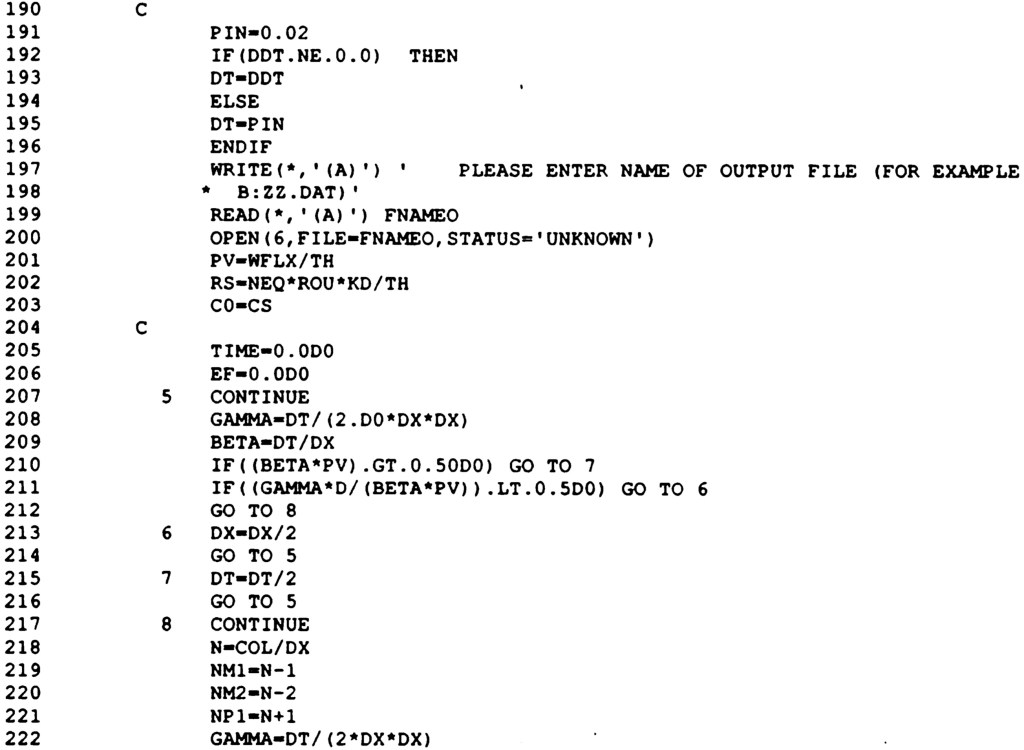
They handed me half-inch thick printout on 11×17 tractor feed printer paper filled with thousands of lines of Fortran code. It was my job to finish the coding, test it, and write it up. I worked alongside many group members who were level higher than me. I’m amazed I remember so many of their names: Joan Bazely, Pam Turner, Ted Ahern, George Askance, Joe Scholl, Gina Langlois, Lachsman Sinha, Eric Grimmelman. A few guys from Western Electric who knew a lot about equipment in the field were around the office a lot, too.

I had an office, a CRT terminal to work on, and shelves filled with IBM manuals. I would work on the code, test parts of it, and then have to go down to the computer room to pick up printouts of what I had worked on.

Once I had the program up and running, I wrote it up for internal publication and made a presentation to some who were higher up the organization who were preparing to go up against the justice department.

Our network model was a stepping stone for my next assignment. Now we began to look at how solar flares and electromagnetic pulses (EMP) would affect telecommunications. If an enemy detonated an EMP device over the United States, it could disrupt communication. But how much? And for how long? Some of this project must have had a connection with the Department of Defense, because I had to get top secret clearance. I felt pretty important for a moment, until I realized no one was going to tell me any secrets.

Anyway, to study this, we found a long distance cable between Aurora, IL and Clinton, IA that was perfectly east and west. I programmed an HP minicomputer in Basic that we installed in Aurora. The staff there would send us a cassette tape filled with data every week that we would analyze along with solar flare activity. I don’t remember what we learned from the whole effort, but it was a fun project to work on.

While I was working on those projects, I go to see other Bell Labs facilities in Holmdel and Murray Hill, both in New Jersey. Those are the places where engineers and scientists invented transistors and lasers, and developed digital communication. I also got to go the main switching office in Manhattan to see all kinds of different phone switches in action. For three years I was a beneficiary of the massive amount of money AT&T poured into it’s research arm. I met a lot of brilliant people and learned so much from them.

Posted in Life, memories

My other career: getting to Bell Labs

I was sitting eating supper with some of the men in my small group when Jim, across the table from me, asked, “You’re from south Florida, right?”

I chuckled, “Almost. Not south Florida. I grew up in south Philly.”

Knowing that I’m a retired pastor, he asked, “Did you serve a church in that area?”

“No, I left there after high school to go to college in Lancaster. Then I worked for Bell Labs in New Jersey for a few years before I found my way to the seminary.”

The mention of Bell Labs sparked interest at the table. “What did you do there?”

I explained, “I was a programmer, working with a bunch of people who were way smarter than me. Like the guy up the hall who developed digital voice communication for Apollo 8. I worked on some projects for the antitrust case against AT&T, and then some telephone network survivability studies.”

One of the guys asked, “Whatever happened to Bell Labs?”

“AT&T lost the antitrust case and had to spin off Western Electric, a bunch of Baby Bells, and Bell Labs, later renamed Lucent Technologies. But that was after I had left them for another job.”

That brief discussion brought back memories of my first career at Bell Labs after graduating from Franklin and Marshall College in 1979. At the time I did not realize how prestigious the labs were. I was an overconfident graduate from a small liberal arts college with a degree in math and experience in programming in an organization filled with geniuses.

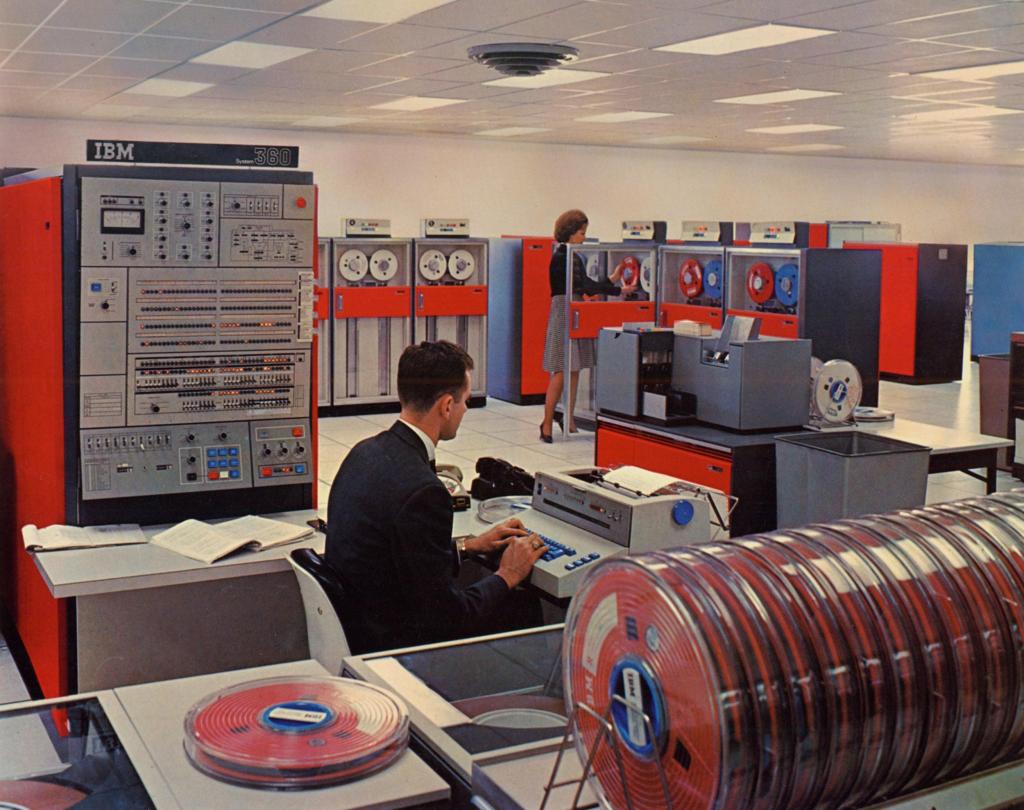
Keep in mind that programming in the early 80’s was Fortran, Cobol, and PL/1 on big old IBM 360s and 370s, with disk storage the size of forty-five pound barbell plates and long term tape drive memory. (IBM’s first desktop computers were released in August of 1981.) I could also program in Basic, which would come in handy a little later on.

My programming portfolio included compiling some survey data a friend of mine collected for the college radio station, some statistics for the basketball team, and some numerical analysis for some math classes. In retrospect, that doesn’t seem like much. But it was more than many of my classmates could do.

I only had to take three classes in the fall of 1978 to finish up my degree a semester early. I spent most of that fall applying for jobs. With just a manual typewriter, I cranked out dozens of cover letters to send out with my resume. I don’t remember how I found out where to apply for jobs. I must have found opportunities in math and science journals. I really swung for the fences, applying to Sandia Labs in Albuquerque, Lawrence Livermore in California, Bell Laboratories in New Jersey, New Jersey Bell, and a load of other places I can’t remember. I think I also sent away for master’s programs at universities all over the country. I had a pretty impressive collection of college catalogues. I had no idea how I would get there or pay for more education, but I would worry about that later.

I finished up my course work and moved back home in December of 1978. The next six weeks dragged on as I waited to hear from someone, anyone. Finally, at the end of January, I got a call from New Jersey Bell and Bell Labs in the same week, inviting me to come and interview.

My interview with New Jersey Bell came first. I drove up the NJ turnpike from south Philly to Newark. First, I took a test of general knowledge, simply math problems, vocabulary and grammar, and current events. After talking with a few people, I was taken to a room with about a dozen other interviewees to work on a test problem. The problem was a math and physics exercise about telephone poles and lines and cables. Wrote up my answer and headed home.

The Bell Labs interview was much different, lasting two days, talking to people from four different departments. They offered to put me up in a hotel in the area, but it was less than an hour away, so I elected to drive up each day. The first day of interviews was at the Holmdel, NJ location. It was impressive inside and out. I don’t remember much about the first day of interviews since I didn’t go to work at that location. The second day of interviews was in the Holmdel overflow location in West Long Branch, NJ.

I interviewed with two different groups in a department called Network Modeling. Just so you know, I had no idea what that meant. I interviewed with Gerd Printz and Ron Skoog, two group supervisors. They brought along Ted Ahern and Pam Turner, two of the group members I would be working with. I also talked with Bill Ross, the head of that department. As I sit here writing this, I am amazed that I remember these names from forty-four years ago!

Could I actually land a job there? I had no idea. But a couple of weeks later, a offer letter came in the mail and I had my first post-college job. I was on my way to Monmouth County New Jersey, my first apartment and life on my own.

Now that I’ve written this much, I think I’ll write about working at Bell Labs and leaving there in two subsequent parts.

Posted in Food

My newest hobby: sourdough bread

In 1981, my New York Times Book of the Month choice was James Beard’s Beard on Bread. It was my first step into making my own bread. My favorite recipe in the book was actually Kate Claiborne’s cornmeal pancakes. It’s a complicated recipe that I seldom make, but the pancakes are awesome so it still has a place in our recipe box. Of course, the author also inspired me to bake my first loaves of bread.

While I liked the idea of making bread, I don’t think I made a lot of loaves back then. After mixing the ingredients there’s a lot of time spent kneading, waiting for the dough to rise, more kneading, more waiting for another rise, before you finally put the bread into the oven. More time than I was willing to invest in a loaf that made the house smell great but wasn’t the best bread I’d ever eaten.

We had a bread machine for a while, and made some pretty good loaves in it. But the kneading cycle got a bit bumpy sometimes. We had to toss it when the machine vibrated itself off the kitchen counter.

In recent years, grains weren’t on the approved list for Whole30 and Paleo eating plans. We were also a fairly gluten-free home, so we didn’t eat much bread. Slowly but surely this past year, bread has returned to our table again. When I learned that it’s gut-healthy, I decided to try baking my own sourdough bread.

At first, I tried to bake some gluten-free sourdough loaves. Challenging, but not impossible. Following a little pamphlet of instructions, I mixed some rice flour with water and a special starter we purchased online. I assumed it was doing something as I added water and flour each day. When it was baking day, I followed the directions, put my ball of dough on a pan and covered it with aluminum foil. I got a loaf of bread. It smelled great and looked wonderful. It was just really hard to slice into. I have a really good bread knife, but the bottom of the loaf was so hard I’m not sure I could have cut it with my power mitre saw.

At this time, the Instagram algorithm started showing me sourdough recipes. I took a lot of notes from people willing to share their methods and secrets.

It turns out you can make your own starter with just flour and water. Distilled water. The chlorinated water from the tap hurts the fermentation. Using a mason jar from our cupboard, covered with a coffee filter and rubber band, I faithfully fed my starter each day, watching it bubble and double. In a week or so, it actually smelled like sourdough. Now I was getting somewhere.

I bought a cast iron dutch oven on eBay online for about $20. After watching a few more videos, I was ready to give it a try. Using a kitchen scale, I measured everything by weight. Mix up the dough (made with higher protein bread flour) and wait. Stretch and fold, and wait. Repeat. Repeat. Repeat. Put it in the refrigerator overnight. Grabbing the corners of the parchment paper, I lowered my ball of dough into the dutch oven, threw in a few ice cubes, covered it, and slid it into the oven. A little half an hour later, I had a nicely puffed up, brown loaf of sourdough bread. It tasted pretty good, even if it was denser than all the pictures I had seen.

I began varying my feeding schedule and amounts. I tried a few different recipes. Finally, I started getting some nice looking loaves. Puffed up just right, easy to slice, and delicious. What a feeling of satisfaction!

Once I got a few good loaves, I thought, “That wasn’t so hard.” I still eat some store bought bread, the kind made with lots of different grains. But it doesn’t taste the same. A thick slice of homemade sourdough with butter is the best. Pair it with some homemade soup, and it’s even better.

Now if you’ll excuse me, I have to go feed my starter. I’ve got some baking to do in a few days.

Posted in flash fiction

Just a box of ashes? Or something (someone) more?

Photo by Polina Tankilevitch on pexels.com

The attic stairs moaned like an old man getting out of bed in the morning as I pulled them down from the garage ceiling. As I ascended the stairs, I thought to myself, “I hope the light still works.” I found the cord and pulled. Suddenly, I could see to the far reaches beneath the roof. It was empty except for one box.

When we moved into the house, we made a pact. We will not fill the attic with stuff. We worked too hard to declutter our lives with this move. If there is no place for it in the house, we’ll sell it or donate it. But it will not find a place in our attic.

Unless we’re talking about Christmas. Five totes of decorations, one filled with nativities, Santas, snowmen, and themed-plates, plus a three-part Christmas tree had to go somewhere. April is a long way from the holidays, so all those things get a place in the attic.

As I surveyed the space, I was glad to see some plywood nailed across the the rafters. From experience, I knew it was way too easy to step through the ceiling.

I scrambled back down the stairs for the first tote. I pushed it up ahead of me and found a good place to start storing up Christmas. I grabbed the box left behind by the previous owners and headed back down for more.

The box was about eight inches per side, a cube that felt to be a little more than five pounds. What did they forget to take with them? What did they leave behind?

I was too curious to wait. I grabbed by knife and sliced through the packing tape. Pulling the box flap aside, I looked inside and saw a plastic bag secured by a twist tie. I untwisted the tie and looked inside, finding what looked like ashes.

Ashes. Uh-oh. I’ve held a box like this before. Someone once handed me a box like this in their backyard at a family memorial and said, “Do what you usually do.” At the time, I was a rookie pastor who had never held a box of remains. As we stood in the backyard, bordering a salt marsh, I said a quick prayer, opened up the box, and threw the contents up into the air, letting the wind carry them away. (Note: always make sure the wind is blowing away from you and the family’s home.)

Ashes. This was a box filled with someone’s remains. Grandma? Uncle Sid? The wife everyone thought ran away with the other guy? The family dog? Great-grandpa?

It was weird, but I had to make the phone call. “Hey, I found a box in the attic. When can I drop it off?”

It wasn’t theirs. They didn’t leave anything behind. They never went up into the attic. It must have been from a previous owner. “I’m sorry, I don’t know how to get in touch with them.”

Great. Here is a person, a life, a relative, reduced to a box of ashes. Doesn’t anyone miss this, I mean, them? Is this what we’ll all be someday, a box of ashes forgotten in an attic?

Maybe there’s something written on the box. A clue. A crematory? Funeral home?

Nada. Nothing. Not a clue as to who this was. I searched the internet. No obituaries, stories, or missing persons connected with this address.

It’s sobering to realize that this is how you’ll end up. A simple six or maybe seven pounds of ashes in a box in an attic. It’s a little depressing, too.

As I sat and pondered my discovery, something caught my eye. It was subtle, not gray. Something shiny? This is too weird. I ran my finger through the ashes and hit something hard. Bone? No. It’s…a ring. A gold ring. It’s large, like one that would fit a man’s finger.

Well, it’s not Grandma. Or Aunt Kate. Or the missing wife.

It was Uncle John. Great-grandpa Will. Someone with large fingers and strong hands.

Well, we’re not going to live here forever. I folded the flaps together and pushed the box to a far corner of the attic. When we move to another house, we’ll just leave it – or them – right here.

This is their home.