Sixth, seventh, or eighth on the bench? You’re not a starter. You can wait to sub in to show what you can do on the court.
A substitute teacher? That’s got to be one of the toughest jobs ever. It takes a special person to take on students you don’t know for little pay.
“Playing the part of…” The audience is disappointed that an understudy will be performing. The understudy is thrilled.
When the menu states, “No substitutions,” will you still ask for fruit instead of fries?
“Alexa, what can I substitute for buttermilk?” Answer: milk with vinegar; or sour cream.) Since we’re in the kitchen, you can also substitute granulated sugar and some molasses if you don’t have brown sugar for a recipe.
When God tells Abraham to sacrifice his only son Isaac, Abraham is confident that “God will provide for himself the lamb for a burnt offering”(Genesis 22:8). When “Abraham lifted up his eyes and looked, and behold, behind him was a ram, caught in a thicket by his horns. And Abraham went and took the ram and offered it up as a burnt offering instead of his son” (Genesis 22:13). Just as promised, God provided a substitute for his son.
That is faith. Abraham has confidence. His obedience demonstrates absolute trust. In this story, God paints a picture of who his son Jesus will be. He’ll be a substitute for us, suffering and dying in our place on the cross, suffering the punishment for sin.
Advent is about the coming of a substitute. You could shoot spitballs at him in an unruly classroom. You can cheer him on when he step onto the court. You can applaud when he finally has a chance to take the stage. You can thank God that there are substitutions in his kingdom. You can worship him as the one who stood in for you and took the wrath of God for your sin.
Two words to sum up the gospel? “Instead of.” Forgiveness instead of punishment. Life instead of death. Joy instead of sadness. Hope instead of despair. Light instead of darkness.
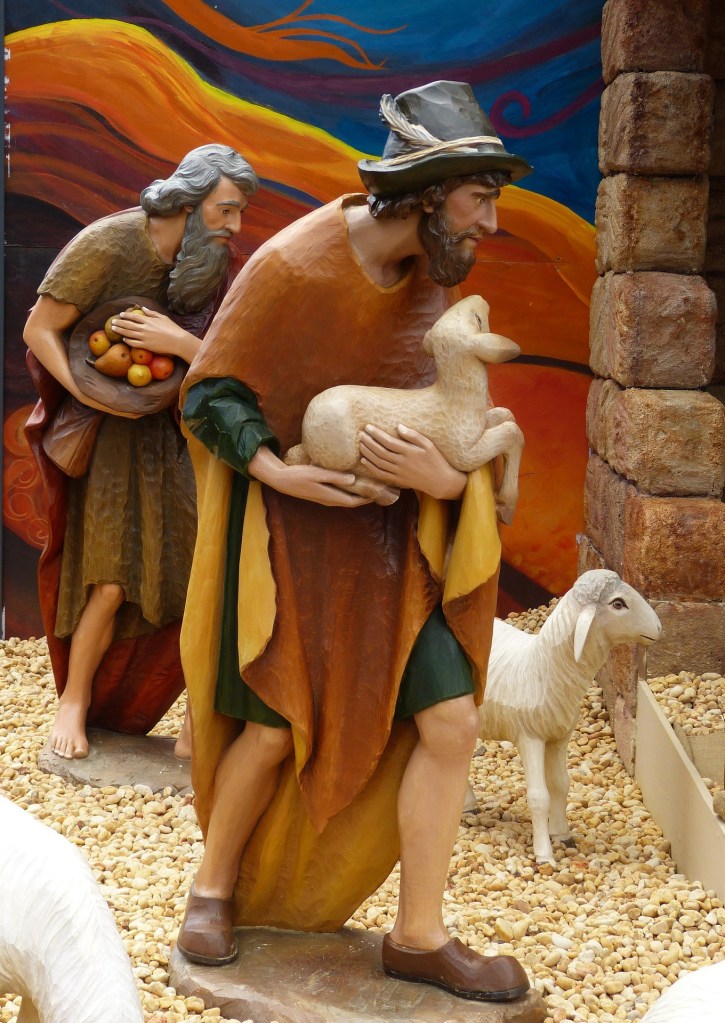
And a ram instead of Isaac. Another image of Jesus. Here’s one for the Jesse Tree:
Pretty soon you don’t enough space for everyone at the table. You don’t have enough chairs. You blinked, and the family got a lot bigger. It began with the two of us. We had three children. Now we have ten grandchildren. We don’t have everyone together very often, but when we do, it’s a houseful. That huge dining room table must have shrunk. There’s always more than one conversation going on at a time, filling the room with voices.
Now the Lord said to Abram, “I will make of you a great nation…and in you all the families of the earth shall be blessed” (Genesis 12:2-3).
It’s a powerful promise for a childless couple who have just moved into a new home. But you have to start somewhere, right? Plus, nothing is too hard for the Lord.
A little later, when Abram is wondering how God is going to do this, “[The Lord] brought him outside and said, “Look toward heaven, and number the stars, if you are able to number them.” Then he said to him, “So shall your offspring be” (Genesis 15:5).
Not only would Abram father a son named Isaac, but one of his descendants would be Jesus, who came to save his people from their sins. Jesus would be a blessing to all, for “everyone who calls on the name of the Lord shall be saved” (Acts 2:21).
More importantly, Jesus is a blessing to me. I am one of those innumerable stars Abram saw in the sky. So are you.
So we hang a tent on the Jesse Tree to remind us of Abram (aka Abraham), to whom God made a wonderful Advent promise.
I’m tempted to believe that the world is much worse than it has ever been. Just look around. War, communities in ruin from hurricanes and tornadoes, pandemics, contaminated food, and sex trafficking. I could list more, but it’s depressing.
If you think it’s bad now, the bible tells us about a much worse time in history. Just a few generations after Adam and Eve were expelled from the garden of Eden, “Every intention of the thoughts of [people’s] heart was only evil continually” (Genesis 6:5). In just a few pages, sin ran amok in God’s “very good” creation.
That reality doesn’t sit well with the Creator, who tells Noah to get to work on an ark because, “I will bring a flood of waters upon the earth to destroy all flesh in which is the breath of life under heaven. Everything that is on the earth shall die” (Genesis 6:17).
Advent is a sobering reminder that when God shows up, he’s not happy. He’s holy. We’re not. This is gonna be ugly.
Unless you’re on the ark.
On the ark, you’re safe from the flood.
On the ark, you float on the water. On the ark, you’ll survive. You’ll be tossed by the waves, heaving over the side of the boat, and have to take care of all those animals, but you’ll survive. You’ll live to tell about it.
Divine judgment is real. “We will all stand before God’s judgment seat” (Romans 14:10). “Each of us will give an account of ourselves to God” (Romans 14:12). And if you’re honest, it’s gonna be ugly.
Unless you’re on the ark.
Unless you find refuge in the arms of the one who comes to rescue you. “Who will rescue me from this body that is subject to death? Thanks be to God, who delivers me through Jesus Christ our Lord!” (Romans 7:24,25)
Jesus is your ark, a refuge from the judgment to come. Wrapped in his righteousness, you’re safe from the deluge of wrath. You’ll survive, forgiven and alive. (And he gives you animals to take care of, too!)
One of the most asked questions is, “Why doesn’t God do something about the evil in the world?”
It’s a great question. God is all powerful. He’s holy and cannot tolerate anything less.
And yet evil exists. It exists because his own created people decided to listen to someone other than him. Evil exists because the very people he created decided to disobey the one command he gave.
Isn’t it interesting that we will pray, “God, please fix this,” when we have made a big mess?
Well, God does something. Here’s what he says:
And I will put enmity between you and the woman, and between your offspring and hers; he will crush your head, and you will strike his heel.”(Genesis 3:15 NIV)
The first gospel promise in scripture comes on the heel of Adam and Eve’s disobedience in the garden of Eden. God speaks these words to the serpent who deceived Eve to eat from the tree of good and evil, the only tree in the garden that was off limits.
God could have been angry. God could have been furious. God could have been beside himself.
But God was slow to anger. God was rich in mercy. God abounded in steadfast love.
Enmity: they will know that you are an adversary. You are not looking out for their best interests. You are an enemy. Your are a liar. You are looking for someone to devour.
God doesn’t fool around. Even though the devil prowls around like a lion, the Lord is much more than a lion tamer. The devil might seem strong, but the Lord is going to more than tie him up and plunder his house. (Although he will do just that.) Jesus isn’t going to put the devil in his place with a commanding “Get behind me, Satan!”
Christ comes to crush the enemy. By the time Jesus is done, the adversary is going to look like the car crushed into a small cube of metal before being hauled off for scrap. The one who put enough pressure on carbon to make diamonds is going to put the squeeze on the devil. The pressure at the bottom of the deepest part of the ocean? That’s nothing compared to the weight of God’s boot on the neck of Satan. Messiah comes to crush the enemy.
We’ve got a few “rage rooms” in the area. A rage room is “a place for individuals and families to release stress and tension by breaking various items, from dishes and knickknacks to TVs and furniture.” Sweet. They provide you with bats, axes, and sledges so you can smash and scream to your heart’s delight accompanied by blaring music.
For a moment, the temple was Jesus’s rage room, when he cleared out the money changers. But that was just the coming attraction. Just wait till the Christ goes to town on the forces of evil!
There shall come forth a shoot from the stump of Jesse, and a branch from his roots shall bear fruit.
And the Spirit of the Lord shall rest upon him, the Spirit of wisdom and understanding, the Spirit of counsel and might, the Spirit of knowledge and the fear of the Lord. (Isaiah 11:1,2)
Where I live in Florida, winter means cooler temperatures, but certainly nothing like the cold I’ve experienced when I lived further north. The temperature might dip below freezing one or two days in January or February. When it does, all the leaves fall off my Hibiscus, Mandeville, and Bougainville plants.
That’s my cue to get to work. I cut everything down to the ground and fill up bags for the trash guys to haul away on Wednesday.
Within a week, though, small green shoots with leaves will begin to grow from the stumps I left behind. As the weather gets warmer those shoots will grow inches overnight until a new vine is reaching towards the sky. I gather the new vines and use some twine to keep them close to the backyard fence.
It’s not a wintry blast of cold air that freezes God’s people in the Old Testament. It’s the loving discipline of the Lord for his people who have forsaken him to worship idols. Foreign nations and kings destroy and disperse God’s people.
When God decided that someone with a heart like his needed to be on the throne of Israel, he chose David, the son of Jesse. Not only would David be king, but his descendants would always be king over God’s people.
But once a pagan ruler exiles the people to a pagan place far away from Jerusalem, there doesn’t seem to be much hope. All that’s left to hold onto is the promise that “a remnant will return (Isaiah 10:21). And “there shall come forth a shoot from the stump of Jesse,” a king descended from David infused with the Spirit of the Lord (Isaiah 11:1,2).
This is a messianic promise. That shoot would not be just any king. “The Lord God will give to him the throne of his father David, and he will reign over the house of Jacob forever, and of his kingdom there will be no end” (Luke 1:32,33).
That’s right, it’s not over till it’s over. God has the final word, and his word becomes flesh to rule and reign over his people. From that dead stump of disobedient and unfaithful people would come the one who would save his people from their sin, overcome death, and defeat the adversary, Satan.
When Jesus is born, a fresh green shoot starts to grow from the stump of Jesse, rooted in the promises of God. All that Jesus comes to be and do results in life, growth, and fruit. And guess what? By grace, you’ve been grafted into his family by faith. This isn’t just his story. It’s yours. You are part of God’s family.
In the song “Made for More,” Josh Baldwin sings, “I know who I am ’cause I know who You are.” Did you ever stop to think what a wonderful Christmas gift it is to know who you are? By grace you’ve been adopted into his family by faith.
If you’ve forgotten your identity, don’t just get out your wallet and look at your ID. Remember the shoot that comes forth from the stump of Jesse!
Since it’s December and Advent, I thought it would be fun to write some devotions for the season. Some decorate a Jesse Tree in the month leading up to Christmas, so I thought it would be interesting to write about the symbols that hang from its branches to remind us that Christ’s coming begins a long time before his birth in Bethlehem. In fact, we know that God had that day on his calendar before creation. “[God the Father] chose us in [Jesus Christ] before the foundation of the world, that we should be holy and blameless before him. In love he predestined us for adoption to himself as sons through Jesus Christ” (Ephesians 1:4,5).
When I searched online for a list of Jesse Tree symbols, I found many variations. These devotions are based on one list I found from Martin Luther College in New Ulm, Minnesota. You can find more here: mlc-wels.edu/publications/the-jesse-tree.
I really want to up my readership, so please share this post with anyone you think might be (or needs to be) blessed by some Advent devotions!
A bonus “Live and in person” Advent devotion for December 25, 2020. Read Luke 2:1-20 and Psalm 148
“But Mary treasured up all these things, pondering them in her heart” (Luke 2:19).
After the shepherds find Mary and Joseph the the baby lying the manger, they shared just why they were there. They had a quite the story to share about the angel’s announcement and the multitude of angels’ wonderful praises that night. Once they left, Mary had plenty of things to ponder. What a night!
We all have memories that we treasure. We store away special places we’ve been and people we’ve met. Photo albums and scrapbooks are filled with treasured moments from our lives. Certain songs or smells or sights bring those moments to mind as well. The music played at your wedding. The aroma of the cookies your mom always baked. The sight of an ornament that you’ve hung on your Christmas tree every year you’ve celebrated.
A ceramic nativity my wife made during her first pregnancy brings back the memories of our firstborn son. A set of nesting Santas we received as a gift in Des Moines brings back memories of playing “hide the baby Santa” with our children and grandchildren. Christmas poems I’ve written for my wife over the years remind us of what was going on at that time in our lives. And how we love to retell the stories – so many stories – of celebrations with our family in different places and in different ways.
I don’t know how often Mary talked about that night. After all, her pregnancy would have been a bit of a scandal. Her explanation a little fantastical for the average listener. At some point, she must have shared it with Luke, or someone Luke got to know. He wanted to be sure he got the story straight when he wrote his gospel about the Christ.
She would have a lot of time to reflect upon this night and what it really meant to be a servant of the Lord. She wouldn’t get much sleep until Jesus began sleeping through the night. She would have a lot of time to ponder while feeding him, rocking him and just simply watching him sleep. She had no idea what was coming. No parent does. Each day is a new page in the story of a baby’s life.
I hope you have a little time to ponder this Christmas. Hopefully, you’ve had some fun, joy and food with family and perhaps some good friends. But if you have a moment, just listen to your heart. What memories of the past are treasured up there? What questions about the future does it ask?
Chances are you’ve heard Luke’s account of Jesus’ birth within the past twenty-four hours. How did you feel as you heard those words? Tuck them away in your heart, think about them often, marvel at this good news of great joy that will be for all the people, and hum whatever carol comes to mind.
Thank you, Lord, for the many memories we store up in our hearts that always bring us back to the good news of Christmas. Amen.
“Live and in person” Advent devotion for December 24, 2020. Read Luke 2:8-20 and Psalm 23.
And when [the shepherds] saw it, they made known the saying that had been told them concerning this child. And all who heard it wondered at what the shepherds told them.
And the shepherds returned, glorifying and praising God for all they had heard and seen, as it had been told them. (Luke 2:17-18, 20)
Who doesn’t love to tell the Christmas story? With little nativity figures in hand we act out the story to our children. We teach them to act it out in Sunday School programs. We sing about it in choir cantatas. We make movies about it. We love to hear Linus recite the story in A Charlie Brown Christmas. It just never gets old.
After seeing and hearing the angel, and after seeing Mary and Joseph and the baby lying in a manger, the shepherds had a story to tell. And everyone was in wonder when they talked about what happened that night in Bethlehem. I’ll bet it never got old for them, either!
Luke tells us that all who heard it wondered about the shepherd’s story. Did people believe them? Or were they amazed at such a contrived story? It does seem rather fantastical.
But on the other hand, as I mentioned in a previous devotion, Luke took great pains to compile his gospel. He wanted to get the facts straight, so that Theophilus could know for sure about the Christ (Luke 1:3-4). I wonder if he somehow he found and talked to those shepherds. Wouldn’t that have been a great interview? I’d have so many questions. What time of night was it? How bright were the angels? Exactly where did you find the manger and the baby? What were Mary and Joseph like? I could go on and on.
Families accumulate so many stories about Christmas. We love to talk about trips to celebrate Christmas with family. We love to talk about traditions that have been handed down from one generation to another. We fondly remember giving and receiving certain gifts (some good, some bad!) We talk about putting toys together late at night and children waking up way too early in the morning. We recall both blizzards and balmy Christmases.
On Christmas Eve, I get to stand in the center of the congregation and read about Christ’s birth, the appearance of the angels and the reports of the shepherds. I have the honor of reading the one account everyone has come to hear and no one ever gets tired of hearing. I believe there is just as much wonder in that moment as there was when the shepherds let everyone know about their night!
Thank you, Lord, for such a compelling account of your birth! Amen.
“Live and in person” Advent devotion for December 23, 2020. Read Luke 2:10-14 and Psalm 9.
And this will be a sign for you: you will find a baby wrapped in swaddling cloths and lying in a manger.” And suddenly there was with the angel a multitude of the heavenly host praising God and saying,
“Glory to God in the highest, and on earth peace among those with whom he is pleased!” (Luke 2:12-14)
When Isaiah had his vision of the Lord in his throne room, there were angels flying around, praising him. When John has his visions in Revelation, there are myriads of angels around the throne, praising the Lamb (Rev. 5:11,12). After Jesus was tempted in the wilderness, angels were there to minister to him (Mark 1:12). When the mob came to arrest Jesus in the Garden of Gethsemane, he told them he could easily summon twelve legions of angels to help him (Matthew 26:53). In fact, there was one there in the garden to strengthen him through his agonizing prayers (Luke 22:43). So it makes perfect sense for angels to show up when Mary gives birth to her firstborn in Bethlehem and laid him in a manger. Of course they were there. The angels are part of Jesus’ entourage or security detail. They might not always be in sight. But that night they were, and their praise was in high gear!
I wonder what these angels thought of this event. Suddenly, they’re assigned to an infant. Their praises are not heard in a sold-out concert hall, but by a few shepherds out in the Bethlehem hills. Even in this humble setting, he is still the Lord and worthy of their praise.
The angels next big assignment would be at the tomb where the stone has been rolled away and a few friends of Jesus discover that he has been raised from the dead. That’s right, they pretty much only show up for Christmas and Easter! But they always come with big news: the Savior has come and the Savior is back!
Every once in a while, people catch a glimpse of an angel or hear their voice. Their stories are always powerful. They are ministering spirits sent out to serve for the sake of those who are to inherit salvation (Hebrews 1:14). The angels are never that far away. But that reminds us that our Lord is never far away, either!
We hear the Christmas angels, The great glad tidings tell. O come to us, abide with us, Our Lord Emmanuel.
Thank you, Lord, for the angels, who lead us in praising you for your birth, your resurrection and your return. Amen.
“Live and in person” Advent devotion for December 22, 2020. Read Matthew 1:18-25 and Psalm 116.
“When Joseph woke from sleep, he did as the angel of the Lord commanded him: he took his wife, but knew her not until she had given birth to a son. And he called his name Jesus.” (Matthew 1:24-25)
I’m sure Joseph never imagined his life would take a turn in this direction. An angel in a dream? A pregnant fiancee (and it’s not your baby!)? Marry that woman and trust that God has a hand in this? Raise a child spoken of in prophecy? Suddenly, you have a part to play in God’s plan of salvation for the world. I imagine it would be a bit overwhelming.
The part of Joseph isn’t much in a typical Christmas play. He’s not much compared to angels, shepherds, or even the innkeeper (who isn’t even in the biblical account of Jesus’ birth!). He’s an innocent bystander. Collateral damage. A descendant of David, and therefore the connection with Bethlehem.
But Joseph is the one who has the dreams. He’s the one who hears from the Lord. He’s the one who shuttles the Christ around in accordance with the prophecies. He’s the “carpenter” associated with Jesus. He’s the one who will fade into the sunset by the time Jesus begins his public ministry. After he and Mary find Jesus in the temple at age twelve, we never hear from him again.
But he makes into the pages of scripture. Luke tells us that he carefully compiled his account of Jesus’ life. Do you think he talked to Joseph?
I think that would have been a great conversation. “You heard from God in a dream? What was that like?” “How did you feel when you learned that Mary was pregnant?” “What was it like being the dad of the Messiah?” It would be amazing to spend a day with Joseph!
No one plays a minor part in God’s plan. Each of us is an important brick in the temple built upon the prophets and apostles, with Christ as the cornerstone, where God dwells in His spirit (Eph. 2:19-22).
Joseph got to teach Jesus how to work with wood. I loved learning a craft from my father. I loved teaching my children, too. I’ll bet he loved every minute he got to spend with his son! And I’ll bet his son loved every minute he got to spend with his dad. Parents: never forget how much your kids love spending time with you!
Heavenly Father, thank you for sending your son to spend time with me. Amen.














 Waite for it...