Posted in Through the Bible Devotions

Will this be on the test?

Then the Lord said to Moses, “I will rain down bread from heaven for you. The people are to go out each day and gather enough for that day. In this way I will test them and see whether they will follow my instructions. On the sixth day they are to prepare what they bring in, and that is to be twice as much as they gather on the other days.” (Exodus 16:4-5)

A teacher can’t test on everything that’s in the book. No test will cover everything in the lecture. With that truth in mind, students ask, “Will this be on the test?”

I’ve watched classmates attempt to write down everything spoken in a lecture. I’ve seen highlighter stain every line of a textbook page. How is that helpful? Is everything important? Will everything be on the test?

God tests his people. Will they trust him? Will they follow his instructions? God’s faithful provision is on the test. Did you write that blessing down? Did you highlight that abundance?

Will that moment be on the test?

Whenever you feel like grumbling, it’s a test. Whenever you want to have a heart-to-heart with God, it’s a test. When you desire a come-to-Jesus moment with Jesus, it’s a test.

Is he faithful? Do you trust him? Can you lean on him? Is he dependable?

Those are the test questions. It’s not about what you know about God. It’s not about your performance. It’s not about your potential.

It’s just one question.

Do you trust him?

Posted in Through the Bible Devotions

God is good

Photo by Jon Tyson on Unsplash

“God is good all the time, and all the time God is good.”

I don’t hear it as much as I used to, but it’s still pops up here and there.

It’s a truth right from the pages of scripture:

  • “For the Lord is good and his love endures forever.” (Ps. 100:5)
  • “Taste and see that the Lord is good.” (Ps. 34:8)
  • “Oh, give thanks to the Lord, for he is good; for his steadfast love endures forever.” (1 Chronicles 16:34)

There’s plenty more where that came from.

But here’s my question. What does it mean that God is good? Ever ponder that? Ever doubt that statement? What’s so good about God. And if God is good, what difference does that make? How does that statement affect the way I view the world and people around me?

If something or someone is good, that means it’s not bad, right? That’s not much of a definition. Dictionaries offer up “of a favorable character or tendency.”

But that makes goodness subjective. Food tastes good. A tennis serve that is inside the line is good. A dog who sits on command is good. Someone who stays fit is in good shape. Someone who is happy is in a good mood. In stores you still see products rated good, better, and best, depending on how much money you want to spend. In that case, good isn’t all that great.

God’s goodness isn’t based on his performance or my opinion of him. It’s one of his attributes, just like all-powerful, all-knowing, eternal, and merciful.

God’s goodness doesn’t vary. He is still good whether you’ve had a good day or a bad day. It’s doesn’t matter if you feel good or not, he’s still good. If bad things happen, he’s still good. If you really mess up, nothing has changed. He’s still good.

In what ways do I experience the goodness of God? When do I catch a glimpse of his goodness?

A good place to start might be John 10. While there are those people and things that kill, steal, and destroy life, the good shepherd comes to give life (John 10:9,10). If sin, which we know is bad, takes life away, whatever gives life, brings us to life, and preserves life must be from God. It’s not a perfect explanation, but it’s a good place to start.

Being disciplined, learning hard lessons, and having to confess that we’re wrong never feels good. But they’re all expressions of our Father’s love for us. That’s good. Blessings that go beyond what we ask or imagine are good too. A day when nothing eventful happens might be good when the previous nine days were stressful.

How did God reveal his goodness today?

Posted in Through the Bible Devotions

An unusual classroom

Photo by Sam Balye on Unsplash

Some time later God tested Abraham. He said to him, “Abraham!”

“Here I am,” he replied.

Then God said, “Take your son, your only son, whom you love—Isaac—and go to the region of Moriah. Sacrifice him there as a burnt offering on a mountain I will show you.” (Genesis 22:1-2)

No matter how many times I read this passage of scripture, I come away with questions. How could God ask Abraham to do something like this? How could Abraham even consider going through with it? What did Isaac think about this moment?

From our point of view, little about this makes sense. But I could look at it from a different perspective. What does God reveal about himself in Genesis 22? What do I learn about God?

God does not want human sacrifice. Other Canaanite religions sacrificed their children as a way of appeasing their gods. God is not like those gods. His love does not come in response to anything we do or not do. His love is who he is.

God does provide the substitute sacrifice, just as Abraham knew he would (22:8). A ram is the substitute for Isaac. Ultimately, God provided his own son as a substitute, atoning sacrifice for us. How could he do that? We are that important, that valuable to him.

God had promised Abraham that Isaac would be his heir, the beginnings of a great nation. God keeps his promises. He is faithful. I can trust him.

It takes a long time to learn obedience. It took Abraham twenty-five years to get to this point, where he knows, trusts, and obeys God. It’s a process. It takes time.

We’ll never understand everything about God. He is far beyond our comprehension. But he has revealed a lot about himself in creation and in the bible. That I can understand.

Posted in Through the Bible Devotions

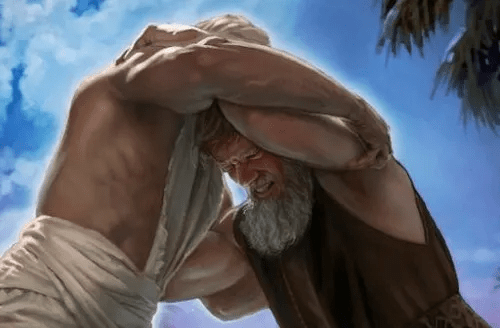
A relentlessly faithful God

On his way back to back to his homeland and family, Jacob encounters a camp of angels. But even with the backup of a heavenly army, Jacob is afraid of his brother Esau’s approaching force of 400 men.

Jacob starts planning for the encounter, preparing gifts, dividing his family into two groups, and praying. That’s right, Jacob prayed. At least he’s learned something these past twenty years working for his uncle Laban.

George Mueller wrote, “The most important part of prayer is the fifteen minutes after ‘Amen.'” What you do next speaks volumes about you and who you trust. Jacob is thankful for God’s provision, recalls God’s promises, and asks for his protection. So far so good. But the next day, he continues lining up gifts to pacify his brother.

That night, Jacob wrestles all night with God (Genesis 32:24). He’s determined to get a blessing from him. Really? Jacob is on his way home with wives, children, servants and livestock. God has shown him kindness and faithfulness, given him the covenant promises, and dispatched the angel army to protect him. How much blessing will it take to get through to you, Jacob?

The world has taught us not to trust anyone. Anyone. I know most of our email, texts, and phone calls are scams. Stories and images are AI generated. Marketers manipulate me to like, desire, and buy things I don’t need or even really want. I understand completely why Jacob is cautious and has a backup plan.

However, God is relentless. He tirelessly shows us that we can trust him. He displays his faithfulness by fulfilling promise after promise. If there is anyone we can trust, it’s the Lord.

It just takes me people like me and Jacob (and probably you, the reader) a long time to take that truth to heart.

Posted in Through the Bible Devotions

What a ridiculous prayer

Photo by Jack Sharp on Unsplash

How bold are my prayers? Do I pray for what I think God would be willing to give? Or do I go out on a limb with a ridiculous prayer for grace and mercy? Will I go to bat for someone undeserving of anything but his wrath? Am I willing to ask for something I don’t — and never could — deserve?

Abraham prays with boldness and humility in Genesis 18.

Then Abraham spoke up again: “Now that I have been so bold as to speak to the Lord, though I am nothing but dust and ashes, what if the number of the righteous is five less than fifty? Will you destroy the whole city for lack of five people?” (Genesis 18:27,28)

From a place of extreme humility, Abraham isn’t shy about challenging God’s plan to destroy the wicked cities of Sodom and Gomorrah. His bold prayer originates from the dust and ashes of someone just as sinful, just as deserving of God’s wrath. He is not afraid to confront God, negotiate with God, and call God out on matters of justice.

“Maybe there are a few good people there.” Sure, keep dreaming Abraham. I know you care about your nephew Lot. He chose to live in Sin City, remember? His wife will look back and be turned into a pillar of salt. His daughters will use him to bear children who will torment God’s people for generations to come.

50? 45? 30? 20? 10 righteous people? If you can find that many, God will step back. He doesn’t. There wasn’t. God’s judgment is perfect, just, righteous, and appropriate. He knows what’s going on. He knows what he’s doing.

Abraham’s humble yet bold prayers remind me of something Paul wrote in Romans 8:34. There we read that Christ “is at the right hand of God and is also interceding for us.” The one who humbled himself and became a servant boldly goes to bat for us, as deserving of God’s wrath as any sinner in scripture. Forget about fifty righteous or even ten. “There is no one righteous, not even one” (Romans 3:10). We’re only spared because he took the full wrath of God on our behalf, “wounded for our transgressions and crushed for our iniquities” (Isaiah 53:5).

Both Abraham and Christ remind me that humility and boldness in prayer go hand in hand.

Posted in Through the Bible Devotions

Familiar lyrics

Where did you come from, where did you go?
Where did you come from, Cotton-Eye Joe?

If you’ve been to a wedding reception lately, you’ve heard and possibly danced to “Cotton Eye Joe,” along with “Shake It Off,” “Sweet Caroline,” “Boot Scootin’ Boogie,” and “Cuban Shuffle.”

But did you know these lyrics came from the bible?

“The angel of the Lord found Hagar near a spring in the desert; it was the spring that is beside the road to Shur. And he said, ‘Hagar, slave of Sarai, where have you come from, and where are you going?'” (Genesis 16:7,8)

Hagar gets caught in the middle. She’s a maidservant Sarah picked up in Egypt. It was her idea for Abraham to have a child with Hagar since Sarah wasn’t able to have children (so far). Abraham goes along, Hagar has a son they name Ishmael. The two women end up despising each other, so Hagar runs away to escape the abuse.

That’s when she encounters God. He asks, “Where did you come from, and where are you going?”

Hagar knows where’s she from. She’s running away. Where is she going? God only knows.

And that’s the key. God says, “Go back home. It won’t be easy, but you’re going to have a lot of descendants, more than you can count.” God knows exactly where this is headed. He sees her and he sees her future.

He sees our future, too. No matter where we’ve been, our future is in his hands. Those are good hands. Strong hands. Gracious hands. Reassuring hands.

It’s okay to take a look back, to see how far you’ve come. God helps us catch a glimpse of where we headed. We can trust him to take us places we could never go ourselves.

Posted in Through the Bible Devotions

Ask hard questions

Photo by Brett Jordan on Unsplash

God took Abram outside and said, “Look up at the sky and count the stars—if indeed you can count them.” Then he said to him, “So shall your offspring be.”

Abram believed the Lord, and he credited it to him as righteousness.

He also said to him, “I am the Lord, who brought you out of Ur of the Chaldeans to give you this land to take possession of it.”

But Abram said, “Sovereign Lord, how can I know that I will gain possession of it?” (Genesis 15:5-8)


So one moment Abram takes God at his word. But the next, he’s got a question: “How can I be sure?”

I think it’s interesting that faith and doubt go hand in hand. Faith doesn’t always displace doubt. Zechariah wanted assurance that an old man could still have a son (Luke 1). Gideon wanted some fleece signs (Judges 6). The apostle Thomas wanted to see the resurrected Christ with his own eyes (John 20). Mary wondered, “How can this be, since I am a virgin” (Luke 1)?

Well, that’s a relief. My questions don’t negate my faith. I can still ask God, “Are you sure?” “How are you going to do that?” “Are you serious?” “You want me to do what?”

Actually, doubts and questions are a wonderful sign of faith. You know God loves you so much you can ask him anything. Anything. He knows. He knows you have questions. He knows you have doubts. He knows his commands and promises are out there. Way out there. He knows it’s not going to be easy to trust him. It doesn’t bother him at all.

Just trust him enough to ask. He wants to hear from you. He wants to hear your questions. He wants to walk with you through your doubts.

Do you trust God enough to ask him hard questions?

After teaching a class, I usually ask, “Any questions?” If there’s silence, I wonder, “Was anyone listening?” I’m not the greatest teacher. And you’re all not ideal students.

Humor me. Just ask.

Posted in Through the Bible Devotions

A faith journey

I was today years old when I learned some things about Abram I had never thought about before (from Genesis 12).

  • When the Lord said to Abram, “Leave your country…and go to the land I will show you,” it wasn’t the first time he spoke those words. According to Acts 7:2-4, God gave him those instructions when he was in Mesopotamia. In Genesis 11:31, the family only made it to Haran. The Lord gives them another nudge, and they finally settle in Canaan (12:5). I wonder why they didn’t go the whole way the first time?
  • The Lord said, “Leave…your people” (12:1). Abram mostly did, but took his nephew Lot with him (12:4). Lot would trouble later when Abram had to give him part of the land (13:5-9), and later when Abram had to rescue him from captors (14:16). Maybe he should have left him home.
  • Then, when there’s a famine, Abram goes to Egypt to find food. While there, Sarai acquires an Egyptian maidservant named Hagar, whom she would hate when Abram fathers a child with her (16:1). Maybe they should have trusted God to provide for them in Canaan.

Even though childless, Abram believed God’s promise to make him the father of a great nation. He’s the poster child of faith: “Abram believed the Lord, and he credited it to him as righteousness” (15:6). But rather than a heroic faith, Abram had a growing faith. Abram made some questionable choices, but always circled back to square one, built an altar, and called on the name of the Lord (12:8; 13:18). His actions had consequences, but nothing can derail God’s plans. And along the way, Abram learned how to trust God.

Posted in Through the Bible Devotions

Never again

Photo by Elly Johnson on Unsplash

“Then Noah built an altar to the Lord and, taking some of all the clean animals and clean birds, he sacrificed burnt offerings on it. The Lord smelled the pleasing aroma and said in his heart: ‘Never again will I curse the ground because of humans, even though every inclination of the human heart is evil from childhood. And never again will I destroy all living creatures, as I have done'” (Genesis 8:20,21).

The flood is over. The ark has come to rest. Noah, his family, and all the animals have disembarked. It’s time to start over. Noah begins with a sacrifice to the Lord, who is pleased with the aroma. No matter how evil humans and their hearts are, the Lord decides this will never happen again. No more curses. No more destruction. No more floods (Genesis 9:11).

At first glance, that might seem like Noah certainly came through with that act of worship. A sacrifice that pleases the Lord is a big deal. It changes the whole trajectory of history from that moment on.

All of that is true. But don’t overlook the awesome underlying Messianic truth here. Every Old Testament sacrifice points to the sacrifice Jesus made for us on the cross. His once for all suffering and death on the cross means a way out of the curse, judgment, and destruction sin and evil demands. Never again will God unleash such devastation on the earth because he unloaded it all on his own son.

Remember what God said at Jesus’s baptism and transfiguration? “This is my Son, whom I love; with him I am well pleased” (Matthew 3:17; 17:5). A pleasing, all sufficient, once-for-all sacrifice that means we’ll never again have to worry about that flood of God’s wrath.