Posted in creativity, writing

Finding Inspiration: Tips for Getting Your Creative Juices Flowing

As I sit down to write today, I see I have posted nearly 1,200 times on this blog, dating back to October 2008. I have a few more saved in some Word files that I had previously posted on another platform. I have written about ministry, family, travel, projects, and various things that have either made me laugh or groan. I have published some of my devotions here, a few sermons, and some memorable pictures.

I started investing more time in writing to become a better storyteller. Our minds are wired for story, and that’s what we remember best. Adding a layer of story to ordinary moments can transform them into something amazing. Not only can I share the moments with others, but it etches them into my soul. It’s a win-win.

It’s not easy to do. At least not day after day. So what revs up and maintains my creative juices? What tools or tricks do I use to come up with topics or issues to write about?

Pictures

I love to start with a picture. It might be a photo I’ve taken of something that caught my eye. It could be a piece of art from a gallery or from a grandchild. The visual sparks my imagination as I imagine the story behind an object, person, or place. I try to make sure I take a few pictures every day, knowing that one day they’ll be a springboard for a story.

Experiences

I’ve written a lot of stories about my experiences. That’s why I keep a daily journal, recapping the events of my day. I keep track of where I’ve gone, who I’ve talked to, what I’ve purchased, projects I’ve completed, what I’ve cooked and eaten, and especially what made me laugh. Sometimes I reach way back into my life to write about memories of school, family, and friends.

Music

Music helps. I am definitely a left-brained analytical thinker. Logic comes easy. Stories are a challenge. But playing music engages the right side of my brain and can shift me into storytelling mode. If I just can’t figure out what to write, I’ll grab my guitar or sit down with my trumpet and let music open up my imagination. It always works.

Gratitude

Gratitude stimulates creativity. Pause a moment to be thankful for anything and everything you have, the people around you, and the creation in which you live. Suddenly, the stories all around you jump out and beg to be told.

Scripture

For devotional writing, I always begin with a bible passage. The living and active word of God reveals how he is involved in the story of my life. His words transport me way back in time, then into the future, and then finally shape my life in the here and now.

Reading

I’m trying to read more now in retirement. When an idea or phrase catches my attention, I jot it down for later reference. I sometimes come up with story ideas that way.

Artificial Intelligence

I haven’t done a whole lot with it yet, but I can see AI being a tool to help me when I’m having trouble figuring out what to write about. It’s easy to ask ChatGPT for ideas and end up with more than you need. It’s new, and it’s a little intimidating, but it’s an interesting resource. I’ve found it very helpful for generating titles that get more attention.

Some days it comes easy. Some days it’s a real struggle. But it’s a process I enjoy and hope to continue.
Posted in writing

New journal day!

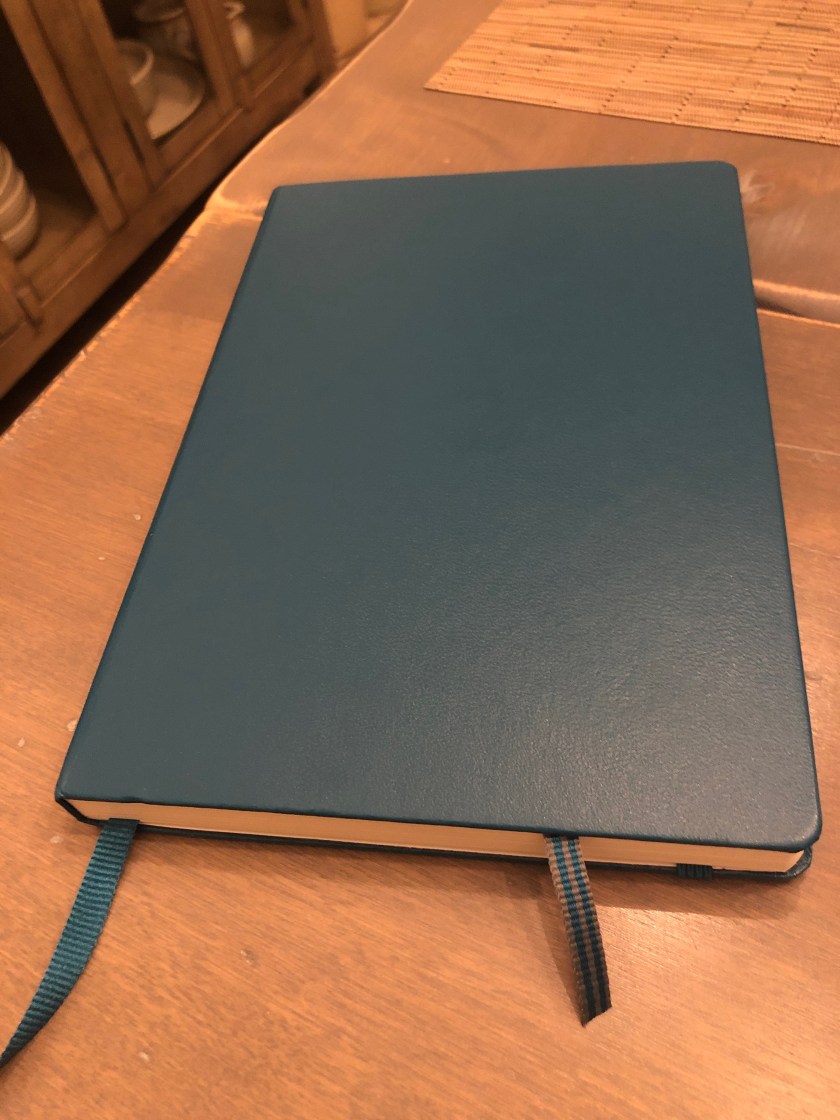
My newest Leuichtturm 1917 notebook

Somewhere in the back of my mind I remember my mom telling me how much she enjoyed opening up and writing in a new notebook, journal or even just a pad of paper. She loved the feel of the untouched pages, the blank sheets and the unlimited possibilities. She must have passed that love down to me. I love new notebook day!

Yesterday was new journal day for me. As I do every three months or so, I started writing on page one of a new Leuchtturm 1917 notebook. This one is dotted. I have used blank and lined journals before, but I find that dotted gives me the most flexibility.

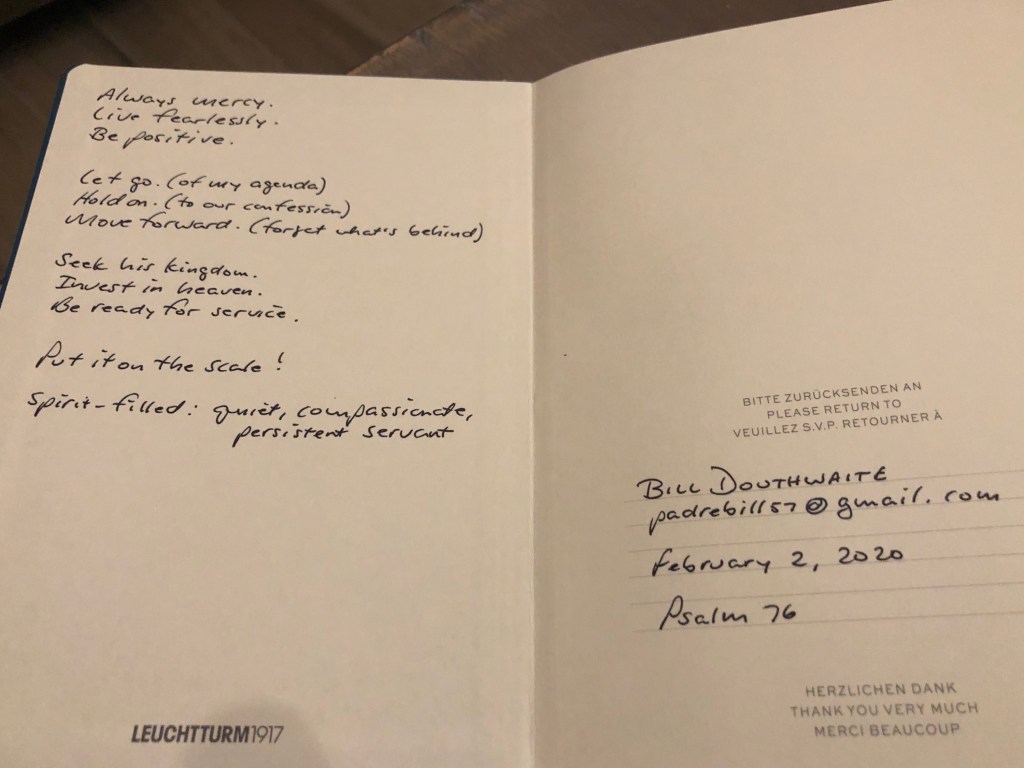
Inside the front cover of my journal

I set up my journal by writing my “mantras” in the front cover. My mantras are little pithy phrases that guide my life. I also record the beginning date and the starting scripture. You see, I record my thoughts here as I read cover-to-cover through the bible. So each volume covers a portion of the word as well as my experiences and thoughts along the way.

I set up the pages from the back with my prayer list. This is where I keep track, so I don’t miss any of the ways God has answered my prayers.

A journal is a place to explore ideas, record my days, track some prayers and remember my blessings. I don’t worry about being legible. After all, I’m the one who reads the daily entries. But this record of my days and interactions, as well as research and ideas, will probably outlive me.

I wonder who else will ever sit down to read through my journals?

Posted in advent, Devotions, writing

What I learned writing Advent devotions

This past season of Advent, I wrote daily devotions which I sent to anyone interested in receiving them. I had about twenty-five folks subscribe, so I was committed to twenty-four devotions, beginning December 1. I chose a selection of bible passages that mentioned darkness and light as the calendar moved us slowly but surely to the winter solstice. The increasing darkness each day was a perfect backdrop for the coming of light, fuel for both physical and spiritual insights. Here are a few things I learned writing this collection of devotions.

  • From the beginning to the end, there are a lot of verses in the bible that mention dark and light. While darkness is used to describe sin, wickedness and death, light brings hope, righteousness and life.
  • Writing daily devotions is hard work. Especially when you’re working from a theme. (I wrote devotions last Lent, too, but used two chapters of a gospel.) Even though each was only three- to five-hundred words, I often struggled to find meaning or application for the passages. This is actually a good thing. It made me stop and think, dig a little deeper, and find personal application. Each one had an important lesson for me.
  • I didn’t get much feedback. Maybe that’s a good thing. My writing could probably use some work. Anyway, you never know who is or who isn’t reading your work. Apart from a few, “I’m really enjoying your devotions,” I didn’t get many comments at all.
  • When you are writing every day, you develop a rhythm. You get into a groove. The more you write, the easier it is to write. I am sure the daily routine improved my writing. It is a good discipline to commit to.
  • I think I wrote more for myself than for others. I wanted to show myself that I could do it. I felt the need to create rather than just consume ideas and insights.

I’m not sure if I’ll do this again. I felt like I could only write once a day, so I put my blog on hold. It took time, maybe ninety minutes or so every day. That’s a lot of time to devote.

But I probably will.

Posted in Devotions, writing

Five things I learned writing daily Lent devotions

glenn-carstens-peters-203007-unsplash
Photo by Glenn Carstens-Peters on Unsplash

A week before Ash Wednesday (February 14 this year), I cast a line via my weekly email into the congregation announcing that I would be writing daily devotions on Mark’s version of the passion of our Lord during the forty-six days of Lent (I included the Sundays). About twenty replied and received a daily early-morning email devotion. This was a new project for me, and here’s what I learned from the experience. Continue reading “Five things I learned writing daily Lent devotions”

Posted in writing

A handwritten letter

aaron-burden-64849
Photo by Aaron Burden on Unsplash

Over the past week, I sat down and wrote and mailed two letters to a couple of men from our congregation who recently moved away from our area. They were both long-time members of our church, amazing supporters and unforgettable friends. Both had reached the point where they could no longer live alone. They moved to a place where they would receive good care for the remainder of their lives.

I hope you caught my nuance in the first sentence of this post. I didn’t call, text or email. I wrote a letter with a fountain pen and stationery, put it in an envelope, addressed it, put a stamp on the envelope and mailed it. I felt that these relationships were worth a unique form of communication. At least in this digital age.

As I wrote each letter, I wondered, “What is it that makes a letter so different, so meaningful than other media?” A few weeks ago I got a little thank you note from a member I visited, thanking me for the visit. I felt a rush of adrenaline. It was so cool. The note was three simple sentences, yet it touched me.

It got me thinking, “What makes a letter so appealing? Why does it make such an impact?” Here are a few thoughts:

It is sensory. You open an envelope. You hold a piece of paper, perhaps unfolding it, feeling its texture. Our sense of touch amplifies what we see. It’s more than just words or thoughts, but a feeling.

It lingers. We can go back and read it again and again. Yes, you can reread emails and texts, but you may not. They soon get lost in a sea of other communication. But a letter in an opened envelope invites you to look at it again and again. I noticed that when my dad opened a birthday card from my cousin last spring. She had written on the inside and the back. He read it through three times. The next time I sent him a card, I wrote as much as I could about what was going on in our lives. His memory may not be great, but I know that he will read it again and again.

It is personal. A part of the person is in the handwritten word. Every communication in Times New Roman looks the same. But handwriting is unique to an individual. It may not be legible or it may be perfectly elegant, but it is like a fingerprint. No one else writes like that. Some claim you can tell much about a person from their handwriting. They are probably right.

It takes time. It takes more time to write a letter. Without the convenience of backspacing, I took a little more time to compose my thoughts before committing them to paper. I can type much faster than I can write with a pen. Slowing down allows my brain to pick from a larger vocabulary.

It’s an art. With a pen in hand, my creative left brain engages in the writing process. As a result, emotion joins information on the page. Words emerge from shapes and shades and spaces, touching both the heart and mind of the reader.

What do you think? Let me know. Who knows, I might write you a letter.