I can’t remember the last I ate it, but Hamburger Helper transports me to my childhood.
General Mills introduced Hamburger Helper in 1971, and our family was immediately on board. I was in middle school that year, and my younger sister and brother were both in elementary school. We were all old enough for my mom, a nurse, to go back to work on weekends. That meant Dad was in charge of making supper.
It’s not that Dad was a bad cook. He just had a limited repertoire.
Beef Noodle Hamburger Helper
Potato Stroganoff Hamburger Helper
Cheeseburger Macaroni Hamburger Helper
Hash Hamburger Helper
Chili Tomato Hamburger Helper
Rice Oriental Hamburger Helper
From time to time, there was no Hamburger Helper in the pantry. No problem. Dad browned hamburger, mixed it with brown gravy made from a packet of gravy mix, and serve it over reconstituted freeze-dried mashed potatoes.
Plus, it was cheap. The original price of a box of Hamburger Helper was 65 cents. A pound of hamburger was about the same. Feed the family for $1.30? Nice.
We did try Tuna Helper. It was the same concept, substituting a can of tuna for the pound of hamburger. We only tried it once.
Not only is Hamburger Helper the food that instantly transports me to my childhood, but it is the top memory I have of my Dad.
“Hamburger Helper helps her hamburger help her make a great meal!”
I decided to wear my navy blazer on the plane rather than packing it. I knew that I would one day be making this trip up to dad’s. It was time to move him out of the house he had lived in for the last forty-eight years.
How do you do that? How do you convince your ninety-year-old father that he can’t take care of the house all by himself? How do you say he shouldn’t be living alone? How do you get him to agree to moving in with my brother’s family? My dad was never disagreeable to the idea. But every time we brought it up, he said it would happen “someday,” “later,” or “soon.” Just not right now.
But when my brother went up to visit dad, he could see it was time. Dad hadn’t shaved for a week. Dad, who went to the barber every two weeks, hadn’t been in months. He wasn’t eating the meals stored up for him in the freezer. The lawn needed cutting. Dust-covered surfaces insisted, “Clean me!” It was time.
We put it on his calendar. Months before, we highlighted Saturday, November 9 on the refrigerator calendar. We wrote “Moving day” in the big, bold letters. For my dad, the calendar was reality. It announced birthdays, appointments, and holidays. And moving day. If he questioned us (my brother, sister, or I), we simply showed him, “It’s on the calendar, dad,” and the discussion was over.
The night before we loaded up a rental truck to move his belongings, we gathered for supper at Aronimink Country Club in Newtown Square, just outside of Philadelphia. My cousin Jack the lawyer was a member there and invited our family for a last meal together where my dad had lived his entire life. My brother, sister, and I were joined by Jack’s wife, Rita, and Jack’s youngest sister Rene with her husband Bill. We hadn’t gathered with this part of our extended family since my mom’s funeral eight years before.
Aronimink is an exclusive club. Membership is by invitation only. Men are required to wear a sport coat in the dining room. No cell phones allowed. No photography, either, so I have no snapshots of that evening.
It is by far the nicest place I’ve ever dined at. The valet parked my sister’s car. As we walked in, we were expected and warmly welcomed. A fire blazed in the hearth as we found our seats around a large round table. When a waiter puts the napkin in your lap, you know you’re in a fancy place. The menus were printed for that night only. No prices were printed on the menu, just choices for appetizers, entrees, sides, and dessert.
The selections included the usual beef, fowl, pork, and vegetarian options. We could choose shrimp, bruschetta, mushrooms, or cheese for appetizers. Sides were seasonal vegetables and potatoes. The desserts included cheesecake, mousse, and ice cream.
I had a medium-rare sirloin steak and a Guinness that night. According to my journal, it was the first red meat I had eaten in a while. My dad ordered a 20 ounce porterhouse steak. That is a big piece of beef, especially on top of a salad and baked potato. He enjoyed every bite but didn’t even finish half the meal. Put the rest in a take-home box? No one was brave enough to ask.
My dad was the youngest of seven children, the only one still living on this day. He was the patriarch of the family and commanded respect. My cousin Rene remembered how she always thought her Uncle Bill was so cool, with a young wife (mom was ten years younger than him) and a great car (a light blue 1956 Mercury Montclair). After this night and this move, I would have minimal family connection to what I call my hometown, Philadelphia.
Dad would never return to this house, just a half mile from where he was born. My brother gave away his car, so he would no longer be driving. Dad didn’t mind, as long as he had a set of keys. He would be leaving the church where he worshiped and served for nearly fifty years. Dad didn’t mind, because he would go to the church my brother pastored. Dad left behind a big flower and vegetable gardens, a basement woodworking shop filled with tools and hardware, and the area he had called home for ninety years. He didn’t mind, since his interest in those pursuits had waned in the past few years.
For the move, we took Dad’s bed, dresser, desk, television, and favorite recliner. His world shrank to a room with a few pieces of furniture. My brother’s home had a suite where the garage used to be. Dad would have a new place of his own, without a two-story house, quarter-acre yard to take care of, and long driveway to blow snow off in the winter.
This would be the beginning of a new chapter in Dad’s life. It would be a significant change for all of us children. How many times did we go “home” from college or for holiday celebrations? I still tell people I’m grew up in Philadelphia. I still root for the Phillies, Eagles, Flyers, and Sixers. When I see Tastykakes in the stores, “Philly” cheesesteaks on menus, and order a soft pretzel at a brewery, I think of home and dad.
After a few years at my brother’s house, we had to move dad into assisted living, where for three years he would be well cared for. When I went to visit him, he showed me a handwritten account of all the islands and atolls he had been to in the south Pacific during World War two. My dad’s life had taken him from the other side of the globe to a small room in northern Virginia.
That last supper was a good one, a vivid memory from ten years ago.
“I get to have lunch with you today. How’s that sound?”
Dad simply shrugged.
“I think it’s time for us to head down to the dining room.” I flipped off the locks and the wheelchair began to roll towards the door, a familiar noontime ritual.
“Okay, I think this is your spot.” I pulled him up to the end of a long table and pulled up a chair next to him. ” Hi, everybody!”
Besides us, five sat around the table. One was nodding forward, doing. Another fiddled with a napkin. One smiled at me and asked, “So how do you like it here?” Another nodded.
After filling glasses with water and juice, one of the caregivers came around with a round of vegetable barley soup. I simply smiled and she set a cup in front of me. It was actually very good. My dad focused on his and I shared with him how my kids and grandkids were doing. Around the table, one lady poured her soup into her juice and stirred it up. The gentleman across from me pushed his cup of soup to the lady next to him and said, “Here, you can have it.” She slid it right back.
The main entree arrived next. Everyone had a choice. Grilled ham and cheese with potato chips, or a piece of grilled fish with some vegetables. I thought the sandwich looked pretty good. My dad didn’t look excited about either. The server set a sandwich in front of him.
Dad nibbled on a few of his chips as I ate my sandwich, pleasantly surprised at how tasty it was. At our table, some ate, some just sat, and some smiled at me as I tried to make conversation. “This is my Dad. I’m here from Florida. It’s snowing outside. How’s your lunch?”
Some smiled politely, some drank their juice, some looked off into the distance. Dad must have eaten a decent breakfast. He didn’t seem to be interested in lunch at all.
Until they brought out the ice cream.
Suddenly, everyone was on task. No one refused dessert. Everyone, including myself, dug into the small cup of vanilla. No matter what else is going on in the world or in your mind, if there’s ice cream, it’s a good day!
As we finished up our cups, I showed Dad the latest pictures of his great-grandkids. Some were wheeled away from our table. Others wandered off. Soon, it was just the two of us.
I gave him a hug as he asked, “Are you leaving already?”
“Yeah, my plane leaves in a few hours. But I’ll be up to see you again soon.”
Dad wouldn’t remember my visit to memory care that day. But I do.
“Live and in person” Advent devotion for December 14, 2020. Read 1 Timothy 3:16 and Psalm 1.
“Great indeed, we confess, is the mystery of godliness: He was manifested in the flesh, vindicated by the Spirit, seen by angels, proclaimed among the nations, believed on in the world, taken up in glory” (1 Tim. 3:16).
Paul writes these words in a letter to Timothy, reminding him that life in the household of God is different. Such a life is a result of and flows from the life of Christ, who was divine, has ascended, is the object of our faith and was revealed to us “live and in person.”
From time to time, someone will ask me, “How did you learn to do that?” More than a few times I’ve answered, “My dad taught me how.” Dad taught me how to throw and catch a baseball, how to tune up a car (when a tune up meant plugs and points), how to drive a stick-shift, how to grow vegetables, how to finish sheetrock, how to do some basic home electrical work, how to glaze a window, how to sharpen a pocket knife, how to solder wires, how to sing harmony, how to fill out a scorecard at a baseball game, how to sharpen a lawn mower blade with a grinding wheel, how to whistle, and how to eat corn on the cob.
Now when I want to learn how to do something, I watch a YouTube video. I’ve always been able to find step-by-step instructions for any repair or project. Just as effective as dad? Probably. But it’s different. You can’t ask questions and you can’t ask for help.
In the life of Jesus, God “manifested in the flesh,” we find out just how serious God is about our lives. Jesus is someone who knew how to do everything required by the covenant. Folks learned a lot about compassion, mercy, sacrifice, forgiveness and love as they interacted with Him.
I learned a lot about pastoral care on my vicarage (3rd year internship of a four-year seminary program). I had a book about it. But I learned a lot by watching a pastor, my supervisor, actually do what a pastor does live and in person.
Such is the blessing of a Savior “manifested in the flesh.”
Thank You, Father, for the life, the example and the sacrifice of Your Son Jesus, who came in person to be my Savior.Amen.
When my Dad died three weeks ago, the news quickly spread and I cannot begin to tell you how many people said to me, “I’m so sorry for your loss.”
I understand the sentiment behind those words. In fact, I’ve spoken them to those grieving the death of a loved one. But as I heard those words spoken to me, I thought, “Why are you sorry?” It’s not like you did something wrong. Are you sorry that I have to go through this? Are you sorry that I will no longer be able to go and visit my father? What is it that you regret?
I’m pondering this because I really didn’t feel that sad about my Dad’s death. Mom died fourteen years earlier, and I know that he’s been lonely since then. He lost some of the ability to care for himself about six years ago when we (his children) sold his house and moved him in with my brother. His kidneys failed three years ago, but after we gathered to be with him, he recovered. He didn’t want to eat anymore about two years ago, but after we gathered to be with him, and with a few bowls of ice cream, he regained his appetite. So in some ways, it’s been a long, three-year goodbye. Rather than being sorry he’s gone, I’m actually a bit relieved. I’m glad he fought the good fight of faith. I’m glad he finished the race (for him it was a marathon!) and finally crossed the finish line. I think we should be cheering rather than crying!
The last time I went to see Dad, he was basically unconscious for three straight days. We talked to him. We talked about him. We read scripture and sang songs for him. Not much response. I couldn’t help but wonder, “How long?” You just never know. A body created to live isn’t going to easily give up. All you can do is wait.
My memories of Dad are good ones. I remember the things we did together, the things he taught me, and the home and education he provided for me. I treasure the name he gave me (he was Junior, so I got to be the Third). Instead of feeling like I lost something, I feel like I gained so much. His ninety-five years were filled with family, love, church, work and hobbies. Rather than feeling empty, I feel so full of all the things Dad gave me.
It’s been a long time since I’ve lived near Dad. I’ve lived most of my life pretty far away and only got to see him a few times a year. So I don’t miss his presence, not like those who daily spent time with him. Instead, his death makes me more aware of all the parts of him that shape me.
A few folks have shared with me that they were a wreck for months after their father died. Some can barely hold back the tears when a departed loved one’s birthday comes around, or the anniversary of a death. I feel bad that I don’t feel worse, if that makes any sense. Maybe it’s my British (not Vulcan) heritage that enables me to contain my emotion.
The one thing that occasionally brings a tear to my eye is the mental image of my Dad seeing Jesus face to face. That had to be and is going to be the best moment ever, and that’s what makes emotion swell up in me. Oh, and imagining the shout of the archangel, the sound of the trumpet and then the resurrection. I always tear up when I think of that day. But rather than sadness, it is overwhelming gladness.
So you don’t have to be sorry. You can cheer along with me. You can be thankful along with me. You can share that joy with me.
After the recent death of my 95 year old father, I stopped to list my top ten memories of him. Most of them are from many years ago, but they are all vivid in my mind.
10 – My Dad usually got paid on Fridays, which for him meant going to the bank to cash his check. I remember watching him divide up that cash into various envelopes for church, food, mortgage, clothes, etc. He was raised and lived most of his life in a cash world without credit (or credit card debt). When I read about money-management systems that emulate cash envelopes, I always think about Dad. He was either ahead of his time, or there truly was nothing new under the sun.
9 – One summer, instead of going somewhere for vacation, Dad put an above ground pool in our backyard. Since much of our yard was on a giant hill – great for sledding in the winter, tough to mow in the summer – it was a major project to level out a 15 foot diameter level circle for the pool. But we loved it! You can do a lot of laps in a 15 foot pool without surfacing to take a breath. You can do a lot of snorkling too. I believe that was one of our best summer vacations!
8 – My Dad was an electrical engineer in the 50’s through the 70’s, which meant he went to work in a white short-sleeved shirt and tie. My mom would send his work shirts out to be washed, bleached, starched and pressed at the local cleaners. When they picked them up and brought them home, each was folded around a rectangular piece of cardboard. As kids, we loved those pieces of cardboard for drawing and coloring.
7 – In the summer, Dad would often sit on the back steps and smoke a cigar. Usually a Phillies blunt. Sometimes I would sit out there with him and just talk about whatever, throw a ball for the dog, or just watch the sunset yield to the night. Just before the ash fell, he would tap it into his palm and toss it out into the grass. It was all about the timing.
6 – One summer, when I was in elementary school, Dad went to a salvage yard and bought a whole bunch of wooden planks. After we pulled all the old nails out of those planks, he helped me and my neighborhood friends build a “fort” at the bottom of the hill in our backyard. It certainly wasn’t fancy, but it did have a window and door, shingles on the roof, a dark green coat of paint, and a door. My friends and I spent a lot of time playing in that fort.
5 – My Dad had played some high school baseball and had a glove from the 1930’s that was much different from the baseball gloves of the 1960’s and beyond. The baseball gloves of my generation were huge baskets, but his was little bigger than his hand. His glove meant you had to use two hands to catch. The gloves of my generation let you use one hand to grab the nastiest grounders. Dad spent a lot of time teaching me to throw and catch, a skill that kept me busy with friends for many years.
4 – My Dad commuted to work in Camden, NJ and Philadelphia, so he was usually the first one up in the morning. His go to breakfast was Wheaties. Every morning, he would be up about 5:30 am he would be up eating a bowl of Wheaties with milk before he got dressed and caught the train to work. I remember getting up early just so I could sit with him and have a bowl of cereal and enjoy his company before he went off to to work and I walked to school.
3- Speaking of vegetables, Dad always had an all-star garden. He grew tomatoes, peas, green beans, peas, beets, carrots, kohlrabi and radishes. In front of our house, though, he planted and cared for beautiful flower gardens. From tulip and hyacinth bulbs in the spring to gorgeous azaleas and mums, the front our house was a gallery of color.
2 – My Mom was a pretty good piano player, and she would sometimes play classic sing along tunes that my Dad would harmonize to. The song I especially remember is “Moonlight Bay.” Sitting in church next to Dad, we learned to harmonize to many church hymns.
1 – When my brother and sister were old enough, Mom went to work on weekends. She was a nurse and picked up weekend shifts at the local hospital. My Dad had to make supper and feed us. His go to meal was Hamburger Helper, or sometimes, just browned hamburger and brown gravy. We ate this along with bounty from his garden, which usually included green beans, tomatoes, radishes, kohlrabi, carrots and in the early spring, lettuce. He also made some instant mashed potatoes for the gravy. We grew up thinking he was a pretty good cook!
There you go – my memories of Dad, each of which brings a smile to my face!
I was the third of three preachers at my Dad’s funeral. My son Adam (pastor at Our Redeemer Lutheran Church and School, Dallas, TX) went first, followed by my brother Jim (Pastor at St. Athanasius Lutheran Church, Vienna, VA), and then me. Here’s what I said.
“[The women] departed quickly from the tomb with
fear and great joy, and ran to tell his disciples. And behold,
Jesus met them and said, “Greetings!” (Matthew 28:8,9).
That’s a game-changer, isn’t it? It’s a life-changing moment
for the women who came to the tomb early on the first day of the week. It’s a
life-changing moment for Jesus’ disciples who were hiding in an upper room.
It’s a life-changing moment for us who have gathered here today in the name of
the one – Jesus – who met them and said, “Greetings!”
Just like us, those women and disciples were dealing with
death. On Friday, Jesus had been crucified. Some had heard the sound of nails
driven through his hands and feet into the wood of the cross. Some had been
there through the three hours of darkness. Some had been there to hear his last
words and witness his last breath. Others had wrapped his body in linen and
laid it in a tomb. A few witnessed the rolling of a huge stone across the
opening of the tomb, to seal it shut. It was a dark day. A sad day. A
tear-filled day. A Friday.
But these words are from Sunday, the first day of a new
week. The earth shakes. An angel comes rolls away the stone from the tomb. The
guards pass out. And the angel says to the women, “He is not here, for he
has risen, as he said.” (28:6). The tomb no longer contains a corpse.
It is empty. Jesus is no longer dead. He is alive. Jesus’ words about death and
resurrection are no longer a prediction. They are now a reality.
This moment really does change everything.
Jesus is clearly not just a man or a great
teacher. He is truly the eternal Son of God.
We can believe every word Jesus says.
We are not simply sinners who will always fall
short of God’s glory. Jesus died in our place to pay for our sins. We are
forgiven. We’ve been declared righteous. We will share his glory.
The
grave cannot hold God’s people. Not for very long. “For the Lord
himself will [one day] descend from heaven with a cry of command,
with the voice of an archangel, and with the sound of the trumpet of
God. And the dead in Christ will rise” (1 Thess. 4:16).
These truths certainly changed everything for Dad.
Baptized ninety-five years ago, he became a
child of God.
He sought and found the truth in a lifetime of
hearing and reading God’s Word.
Words of absolution from his pastors (and his sons) continually and consistently announced God’s forgiveness for all his sins.
And now he waits, along with us, for that day, for that voice, for that trumpet and for the resurrection!
These truths have certainly changed things for me! Just
about every day I look at the picture of Mom and Dad holding me on my baptism
day, September 29, 1957, and remember that I too am a child of God.
Next weekend, when I am back in the pulpit, I’ll be
preaching about God’s discipline. The writer of Hebrews says that’s how you
know you’re a child of God. Discipline was a little bit different when I was
growing up, but Dad never hesitated to remind me that I was his dearly loved
son!
I’m not sure how he did it, but somehow Dad got us to fight
over who got to read the bible at family devotions. We had to keep a calendar
to keep the peace. I don’t remember ever doubting that God’s Word was
true.
One of the greatest gifts Dad ever gave was making sure we
met Jesus on the way. In the Word. In worship. In song. In prayer. In life. And
in death.
Very few people will ever hear of Dad’s faith. Yet his quiet faithfulness, left a legacy. Three pastors – so far. Three generations of children, grandchildren and great grandchildren – all zealous for the Lord. What a great gift to receive. What a great gift to pass along. And what a great gift to celebrate today!
Preached at the funeral for William Douthwaite, Jr. (1924-2019) at St. Mark’s Lutheran Church, Ridley Park, PA on Friday, August 16, 2019. The entire service can be viewed here.
At the end of last month, I got to spend a few day with my dad. If you’ve read any of my blog posts, you know he lives on a memory care floor in a very nice assisted living facility in Springfield, VA. I not only got to visit with him for a couple o days, but also got to have lunch with him and some of his friends.
I flew up early on a Tuesday morning, took the Metro to Springfield and walked up the hill to his residence. On my way in, I mentioned to the front desk that I wanted to eat lunch with dad. Eight bucks. No problem; I had a little cash in my pocket. I was all set. That evening, my brother was surprised that I had to pay. They usually offered him lunch when he sat next to dad. Sure enough, the next day, I simply sat there and they brought me lunch. Sweet.
Dad wasn’t awake much the first day and only ate soup and ice cream on the second day. I, one the other hand, had a nice grilled ham and cheese sandwich on my first day there, and some really good lasagna on day two, plus much of dad’s turkey reuben.
But the best part was sitting there with all the other people at dad’s table. Across the way from me was Joe, who didn’t eat much, but often looked and me and smiled. Next to him was Irene, who kept trying to get Joe to eat some of her food. On the second day, she poured her soup into her juice glass and drank it. When one of the caregivers asked, “What are you drinking?” I explained that it was her soup. Both of them just smiled. Hey, when you’re that old and in a place like that, why not?
To my right was Bob, who though most of the food was so-so, even though he ate all of it. Next to him was Millie, who ate her lunch very slowly and deliberately. I must have looked young to her. She asked me, “So how do you like your classes?” At the end of the table was Glenn, who I later found out had been there as long as my dad, close to two years. It took a while, but he ate every bit of his lunch.
In many ways it is an alternate reality. These beautiful, sweet and wonderful folks welcomed me into their world. They graciously made room for me at their table, shared their food with me and accepted me with no reservations. It was a liberating moment, for no expectations were thrust upon me. All I had to do was enjoy my lunch.
I needed that moment. Not just to be with my dad, but to be with them. Life is so much more than all the stuff I have on my mind. Sometimes it’s just about lunch.
It’s been about three months since I’ve seen my dad. My brother gave me a heads up last week that he thought dad was slowing down. Sleeping more, eating less, not sick, just wearing out. Since I was going up to northern VA, i took time one morning to drive about 2 hours to see him.
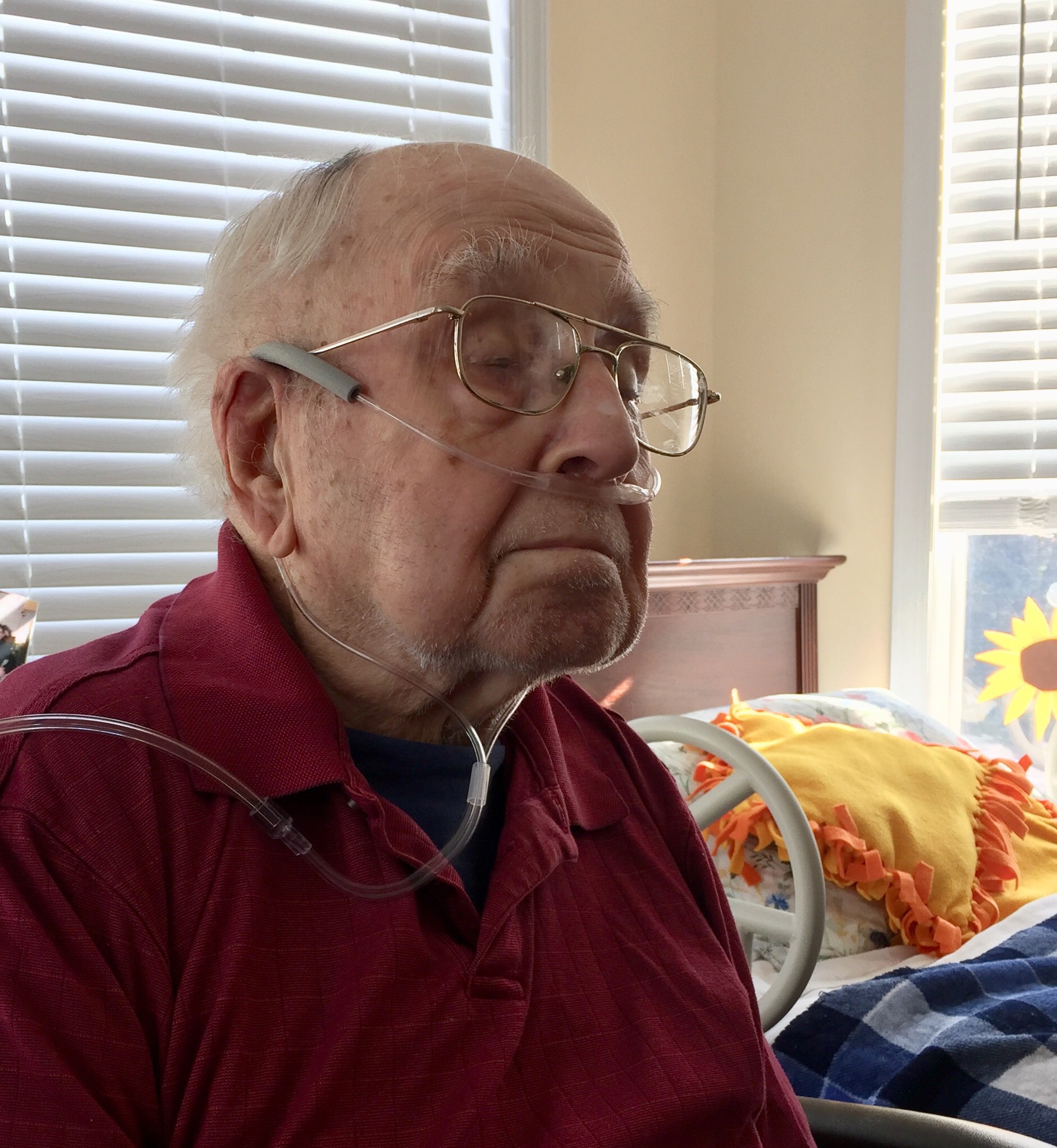
My brother was right. Dad was different. There but not really there. I could only keep him awake for about five minutes at a time. I showed him pictures of the great-grandkids, read with him, drew a picture on his white board, but he quickly dozed off each time. So my visit became more of me just being there. Ironically, that’s all dad could do, too. Just be there.
I thought a lot about that on my way home. Is just “being there” a good thing or a bad thing? We spend a lot of time telling people in the church and community, “Don’t just sit there; do something!” Yet there are times when simply being present is not just meaningful, but is everything.
I’ve heard some describe this as “ministry of presence.” Maybe there’s not much you can do. There aren’t any profound words to speak. There’s nothing you can bring. But you can be there.
You can be there when your child looks up in the stands or out into the crowd. You can be there when someone comes home. Or when it’s time for them to leave. You can be there when they open their eyes. Or when they close them (maybe for the last time).
You can be there because it’s not good to be alone (you or them).







 Waite for it...