Posted in Through the Bible Devotions

What’s your backup plan?

Photo by Changbok Ko on Unsplash

A “through the bible” devotion from Exodus 32.

The room was filled with random conversations as students continued to shuffle into the lecture hall and find a seat. Most were looking at their phones, a few unfolded laptops, and others pulled lunch sandwiches from takeout boxes. Some were laughing. One had his hood-covered head down on the desk, eyes closed. Many scrolled through emails and social media.

After about ten minutes, when no professor or teaching assistant had arrived, each student packed up their stuff and left. No one was upset or concerned as they wandered off to do something else.

Not long into the exodus from Egypt, the question on everyone’s mind is, “Where’s Moses?” He went up the mountain to talk to God in the cloud, but “we don’t know what has become of him” (Exodus 32:1). The people quickly assume, “I guess we’re going to need some new gods.” Everyone pitches in some jewelry, Aaron makes a calf of gold, similar to a Canaanite god, and they create their own religious ritual and festivities.

It’s hard to believe the nation of Israel so quickly goes off the rails. But not if you ask yourself, “What’s my backup plan” when God takes too long to answer prayer? Or when I lose confidence in his presence, provision, or protection? What cultural gods take his place?

Everyone’s got a golden calf of some kind. We all hedge our bets. Work harder. Get a second opinion. Eat comfort food. Go shopping. Ask for a prescription. Quit.

And that’s after about forty minutes. Moses was up on the mountain forty days and forty nights.

None of those things are necessarily bad. But why not, as Air1 Radio puts it, “Worship through it?”

After Aaron makes the golden calf, the people “got up early and offered burnt offerings, and brought peace offerings;” and the people “sat down to eat and to drink, and got up to engage in lewd behavior” (Exodus 32:6).

Why not enter his gates with thanksgiving, offer up a sacrifice of praise, and wait to see what God’s going to do next? Why not approach his throne of grace, where we find grace? Why not keep our eyes on Jesus?

Having a rough day? Bored? Stressed? Restless? Sounds like an opportunity for worship.

Posted in Through the Bible Devotions

Oil and incense

A “through the bible” devotion from Exodus 29.

It’s possible to find a copycat recipe for just about anything. I’ve made a lemon loaf just like the ones at Starbucks, Italian salad dressing just like Good Seasons, and Olive Garden’s chicken marsala.

However, you didn’t want to mix up a batch of anointing oil or incense like the blends used for the tabernacle. If you got caught, you’d be in big trouble.

“This shall be a holy anointing oil to me throughout your generations. It shall not be poured on anyone’s body, nor shall you make any like it in the same proportions; it is holy, and it shall be holy to you. Whoever mixes any like it or whoever puts any of it on a layman shall be cut off from his people” (Exodus 29:31,32).

“And the incense which you shall make, you shall not make in the same proportions for yourselves; it shall be holy to you for the Lord. Whoever makes any like it, to use as perfume, shall be cut off from his people” (Exodus 29:37,38).

Worship wasn’t a do-it-yourself endeavor. It was set up to be done a specific way at a specific time in a specific place. Unlike pagan rituals done on any and every high place to any number of different gods, there’s only one true God. We relate to him on his terms, not ours.

God is holy. Nothing about him is ordinary. So it is fitting to have oil and incense only used for worship. The fragrance of each would remind you of the uniqueness of God. Is anyone or any thing like him? Nope. Nothing even comes close.

Posted in Through the Bible Devotions

Dress code

A “through the bible” devotion from Exodus 28.

As I sit in the waiting area, a service representative steps over to let me know what repairs my car needs. He or she is well dressed in a polo shirt and khakis. Their hands are clean unlike the mechanics who are working with tools, parts, and fluids underneath my car. That’s the one I pay. That’s the one who hands me my keys and sends me on my way. I never get to meet the actual technicians, only the rep.

That scenario reminds me of the Old Testament priests who served at the tabernacle and later, the temple in Jerusalem. God established a dress code for Aaron and the priests who go before the Lord on behalf of the people. Why? There are two reasons: “For glory and for beauty” (Exodus 28:2). The garments will glorify God. But they will also reflect a relationship with the Lord.

As you read through it, it’s complicated. There is a “breastpiece, an ephod, a robe, a tunic of checkered work, a turban, and a sash.” These all work together as a reminder that when the priest goes before the Lord, it is on behalf of all the people. The priest represents a nation, but also every individual in that nation. That includes the good and the bad, the rich and the poor, and the sick and the healthy.

As the gold plate on the high priest’s turban states, the people are “holy to the Lord.” They have been chosen. They have been set free. Their sin has been atoned for, that is covered. It’s easy to forget these truths. This was a great reminder.

In the very first chapter of Revelation, John catches a glimpse of Jesus in glowing, glorious, and beautiful priestly attire. He’s also the mechanic who did all the work of salvation. Not only does he clean up nicely, but he’s give me garments of salvation and robes of righteousness, too.

Israel may not have put all these pieces together in the Sinai desert. But now, in the last days, it’s good news!

Posted in Uncategorized

Imagine what that looks like

Photo by FotoGuy 49057

A “through the bible” devotion from Exodus 26.

When I’m working on a jigsaw puzzle, I always look at the picture on the box to try and figure out where some of the pieces go. I do that even when I am working with my grandson on a hundred piece puzzle.

When I’m putting together a piece of furniture that came in a box, it helps to look at the picture of the item online or sometimes on the side of the box.

My finished food preparation rarely looks like the picture in the cookbook or at the top of the recipe page, but at least I know what I’m aiming for. Sometimes I’m even in the ballpark.

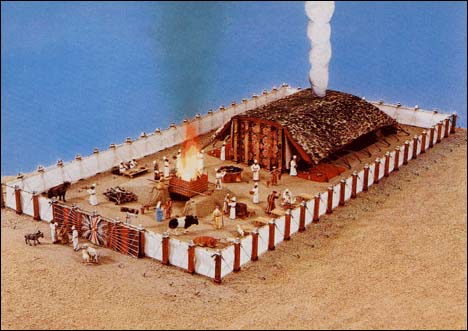
As I read through the instructions for the construction of the tabernacle, I think there’s a lot of room for interpretation. It’s a good thing God showed Moses what he had in mind.

God told Moses, “You shall erect the tabernacle according to its plan which you have been shown on the mountain” (Exodus 26:30).

I so wish Moses had a camera at that moment. I would love to see what Moses saw and the tabernacle he built. I can find all sorts of pictures online of what it might have looked like. But there’s not even have a sketch to look at.

Sometimes I think it must have been magnificent. After all, this is where the Lord will “tent” or camp out with his people. But other times I think it was ordinary. I think that because Jesus came in ordinary form. His physical “tent” was just like us.

Fancy or plain? Who knows.

Posted in Through the Bible Devotions

He’s got you covered

A “through the bible” devotion from Exodus 25.

When he got to his cubicle and logged into the computer, the first email that caught his eye was from the boss.

Come by and see me when you get in.

Uh-oh. That doesn’t sound good. Now what? What did I do? What did I forget to do? Should I just clean out my desk?

But it was a different kind of meeting. It was all about a a great annual review, a promotion, and a raise.

In a flurry of instructions about building a tabernacle and an ark, God gives Moses this instruction:

 “You shall make an atoning cover of pure gold…Then you shall put the atoning cover on top of the ark, and in the ark you shall put the testimony which I will give to you. There I will meet with you (Exodus 25:17,22).

Another expression for “atoning cover” is “mercy seat.” God would come and meet with his people from a place of mercy.

This is huge. As David will later sing, “The Lord is compassionate and gracious, slow to anger and abounding in mercy” (Psalm 103:8). The gold-covered lid for the ark, topped by two angels, was a visual statement of this truth. The condemning law of God, tablets inside the ark, was covered or “atoned” for by the mercies of God. Ultimately, that mercy would be seen at the cross, where the death of Jesus covers sin.

Now that I think about it, once the ark was placed in the holiest place of the tabernacle, no one but the high priest ever got to see it. When it was time to travel, the ark was covered in blue cloth. But everyone knew about it. The craftsmen made everything according to specifications. And then the cloud of God’s presence filled the tabernacle, it was an awesome and reassuring sign of his presence and mercy.

Posted in Through the Bible Devotions

It’s a deal

A “through the bible” devotion from Exodus 24.

When I install or update software on my phone or computer, I have to agree to terms and conditions. I have to admit, I never read them. I scroll to the bottom and check the agree box. I don’t have time for all that.

I’ve only met one person who told me they always read every end user license agreement. He’s never refused to agree to the terms and conditions. But he knows what they say.

Starting with the commandments in Exodus 20, Moses brings a boatload of laws down from the mountain. There are rules about everything from personal injury to property rights. There are regulations for financial matters, farming, and feasts.

In response, “The people answered with one voice and said, ‘All the words which the Lord has spoken we will do!’” (Exodus 24:3).

Really? Don’t you want to sleep on it before you make this kind of commitment? Do you want to talk it over with your family? Do you want to have your lawyer look it over, just for good measure?

You and I know the people will not do all the Lord has spoken. Not even close. God knows it, too. They couldn’t even handle one rule in the garden.

But this isn’t just list of rules and regulations. God cares about his people. So he brings order to their life together just as he brought order to the universe at creation. He says he’ll be their God. They agree to be his people.

Yes, they have a lot to learn. Of course they will make mistakes. Lots of forgiveness will be needed. And all that is included in the words the Lord has spoken.

Just like I need a lot of forgiveness. Because I make a lot of mistakes. And I have a lot to learn. Just like he says in his word.

Posted in Uncategorized

Are you ready to learn?

Photo by Kenny Eliason on Unsplash

A “through the bible” devotion from Exodus 20.

Even though my memory gets fuzzier each passing year, I remember some of those September back-to-school days. (I grew up as a public school student). It was great to see my friends. I had teachers to get used to. I had to find all the different classrooms. There was a new locker combination to memorize.

And of course, there were rules. Get to class before the bell rang. This is where you sit. Homework must be turned in on time. Get a physical at the doctor before you try out for a sport. No smoking in the bathroom.

God’s people have experienced his power, provision, and protection, summed up pretty well here: “I am the Lord your God, who brought you out of the land of Egypt” (Exodus 20:2).

And then there are rules (Exodus 20:3-17). There are rules about how to live together. Other rules are about taking care of each other. God provides structure for their lives as they journey from a place of hopeless bondage to a new home of freedom and abundance.

Even though the rules aren’t numbered, they will be called the Ten Commandments (Exodus 34:28; Deuteronomy 4:13). Different traditions have numbered them differently, but it probably doesn’t make that much difference.

But I guess it’s like the first day of school. Are you ready to learn? Are you ready to learn about mercy, grace, and forgiveness? Are you ready to learn what it means to trust God? Are you ready to not only hear his word but keep it and be blessed?

We’ll see. We’ve got a long way to go.

Posted in Through the Bible Devotions

Do you need some help?

Image by freestocks-photos from Pixabay

A “through the bible devotion” from Exodus 17 and 18.

It was so easy to do too much. I remember too many “perfect storm” Sunday mornings when not only was I preaching, but also opening up the church, playing guitar to lead contemporary worship, teaching a Sunday School class, and taking out a bag of garbage someone forgot to put in the dumpster. It too me a while to learn that if I spread myself too thin, I really wasn’t doing anything well.

I’ve learned to always answer, “Yes,” when asked, “Do you need help?” I don’t need to be independent and self-sufficient. I used to hate group projects. Now I’d much rather be part of a team.

Moses had to learn this lesson, too. He needed help holding up his hands so Israel could defeat the Amalekites (Exodus 17:8-13). He needed help settling endless disputes among the people (Exodus 18). He couldn’t – and didn’t have to – handle all the responsibility of leading a nation.

I guess it’s pride that makes us think we have to do it all and do it alone. A more honest word might be conceit. And if we’re honest, it’s idolatry.

Thank God for all those who are there to help!

Posted in Through the Bible Devotions

What about today?

A “through the bible” devotion from Exodus 14.

Mindful. Present. Situational awareness. In the moment.

No matter how you express it, it’s a challenge to live in the right now. Maybe you’re reflecting on the past with satisfaction or regret. Or your view of the future is filled with anticipation or dread.

But what about now? What’s going on right now? What does your today look like?

The nation of Israel had seen so much. The plagues decimated Egypt. God’s power was clearly displayed for all to see. And yet, when they get to the bank of the Red Sea, with the Egyptian armies in pursuit, they lament, “We’re all going to die!”

Moses reigns in their fears and announces, “Stand by and see the salvation of the Lord, which He will perform for you today” (14:13).

I know that Jesus saved me in the past. I’ve got the cross. I know he’ll save me in the future. There will be a resurrection for me on the last day when he returns. He proved and promised that the grave cannot hold God’s people.

But what about today? Doesn’t the bible say, “Now is a day of salvation”? How does God save me today?

  • I’m probably not aware of all the ways he protects me with his angels. They are with me so that the evil foe has no power over me. Who knows how many close calls they’ve nudged me from?
  • God saves me from a life of futility. In other words, my life has meaning, purpose, and significance. I’m not just taking up space. I’m here for a reason. I make a difference. I’m his workmanship, created to do good things.
  • And I am forgiven. He doesn’t count my sins against me. That applies to today or any day.

I’ve decided that my dogs are the best teachers in this area. They never dwell on the past. It’s irrelevant to them. They never worry about the future. I’ll fill their bowls with food tomorrow. They live in this moment, filled with chew toys, food under the table, tummy scratches, walks in the rain, and snoozes in the recliner. They live in today.

And so should I.