Posted in Through the Bible Devotions

An unusual classroom

Photo by Sam Balye on Unsplash

Some time later God tested Abraham. He said to him, “Abraham!”

“Here I am,” he replied.

Then God said, “Take your son, your only son, whom you love—Isaac—and go to the region of Moriah. Sacrifice him there as a burnt offering on a mountain I will show you.” (Genesis 22:1-2)

No matter how many times I read this passage of scripture, I come away with questions. How could God ask Abraham to do something like this? How could Abraham even consider going through with it? What did Isaac think about this moment?

From our point of view, little about this makes sense. But I could look at it from a different perspective. What does God reveal about himself in Genesis 22? What do I learn about God?

God does not want human sacrifice. Other Canaanite religions sacrificed their children as a way of appeasing their gods. God is not like those gods. His love does not come in response to anything we do or not do. His love is who he is.

God does provide the substitute sacrifice, just as Abraham knew he would (22:8). A ram is the substitute for Isaac. Ultimately, God provided his own son as a substitute, atoning sacrifice for us. How could he do that? We are that important, that valuable to him.

God had promised Abraham that Isaac would be his heir, the beginnings of a great nation. God keeps his promises. He is faithful. I can trust him.

It takes a long time to learn obedience. It took Abraham twenty-five years to get to this point, where he knows, trusts, and obeys God. It’s a process. It takes time.

We’ll never understand everything about God. He is far beyond our comprehension. But he has revealed a lot about himself in creation and in the bible. That I can understand.

Posted in Easter, grandparenting

A resurrection worship craft

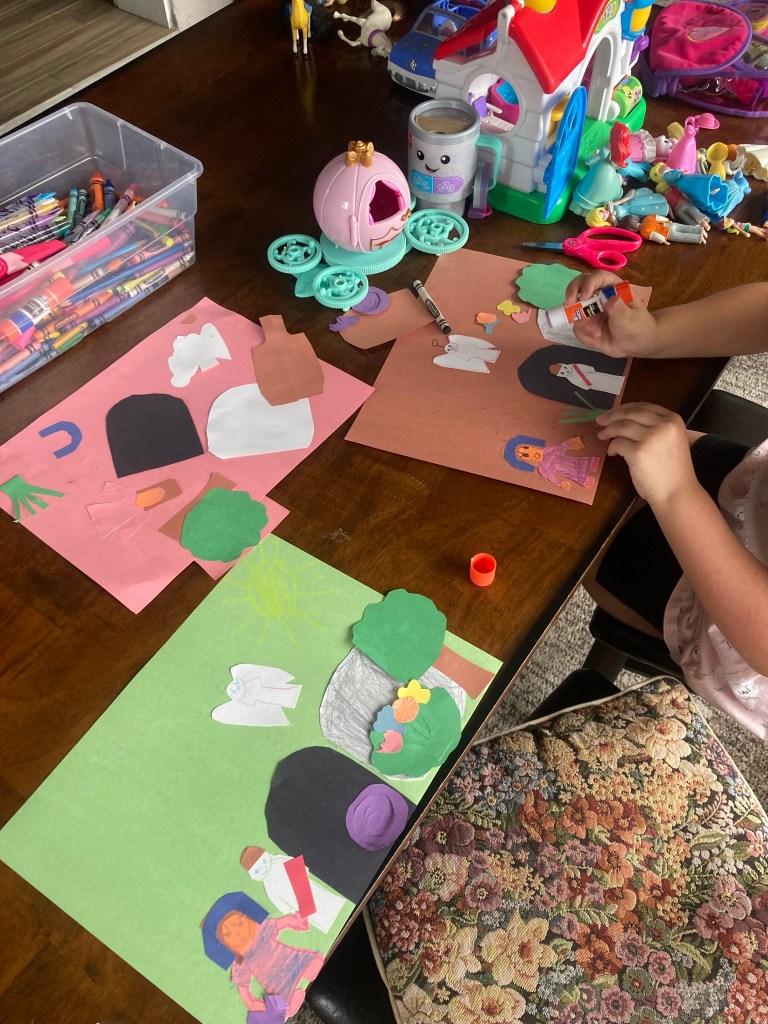
We didn’t make it to church with the three granddaughters last Sunday. But we did a worship craft, which kind of counts, right?

I got out the stack of construction paper, crayons, glue sticks, and scissors. “So,” I said, “Let’s make a bible story craft.” One granddaughter immediately said, “Yes. We need to make one showing the cave, the stone, and Jesus who is risen.”

Great idea. We started by choosing a background color.

What’s next? “We need a dark cave.” I folded the paper over a few times and cut out the black shape of a cave entrance.

“Now we need the big stone.” I didn’t have any gray paper, so I cut out white circles and gave everyone a gray crayon.

Next is Jesus. “He has to have a white robe and a red sash.”

I asked, “How do you know he had a red sash?” They just shrugged. I cut out a Jesus and a red sash.

“What else?”

“Mary, of course.”

I cut Mary out of some pink paper, with an orange face, brown hair, and a blue scarf. Perfect.

The tomb was in a garden, so we added a bush, a tree, and some flowers.

And an angel. “Why do we need an angel?”

“The angel told them Jesus wasn’t there.”

“Oh. That’s right.” I cut one out. “But where’s the halo?”

“You can draw one in.”

I think the three-year-old’s, five-year-old’s, and seven-year-old’s worship project turned out great.

I did notice that the younger you are, the more glue stick you apply to each piece. Her pieces weren’t going anywhere!

Posted in Through the Bible Devotions

Never again

Photo by Elly Johnson on Unsplash

“Then Noah built an altar to the Lord and, taking some of all the clean animals and clean birds, he sacrificed burnt offerings on it. The Lord smelled the pleasing aroma and said in his heart: ‘Never again will I curse the ground because of humans, even though every inclination of the human heart is evil from childhood. And never again will I destroy all living creatures, as I have done'” (Genesis 8:20,21).

The flood is over. The ark has come to rest. Noah, his family, and all the animals have disembarked. It’s time to start over. Noah begins with a sacrifice to the Lord, who is pleased with the aroma. No matter how evil humans and their hearts are, the Lord decides this will never happen again. No more curses. No more destruction. No more floods (Genesis 9:11).

At first glance, that might seem like Noah certainly came through with that act of worship. A sacrifice that pleases the Lord is a big deal. It changes the whole trajectory of history from that moment on.

All of that is true. But don’t overlook the awesome underlying Messianic truth here. Every Old Testament sacrifice points to the sacrifice Jesus made for us on the cross. His once for all suffering and death on the cross means a way out of the curse, judgment, and destruction sin and evil demands. Never again will God unleash such devastation on the earth because he unloaded it all on his own son.

Remember what God said at Jesus’s baptism and transfiguration? “This is my Son, whom I love; with him I am well pleased” (Matthew 3:17; 17:5). A pleasing, all sufficient, once-for-all sacrifice that means we’ll never again have to worry about that flood of God’s wrath.

Posted in Through the Bible Devotions

Good and evil

The Lord God commanded the man, “You are free to eat from any tree in the garden; but you must not eat from the tree of the knowledge of good and evil, for when you eat from it you will certainly die” (Genesis 2:16).

When the woman saw that the fruit of the tree was good for food and pleasing to the eye, and also desirable for gaining wisdom, she took some and ate it (3:6).

We’re not adept at discerning good and evil. Things that feel good, look good, smell good, and taste good aren’t necessarily good for us. Plus, it’s an ever-changing standard. Things that used to be good for us turned out to be bad, and vice versa. Eggs used to be bad. Now we need them for essential fats. Butter used to be bad. But then we discovered that substitutes like margerine were worse. Coffee? That’s like the weather. Good one day, bad the next. Some cut salt out of their diet only to discover their sodium levels are dangerously low.

People who dress nicely and command respect aren’t always good people. Those who look a little rough around the edges turn out to be the nicest people you’ve ever met.

And then there’s the assumption that if something is good for us, more of that will be even better. Most of the time, that’s not true. Too much of a good dose might just be harmful to your health, if not lethal.

The knowledge of good and evil takes us down a rabbit hole of trying to figure out things that are far beyond our understanding rather than trusting God to point or lead us in the right direction. We usually get it wrong. And God knew that this would only result in suffering, death, and separation from him.

God wasn’t surprised by their disobedience. He knew about the tempter, the temptation, the disobedience, and the consequences. The need and his plan for a Savior was in place before creation (Ephesians 1).

As Jesus would later say, “There is only one who is good” (Matthew 19:17). We don’t have to figure it out. He’s the one.

Posted in Through the Bible Devotions

Soon

Photo by Simon Reza on Unsplash

Some “through the bible” thoughts from Revelation 22.

“I am coming soon” (Revelation 22:7, 12, and, 20).

When someone says, “I’ll be there soon,” I expect their arrival within five minutes at the most. If someone assures me, “Just a minute,” I’m thinking somewhere around sixty seconds. When the text reads, “We’re almost there,” I walk out into the driveway and look for the car coming down the street towards our house.

I’ve learned that soon means different lengths of time to different people. It could be anywhere from a few minutes to a few days to whenever. Or a few thousand years in the case of Jesus who brings the bible to a close with the promise, “I am coming soon.”

The thing is, I live in a world with next day delivery, express lanes, microwavable meals, instant pudding, lightning passes, gig-speed internet, and fast-setting Quikcrete.

So we wonder, “How much longer?” And we pray, “Come, Lord Jesus.”

On the other hand, we are quick to react, “Already?” Vacation is over, it’s time to go back to work or school, and we lament, “Already?” When a loved one dies, it’s often “too soon,” and we wish we had more time with them. Supper’s over and the kids are asking for snacks. Already? Six months have passed and it’s time for your dentist appointment. Already?

Rather than marking a day on the calendar, Jesus leaves us hanging with his promise, “I am coming soon.” That promise makes every day significant, because it might be the last. Make the most of it. It makes every day a gift. Another chance. It keeps him on the front burner of my mind, rather than thinking, “I’ve got lots of time.” It makes today more important than someday.

Do I have a lot of time to witness to a friend? To serve? To pray? Maybe. Maybe not. After all, Jesus is coming soon.


I began this reading through the bible on June 18, 2024. I think it took longer this time since I decided to write devotionally along the way. Now what? Start over again? Read cover to cover using a different translation? Pick a book of the bible and spend more time there? I’m not sure. I’ll figure it out. Soon.

Posted in Through the Bible Devotions

A moment of silence

Photo by Kristina Flour on Unsplash

Some “through the bible” thoughts from Revelation 8.

“When the Lamb opened the seventh seal, there was silence in heaven for about half an hour” (Revelation 8:1).

That silence stands in contrast with the unending praises of the six-winged creatures in Revelation 4:8. They are joined by the twenty-four elders, myriads of myriads of angels, and every creature in heaven and earth and under the earth and in the sea (Rev. 5:9-10, 12,13. People from every nation, tribe, people, and language who have washed their robes in the blood of the Lamb praise him with loud voices as well (Rev. 7:9-10).

Heaven is a noisy place until the Lamb opens the seventh seal and “there was silence in heaven for about half an hour” (Rev. 8:1).

One of the hardest things to do when teaching a class or facilitating a discussion is to ask a question and then be quiet. If no one says anything for fifteen seconds, it’s tempting to speak. A full minute of quiet seems like an hour.

Quiet is important. People are thinking. Pondering the question. Forming their thoughts.

Quiet is important when the baby is sleeping. I disconnected the doorbell so that a well-meaning delivery person didn’t push the button, ring the bell, make the dog bark, and wake the child.

Quiet is important in music. A rest means don’t play. Don’t sing a note.

Quiet is important when you’re playing hide-and-seek. Don’t giggle. Don’t breathe heavy. Don’t give away your hiding place.

Quiet is important in golf. Spectators are warned not to make a sound when a player is lining up a perfectly still ball for a drive or putt. Same for a tennis serve.

On the other hand, when a batter is trying to hit a 90 mile-per-hour fast ball, fifty-thousand people are yelling at the top of their lungs. When a basketball player lines up for a free throw, fans of the opposing team will be anything but silent.

How entertaining is it when an adult’s whispered, “Shut up!” is louder than the noise a wriggling child makes in church?

Or when a moment of silence is interrupted by the ring tone of a cell phone in someone’s purse or pocket?

In that half-hour of silence, the prayers of the saints reach the ears of God. The cacophony of heaven’s praises cannot drown out the asking, seeking, and knocking of believers.

More importantly, the roar of heaven’s worship will never drown out your prayers. They rise up to God like the smoke of incense (8:3-4). Your whispered prayers for his help, mercy, and presence sweetly disrupt heaven’s silence, moving God to respond with the thunder, rumblings, lightning, and earthquakes of his presence (8:5).

Let’s make some noise. Let’s pray!

Posted in Through the Bible Devotions

A good look at Jesus

Some “through the bible” thoughts from Revelation 1.

“Then I turned to see the voice that was speaking to me, and on turning I saw seven golden lampstands, and in the midst of the lampstands one like a son of man, clothed with a long robe and with a golden sash around his chest. The hairs of his head were white, like white wool, like snow. His eyes were like a flame of fire, his feet were like burnished bronze, refined in a furnace, and his voice was like the roar of many waters” (Revelation 1:12-15).

It’s interesting that this is one of the few physical descriptions of Jesus in the bible. Accounts of his transfiguration speak of sudden divine brightness (Matthew 17). Isaiah said there would be nothing special about his appearance, “no form or majesty that we should look at him, and no beauty that we should desire him” (Isaiah 53:2). John says his crucifixion wounds were still visible after his resurrection (John 20).

When you picture Jesus, do you picture him as John describes him in Revelation 1? Probably not. The paintings and drawings of Jesus that come to mind probably aren’t accurate. We have no idea, other than what John writes here, which is overwhelming.

John’s Jesus has snow white hair. Long or short? Bearded? We don’t know. He’s got fiery eyes, kind of like the bright yellow eyes of ring tailed lemurs. Shiny gold-colored shoes (“Oh, Dem Golden Slippers”)?Maybe.

What do you think? Is it better to picture Jesus as an ordinary first-century Jewish man, or an awesome divine being you can’t look at because it’s like looking directly at the sun?

I suppose the answer is both. We should neither overlook his divinity nor his humanity. Jesus is so much the same and at the same time so much more than we are.

One day we’ll get to see him for ourselves (Job 19:26,27)!

Posted in Through the Bible Devotions

Evaluating Churches: Insights from Revelation 2 and 3

Some “through the bible” thoughts from Revelation 2 and 3.

When I look at a church, whether my own or another, I tend to notice different things than God does.

  • I look at it’s size. How many gather for worship? I think most of us assume that bigger is better. They must be doing something right, right?
  • I evaluate the style. What kind of music do they have? What’s the quality of the music? What message does the music communicate?
  • I pay attention to the demographics. Is it just a bunch of old people? I like to see a multi-generational gathering, with lots of families with children.
  • What about their programming? Do they have a lot of things going on? How full is the weekly calendar of events? Is the congregation reaching out to the local community as well as supporting mission efforts around the globe?

As John writes to the seven churches, we learn that God looks at the church in an entirely different way.

  • Is that church’s activity fueled by love (Ephesus)?
  • How does the church respond to difficulties and challenges (Smyrna)?
  • What false teaching does the church tolerate (Pergamum)?
  • What false teachers does the church tolerate (Thyatira)?
  • What programs have stalled out (Sardis)?
  • Is the church pursuing opportunities for ministries in the immediate area (Philadelphia)?
  • Does the church care about people, the community, and the world? Or are they indifferent, isolated in a bubble (Laodicea)?

How can anyone not be convicted when they read these chapters of Revelation? No church is perfect. No church checks all these boxes. Every church has something to work on.

Every church needs to repent.

Any church can dig in and declare, “We’re right and they’re wrong!” How many churches will admit, “We have a lot to work on”? How many will commit to being the kind of church that the Lord wants us to be?

Posted in Through the Bible Devotions

Turn up the volume

Photo by Al Elmes on Unsplash

Some “through the bible” thoughts from Jude.

“Beloved, although I was very eager to write to you about our common salvation, I found it necessary to write appealing to you to contend for the faith that was once for all delivered to the saints” (Jude 3).

In the first church where I served as pastor, the sanctuary was separated from a kitchen/fellowship area by a long accordion-style folding divider. One Sunday morning, a meal was scheduled to follow the worship service. I had to contend with slicing, chopping, conversation, and chuckling from well-intentioned parishioners busy with food preparation during the sermon. With a louder-than-usual-voice and lots of projection, I was up to the task.

It didn’t happen often, but some babies weren’t happy at their baptism. I had to contend with their louder-than-usual cries at the font. Once again, I was up to the task, calling upon the breath support I usually used for playing the trumpet.

Jude calls on believers to “contend for the faith” because there was a lot of other noise filling the early church air. The voices of false teachers, grumblers, complainers, and boasters created division in the church, even denying Christ himself! Jude encourages them to turn up the volume of the apostles’ words, praying and strengthening their faith in the promises of God.

Is the church a place filled with the sounds of joy or complaining? Are we united in mission or divided over worldly issues? Do we hear the voice of truth or lies from the enemy?

It’s always a good day to turn up the volume of love, mercy, and grace as we contend for the faith.