Posted in Through the Bible Devotions

The Significance of Incense in Worship

Photo by Anup Ghag on Unsplash

“Make an altar of acacia wood for burning incense” (Exodus 30:1).

“Aaron must burn fragrant incense on the altar every morning when he tends the lamps. He must burn incense again when he lights the lamps at twilight so incense will burn regularly before the Lord for the generations to come. (Exodus 30:7,8)

Why was the altar of incense and the daily burning of incense such an important part of tabernacle, and later, temple life?

My first experience with incense was at my first pastoral conference in Ashaway, Rhode Island. We gathered for evening prayer in a retreat center chapel. The chaplain for the conference leaned towards high church traditions, and had filled the chapel with thick clouds of incense. It was dense, fragrant, stifling, and intense. That night’s worship was unlike anything I had ever experienced.

Many years later, I was asked to preach at the anniversary of a colleague’s ordination. He also leaned towards high church traditions, and would walk through his church sanctuary leaving a lingering aroma of incense an hour before Sunday worship.

My only other encounter with incense was at the funeral of a good friend’s mother. She was Roman Catholic, and the priest prepared to walk around the casket with incense. To his dismay, there was nothing to light the incense. I watched with interest and amusement as various people did their best to make it happen.

The best explanation of incense may be from a psalm:

“May my prayer be set before you like incense” (Psalm 141:2).

As the smoke of incense rose upward, worshipers would follow the smoke’s upward ascent. Their attention would be focused upward towards the one who is worthy of all honor and praise.

How much of worship is about us? Or me? Plenty. I could use a good reminder that it’s about him, the one, God. He’s the only one worthy of praise.

How could I forget that? When I’m distracted, self-absorbed, and indulgent, the smoke of incense rising up might remind me that it’s about him.

Posted in worship

How was church today?

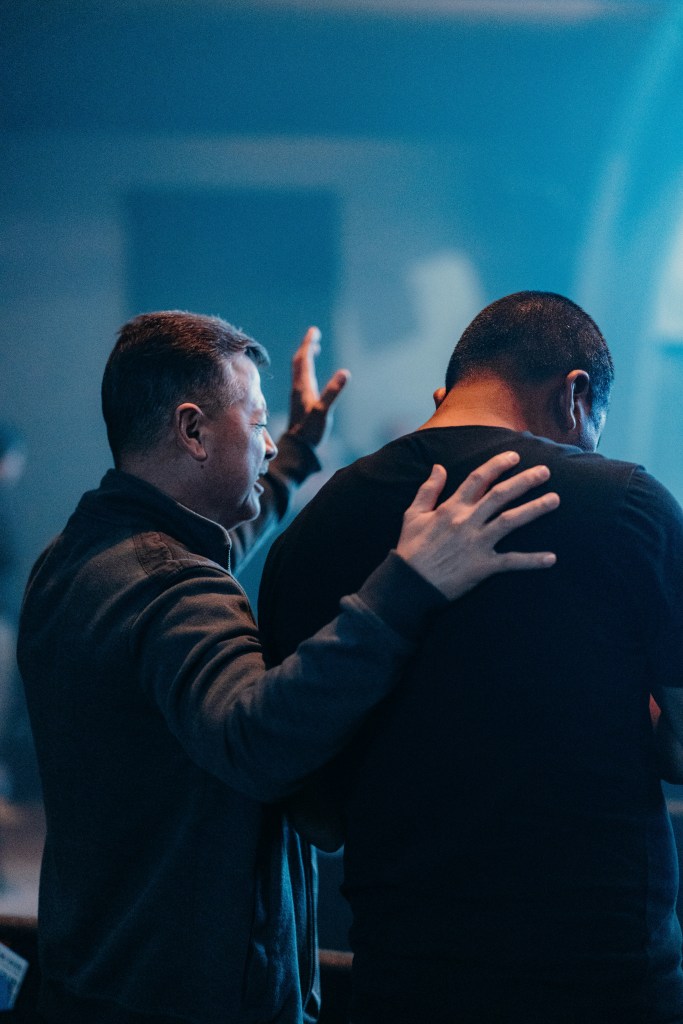
Photo by City Church CA on Unsplash

“How was church today?”

I’ve asked that question. Others have asked me that question. Just as we review a product or business, we evaluate worship experiences.

  • “I enjoyed the music.”
  • “It was too hot/too cold in the sanctuary.”
  • “The sermon was long.”
  • “Why so many announcements? They’re printed right here.”
  • “I love those banners.”
  • “I love/hate it when people bring babies to church.”
  • “Not many/lots of people attended today.”

News alert: God isn’t trolling for a five-star review. His feelings are not hurt if you weren’t inspired, challenged, or fed during the worship service. He will be the same tomorrow as he was yesterday whether you praised or criticized Sunday morning experience.

All God wanted was to be with you. If you were there, it was a five-star moment for him. If you heard his life-giving word, it was a win. If you believed the good news, it was a good day.

If I wouldn’t give Sunday morning worship five-stars, who needs to improve? The preacher? The musicians? The custodians? Late arrivers? Ushers?

Or is it me? What’s going on with me that made worship seem blah, so-so, and forgettable? Why was I distracted, unenthusiastic, non-responsive, preoccupied, comatose, uninterested, and critical?

Instead of reviewing worship after the fact, perhaps I should ask myself a few questions in advance.

  • Do I believe God will speak to me today? Am I ready and prepared to listen?
  • Will I be amazed by God’s grace today? Why would I ever take that for granted?
  • What will I learn about God today? What new thing will he reveal to me?

Someone suggested praying these petitions before any private or collective encounter with God:

  • Give me knowledge, wisdom, and understanding.
  • Teach me something new about you.
  • Direct my steps according to your word.

Maybe worship will be convicting, eye-opening, and instructive. Maybe it will reinforce truths you’ve always known. Maybe it will bring you to tears. Or put a smile on your face.

Posted in Easter, grandparenting

A resurrection worship craft

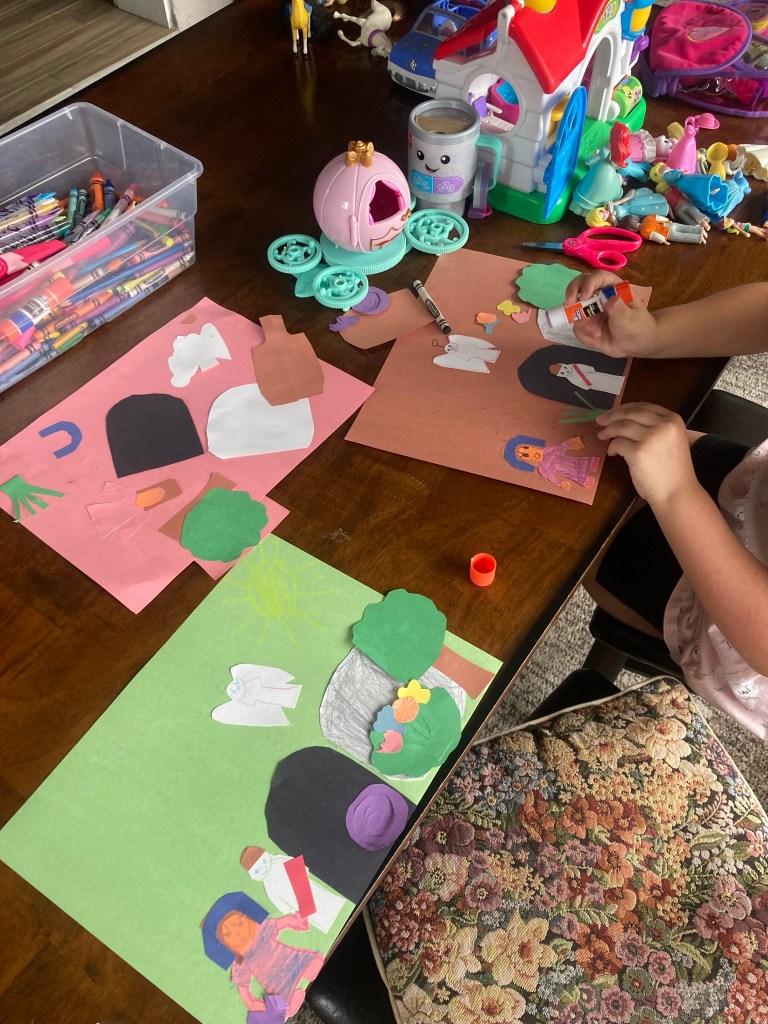
We didn’t make it to church with the three granddaughters last Sunday. But we did a worship craft, which kind of counts, right?

I got out the stack of construction paper, crayons, glue sticks, and scissors. “So,” I said, “Let’s make a bible story craft.” One granddaughter immediately said, “Yes. We need to make one showing the cave, the stone, and Jesus who is risen.”

Great idea. We started by choosing a background color.

What’s next? “We need a dark cave.” I folded the paper over a few times and cut out the black shape of a cave entrance.

“Now we need the big stone.” I didn’t have any gray paper, so I cut out white circles and gave everyone a gray crayon.

Next is Jesus. “He has to have a white robe and a red sash.”

I asked, “How do you know he had a red sash?” They just shrugged. I cut out a Jesus and a red sash.

“What else?”

“Mary, of course.”

I cut Mary out of some pink paper, with an orange face, brown hair, and a blue scarf. Perfect.

The tomb was in a garden, so we added a bush, a tree, and some flowers.

And an angel. “Why do we need an angel?”

“The angel told them Jesus wasn’t there.”

“Oh. That’s right.” I cut one out. “But where’s the halo?”

“You can draw one in.”

I think the three-year-old’s, five-year-old’s, and seven-year-old’s worship project turned out great.

I did notice that the younger you are, the more glue stick you apply to each piece. Her pieces weren’t going anywhere!

Posted in Through the Bible Devotions

Never again

Photo by Elly Johnson on Unsplash

“Then Noah built an altar to the Lord and, taking some of all the clean animals and clean birds, he sacrificed burnt offerings on it. The Lord smelled the pleasing aroma and said in his heart: ‘Never again will I curse the ground because of humans, even though every inclination of the human heart is evil from childhood. And never again will I destroy all living creatures, as I have done'” (Genesis 8:20,21).

The flood is over. The ark has come to rest. Noah, his family, and all the animals have disembarked. It’s time to start over. Noah begins with a sacrifice to the Lord, who is pleased with the aroma. No matter how evil humans and their hearts are, the Lord decides this will never happen again. No more curses. No more destruction. No more floods (Genesis 9:11).

At first glance, that might seem like Noah certainly came through with that act of worship. A sacrifice that pleases the Lord is a big deal. It changes the whole trajectory of history from that moment on.

All of that is true. But don’t overlook the awesome underlying Messianic truth here. Every Old Testament sacrifice points to the sacrifice Jesus made for us on the cross. His once for all suffering and death on the cross means a way out of the curse, judgment, and destruction sin and evil demands. Never again will God unleash such devastation on the earth because he unloaded it all on his own son.

Remember what God said at Jesus’s baptism and transfiguration? “This is my Son, whom I love; with him I am well pleased” (Matthew 3:17; 17:5). A pleasing, all sufficient, once-for-all sacrifice that means we’ll never again have to worry about that flood of God’s wrath.

Posted in holy week, Jesus

Some Good Friday thoughts

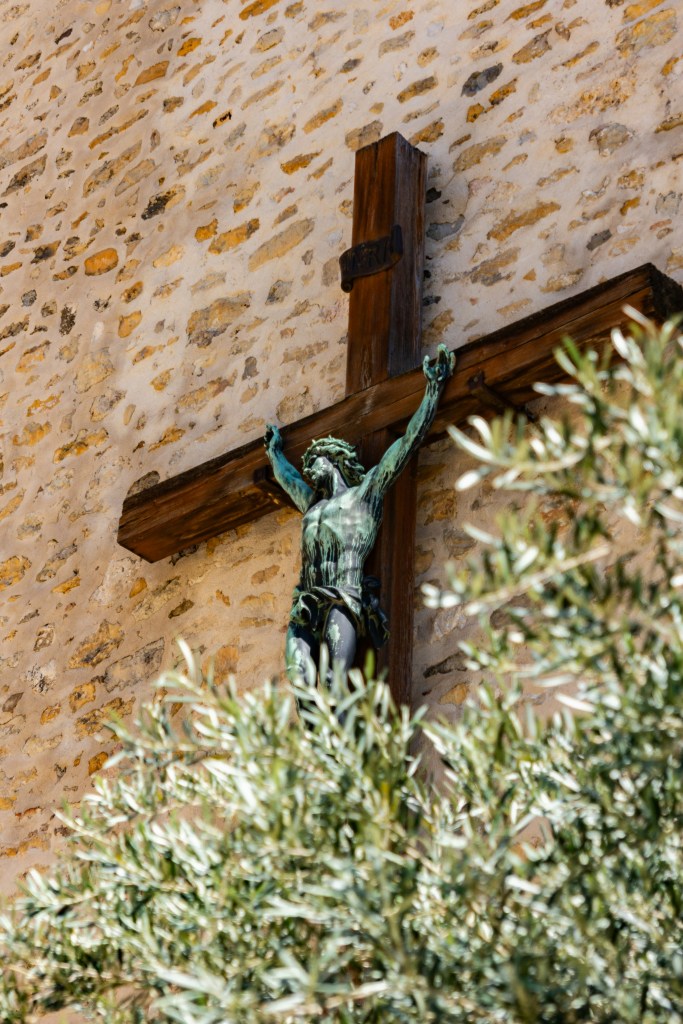
Photo by Paul Keiffer on Unsplash

I’m going to ramble a bit on this Good Friday. My mind is filled with an assortment of thoughts and memories.

First, I doubt that many, if any, of us can imagine what Jesus suffered at the hands of the priests and the Roman soldiers. The physical violence started with the high priest, teachers of the law, and elders who punched and slapped Jesus. After Pilate handed Jesus over the to the soldiers, they beat him with a staff, flogged him, put a crown of thorns on his head, drove nails through his hands, and crucified him.

When one fighter overwhelmingly beats and bloodies the other in an MMA octagon, the referee stops the fight. With Jesus they don’t stop, but dish out more and more punishment. We wince at the “little pinch” of a flu shot, make sure we’re numbed up before the dentist fills a small cavity, and groan when we get up after sitting too long. Jesus has the flesh on his back torn open with a whip, spikes driven through his hands and feet, and is left to hang by his arms to slowly suffocate . The bell never rings ending the round. There no pain relief, other than the drugged wine Jesus refused. There’s no time out. There’s no tapping out. The pain only stops when Jesus dies.

No painting, drawing, or representation of the crucifixion captures the gruesome horror of Good Friday. Crucifixion was a public execution. Some of those who saw it loved Jesus. Others hated him. I wonder if any of us could watch Christ suffer and die. I would turn away.

We gather for worship on Good Friday, at noon, in the afternoon, or in the evening. Our services are adored with beautiful music, encroaching darkness, descriptive words, and silent exits. The only reason it’s not so bad (good?) for us is because it was terrible for Jesus.

A Good Friday Tenebrae (“shadows” or “darkness”) service will conclude in darkness as the last candle is extinguished. The only way out is through the shadow of death, a valley Jesus traverses with us.

I remember my last Good Friday as a pastor because one grandson lit and another extinguished the candles, surrendering the room to the darkness. I took the huge family King James bible my mom gave us at our wedding, raised it high over my head, and slammed it down on the altar with all my might, to remind all of the stone settling into place, sealing Jesus in the tomb.

It’s a powerful worship moment. Everyone who’s been there before knows what’s going to happen. Yet everyone still gasps when it does.

That book was only called into duty once each spring. But it took a beating, the binding barely holding together when I handed it over to my son to use at his church on Good Friday.

The apostle Paul wrote, “We preach Christ crucified.” This is our message. It’s terrible. And yet it’s wonderful. It illustrates how bad we are and what we deserve. It also proclaims how much God loves us anyway.

Posted in Through the Bible Devotions

Beyond ritual to relationship

Photo by Timur Weber on pexels

Some “through the bible” thoughts from Isaiah 58.

“Will you call this a fast,
    and a day acceptable to the Lord?” (Isaiah 58:5)

This whole chapter (Isaiah 58) is convicting. In it, Isaiah challenges us to look at our worship practices. Are they nothing more than ritual? If there’s no horizontal dimension to our spiritual lives, our worship isn’t worship at all. In other words, if our devotion doesn’t affect how we live with others, we’re not worshiping God. We’re just going through the motions.

When love for others is paired with love for God, we get it. He graciously provides food for our souls and an eternal home, and uses us to provide others with physical nourishment and homes. Worship isn’t just about me and God. It’s about God and us, those who intersect our lives every day.

How can you keep your spirituality from becoming nothing more than ritual? Reading this chapter of Isaiah is a good wake up call for those us of, like me, who find that ritual is easier than relationship. The problem is, ritual leaves you further from God. God promises to be closer when we pay attention to each other.

Posted in Life

Worship musician

A couple of months ago, the pastor asked me if I could fill in and lead the praise worship service when he and his wife were out of town for a conference. Another guitarist and bass player joined me as I led the songs a couple of Sundays ago.

I’ve led the music before when other musicians were sick or out of town. On those Sundays, I also preached and taught a bible class. But on this occasion, I would only be doing music. The other tasks were covered by another fill-in pastor.

This was the first time my only job was the music. I picked the songs, led rehearsal, and was the one leading the congregation in song that Sunday morning. These are my reflections on the experience.

For me, the focus required for musical performance engages a different side of my brain from the preaching task. The latter is more of an intellectual endeavor. Music comes from my creative side. In preaching, I am engaging with the listeners. With a guitar and my voice, I find I engage more with the music.

With enough practice, much of performing happens on autopilot. My fingers automatically respond to the chords I see on the page. I picked familiar songs so the sounds that come from my mouth have long been stored in my brain. Most of the tempos came from a rhythm machine. My breath comes from my diaphragm and my vocal chords feel relaxed and resonant. I hate to admit it, but it’s very mechanical.

Someone is running the soundboard, making sure all the voices and instruments are balanced and heard. While someone is reading, preaching, and praying, I am trying to listen, but I am mostly thinking about when I will play next. I am suddenly aware that it’s really hard for any musician to fully engage in worship.

I appreciate all who supply music for worship on a weekly basis. It’s fun to do once. I’m not sure I’d want to do it week after week. Preach? I did it weekly for many years. But that’s a whole different task. I think I’ll reflect on that next time.

Posted in Through the Bible Devotions

The best party ever!

Photo by Nik on Unsplash

A “through the bible” devotion from 2 Chronicles 35.

What would make you exclaim, “This was the best Christmas (or birthday or other celebration) ever”? It might be the presents you received. Or the people gathered with you. Maybe the food was outstanding. A live band, fireworks, or an open bar could make an occasion the best ever. How about the amount of debris left to clean up the next day?

“Josiah kept a Passover to the Lord in Jerusalem” (2 Chronicles 35:1). Boy did he ever! “No Passover like it had been kept in Israel since the day so Samuel the prophet” (35:18).

What made this Passover so memorable?

First, the numbers are amazing. 37,600 lambs and young goats were slaughtered and roasted, along with 3,800 bulls. It’s close to twice as big as the Passover King Hezekiah kept, which was best one since Solomon was on the throne (2 Chronicles 30:23-26).

Josiah kept this Passover “according to the word of the Lord by Moses” (35:4). Those repairing the temple discovered the Book of the Law of the Lord. A convicted but repentant King Josiah made sure they followed God’s instructions to the letter.

Finally, the king kept the best Passover ever during the decline of the southern kingdom of Judah. In just a few decades after Josiah’s reign, Babylonians would capture and burn Jerusalem, and take whoever was left into an exile that would last seventy years. Those whom God loved rejected him and every messenger he sent to warn them. He had no choice There was no remedy (36:16).

What’s the best worship event you’ve ever experienced? Anyone who’s been to church has a story about an amazing service. The more I think about it, the more I add to my list. Mine would have to be my call service at the seminary, my son’s ordination, baptizing my children and grandchildren, and my father’s funeral. They were all very different but powerful moments.

Posted in Advent devotions

Doing good things and God things

Photo by Ryno Marais on Unsplash

In Matthew’s account of Jesus’s birth, Joseph believes he is doing the right thing. When Mary was found to be with child, he didn’t want to shame her, so he resolved to divorce her quietly (Matthew 1:19). While it was the right thing to do according to the law of Moses, it wasn’t God had in mind for Joseph.

Like another Joseph from long ago, this Joseph has a dream in which an angel of the Lord tells him to take Mary as his wife. Her son was conceived by the Holy Spirit, and he would save his people from their sins, just as the prophet Isaiah had said.

Joseph’s life turned out completely different than anything he could have imagined. The family would have to take a trip to Egypt to save Jesus’s life when Herod slaughtered the children in Bethlehem. He would raise God’s son in Nazareth as his own.

Joseph taught carpentry to the one who laid the foundations of the earth. Joseph worshiped alongside the one who would be worshiped by every nation, tribe, peoples, and language.

What a privilege to work and worship alongside the Lord. Since he is Immanuel – God with us – we get to do that too. This truth adds perspective to every task and prayer we offer up!

Of course Joseph gets an ornament on the Jesse Tree. He’s “of the house and lineage of David” (Luke 2:4) and served as a faithful father to Jesus.