Posted in creativity, writing

Finding Inspiration: Tips for Getting Your Creative Juices Flowing

As I sit down to write today, I see I have posted nearly 1,200 times on this blog, dating back to October 2008. I have a few more saved in some Word files that I had previously posted on another platform. I have written about ministry, family, travel, projects, and various things that have either made me laugh or groan. I have published some of my devotions here, a few sermons, and some memorable pictures.

I started investing more time in writing to become a better storyteller. Our minds are wired for story, and that’s what we remember best. Adding a layer of story to ordinary moments can transform them into something amazing. Not only can I share the moments with others, but it etches them into my soul. It’s a win-win.

It’s not easy to do. At least not day after day. So what revs up and maintains my creative juices? What tools or tricks do I use to come up with topics or issues to write about?

Pictures

I love to start with a picture. It might be a photo I’ve taken of something that caught my eye. It could be a piece of art from a gallery or from a grandchild. The visual sparks my imagination as I imagine the story behind an object, person, or place. I try to make sure I take a few pictures every day, knowing that one day they’ll be a springboard for a story.

Experiences

I’ve written a lot of stories about my experiences. That’s why I keep a daily journal, recapping the events of my day. I keep track of where I’ve gone, who I’ve talked to, what I’ve purchased, projects I’ve completed, what I’ve cooked and eaten, and especially what made me laugh. Sometimes I reach way back into my life to write about memories of school, family, and friends.

Music

Music helps. I am definitely a left-brained analytical thinker. Logic comes easy. Stories are a challenge. But playing music engages the right side of my brain and can shift me into storytelling mode. If I just can’t figure out what to write, I’ll grab my guitar or sit down with my trumpet and let music open up my imagination. It always works.

Gratitude

Gratitude stimulates creativity. Pause a moment to be thankful for anything and everything you have, the people around you, and the creation in which you live. Suddenly, the stories all around you jump out and beg to be told.

Scripture

For devotional writing, I always begin with a bible passage. The living and active word of God reveals how he is involved in the story of my life. His words transport me way back in time, then into the future, and then finally shape my life in the here and now.

Reading

I’m trying to read more now in retirement. When an idea or phrase catches my attention, I jot it down for later reference. I sometimes come up with story ideas that way.

Artificial Intelligence

I haven’t done a whole lot with it yet, but I can see AI being a tool to help me when I’m having trouble figuring out what to write about. It’s easy to ask ChatGPT for ideas and end up with more than you need. It’s new, and it’s a little intimidating, but it’s an interesting resource. I’ve found it very helpful for generating titles that get more attention.

Some days it comes easy. Some days it’s a real struggle. But it’s a process I enjoy and hope to continue.
Posted in grandparenting, memories, youth

Joys and memories: watching my grandson play baseball

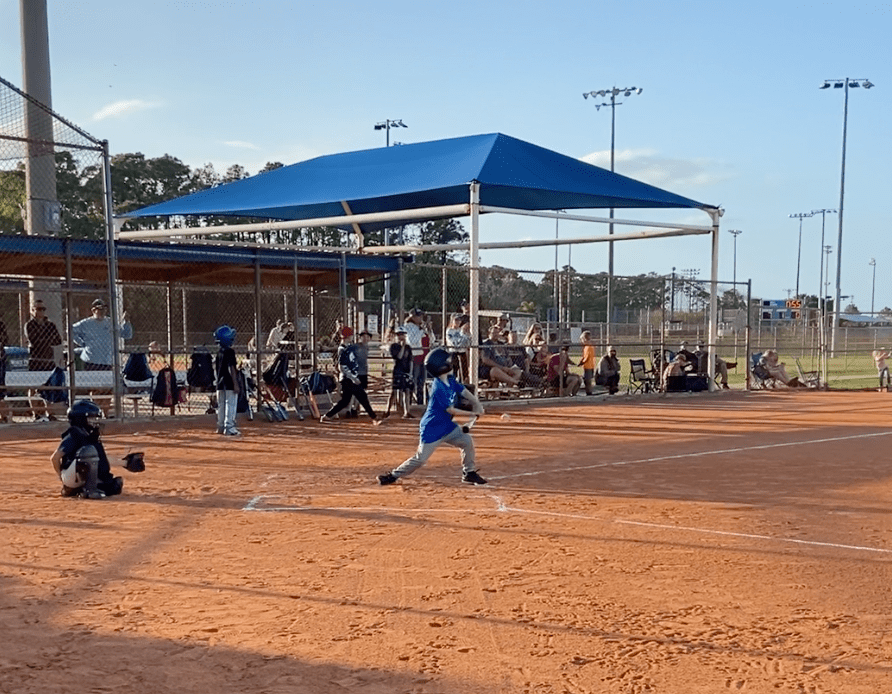
I went to watch my seven-year-old grandson’s baseball game last night. After two seasons of T-ball, he had advanced to a machine-pitch league. His team lost this game, but the coach awarded him the game ball for his efforts!

Watching this game made me think about my own youth baseball experience. I never played in an organized league while growing up. But on my block alone, I had enough friends my age to field two teams to play either on the street or the “ball field.”

The street game required little equipment. We played with a pink rubber ball and a bat. Bases were manhole covers, car bumpers, and sewer drains. We hit single-bounce pitches. The game’s added challenges included traffic, homes on each side of the street, and the unforgiving asphalt surface. When we could only round up eight or nine kids, this was the game we played.

When we had fifteen or more, we played at the ball field, a quick bike ride to a huge vacant lot behind the development where my family moved when I was eight years old. For this game we had gloves, baseballs, and wooden bats. Bases were flat rocks or pieces of wood we found lying around. We used pitchers, but no one threw very hard, so there were hardly any strikeouts. We played a lot of games, especially throughout the summer.

The challenges of this game included a pretty rough field surface. You had to have very quick reactions when ball bounced off holes and rocks in the dirt and grass that wasn’t cut very often. A foul ball into the woods might mean the end of the game if we couldn’t find it. Every once in a while, someone would tag one and it would reach one of the bordering homes. I don’t think we ever caught a window, but we bounced a few off the roof. A few of my friends were pretty good. Only one of them played Little League, beyond the means of most of our families.

It was a good place to hone some skills. Enough that I could later play some college intramural and later, church league softball. I also remember the names of most of the kids and adults I played with. Baseball was really good for developing friendships. Plus, once you’ve played, baseball is much more entertaining to watch, from the major leagues to a local machine-pitch rec league.

Posted in Food, Life

Did I really eat a better school lunch?

I just read the news that Lunchables will now be included in school lunches next fall. I’m sure that raised a lot of eyebrows. I was under the impression that Lunchables, though loved by children, were one of the unhealthiest meal choices. Kraft Heinz, who produce Lunchables, says they have reformulated them to meet government nutrition guidelines. Hmm.

My daughter told me that in her school district, every child gets free breakfast and lunch. Everyone. On the one hand, that’s a blessing for those families who are struggling financially. On the other hand, I remember what school lunches were like when I was growing up. That’s why I usually brought my own lunch with me. More on that later.

When my children were in school, spring standardized tests were a big deal. So big that the schools served breakfast on test days. Brain food they called it. It consisted of honey buns and mini-donuts. Brain food?

The only days I didn’t bring my lunch to school was pizza day. I guess you could call it pizza. It was more like a piece of cardboard with some red sauce and melted cheese on top. When you’re in elementary school, there’s nothing better.

The rest of the time, all the way through high school, I brought my own lunch. In a brown paper bag. My mom wanted me to save the bag to use a second or third time, but I rarely did. Typically I had a sandwich made with white bread with Oscar Meyer bologna, sliced ham, or peanut butter and jelly. Every once in a while, a tuna sandwich wrapped in aluminum foil. I also had an apple, once in a while an orange. I bought milk or juice to drink. And that was it.

Unless the desert of the day was a peanut butter bar or a slice of cake wrapped in cellophane. If I had a little bit of money, I would get one of those. But those moments were few and far between.

I never envied the kids who bought their lunch at school. It was often hard to identify what the cafeteria served, even though the school published the menu each month. (That’s how we knew when there was pizza.) I doubt that our lunches were much more nutritious than Lunchables or whatever else is available today. We survived. I guess our grandkids will, too.

Posted in Life

The power of one: What can I possibly do about climate change?

Well, it sounds like we’re all doomed. The United Nations Intergovernmental Panel on Climate Change released a report yesterday stating that climate disaster is inevitable unless nations take drastic measures right now to cut their carbon-emissions. Otherwise we can look forward to even hotter heat waves, food shortages, and more infectious diseases.

I would expect a report like this to generate all kinds of activity to do something, anything to stave off the earth’s demise. I read about it in the news. I hear about it on TV. But I personally don’t see many worried about this. The roads are filled with more semis, pickup trucks and SUVs than ever. Okay, I see a few more electric cars than I used to. But not enough to make much of a difference. I don’t see roofs covered with solar panels. The long line of cars dropping off and picking up students from schools means that most students aren’t taking the bus. Hardly any of the food I buy is grown locally. It’s all from far away places. Oil companies are still investing in fossil fuel production. Power plants are still burning coal.

Maybe I shouldn’t worry that much about it, either. I’m just one person on a planet with 7.9 billion people. What would or could I do to make a difference?

I know, that’s not a very good attitude. I know that my vote always counts in an election. I know that my acts of kindness have a ripple effect in the lives around me. My presence in the world does affect the lives of others. Plus, my faith includes taking care of the creation in which I live.

I would love to put solar panels on my roof. But there are too many trees on the lots around my house. Until those lots are sold and there’s less shade, I’m out of luck.

I’d buy an electric car. If I could afford one. And if I knew that the power to run one came from a clean energy source, which it probably doesn’t.

I could grow more of my own food at home. However, my gardens haven’t exactly produced bumper crops to date. Gardening in Florida has been challenging.

I could buy less stuff and have less delivered to my home. Or at least combine orders for fewer deliveries each week. Less stuff would also cut down on my trips to the thrift store when we get rid of everything we’re not using.

I could ride my bike more often. To the library, to the gym, and even for a few groceries. That’s the most doable idea I’ve come up with. Other than recycling, and I already recycle everything I can in our community.

So I guess I can choose to be powerless or recognize the power I have in this world.

Posted in garden, Moments of grace

Amaryllis Blooming: A Reminder to Slow Down and Enjoy Life’s Simple Pleasures

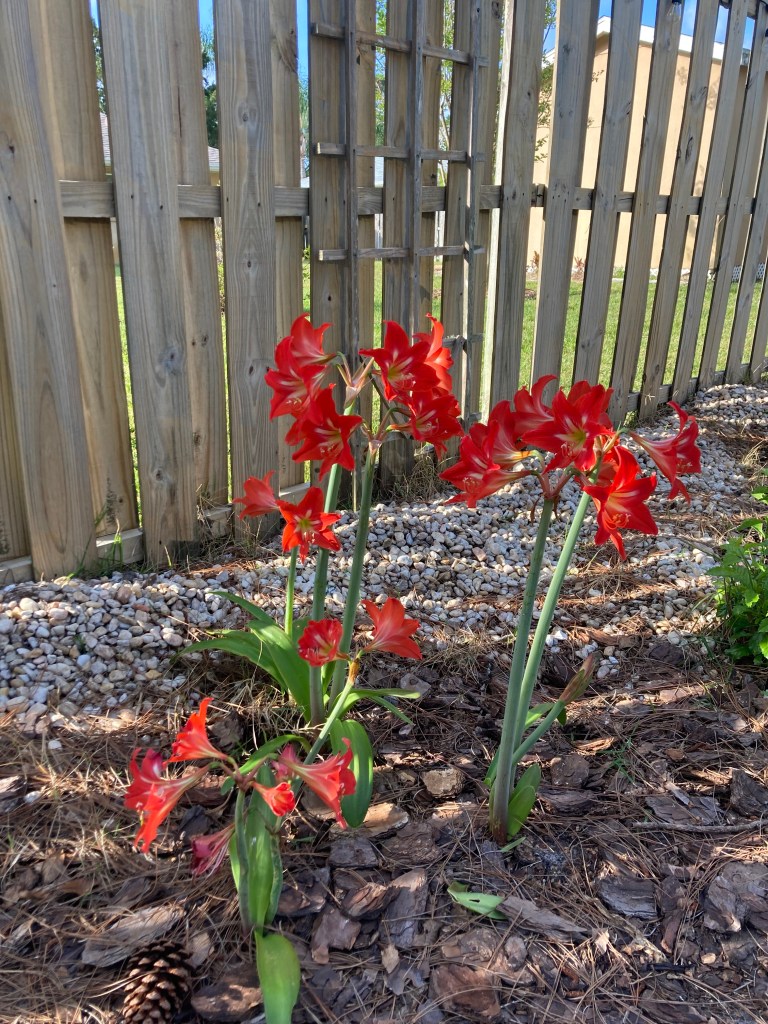
They are sneaky. You forget all about them for most of the year. Then suddenly, one day, BAM! There they are. The amaryllis.

I didn’t even notice as the plants began poking their heads through the pine needles and bark much. Even when they were a foot tall, they blended in with stalks of hibiscus and other plants that had died when the temperature dipped below freezing for a few days. The perfect disguise.

One afternoon, walking through the backyard, a tiny glimpse of red caught my eye. I couldn’t ignore them any longer. They had blown their cover. They weren’t coming; they were here.

The next day it looked like someone had run through the garden with leaking buckets of bright red paint. Flames shot out in every direction from the stems. The colors shouted from the brownish-gray backdrop, “It’s spring!”

The brilliant hues make me laugh out loud. I can’t contain the joy inspired by sudden spring color. I have to stop and look and look and look again. They are beautiful.

The red ones are the first wave. The big pink ones won’t be far behind. And then – the lilies!

Posted in Life, shopping

What’s in your shopping cart?

So I very carefully snapped this picture of a shopping cart just a few spots behind me at a self-checkout lane in Walmart. The contents caught my eye then and still intrigue me now.

  • At least 8 cans of spray disinfectant
  • A large double stack of red solo cups
  • A tall pile of plain white hand-towels
  • A couple of trash cans
  • A huge container of cheese balls

I thought it was an interesting collection of things to purchase. I’m not here to judge; I’ve filled carts with just as many attention-getting items. More on that in a minute.

My first thought: this person teaches preschoolers. Perhaps a Sunday School class. Maybe just a bunch of kids at home.

This shopper could be turning over a short-term rental. Or cleaning up a house before the movers arrive with the furniture.

When a youth group was selling food at an outdoor church festival, I went out the day before to purchase supplies. I overloaded a cart with giant packages of hotdogs and hamburgers, bags of buns, cases of soda, and assortments of chips. As I pulled up to check out, I felt a little self-conscious. “No,” I wanted to explain, “I don’t eat like this all this time!”

Every time I come across this picture I chuckle at the cheese balls. I’ve seen them on display. I’ve always wondered who buys them. One youth brought a similar container on a summer mission trip. Barely lasted two days. I guess it’s not as big as it looks.

What’s in your shopping cart?

Posted in Life

The cleanest lettuce in the world

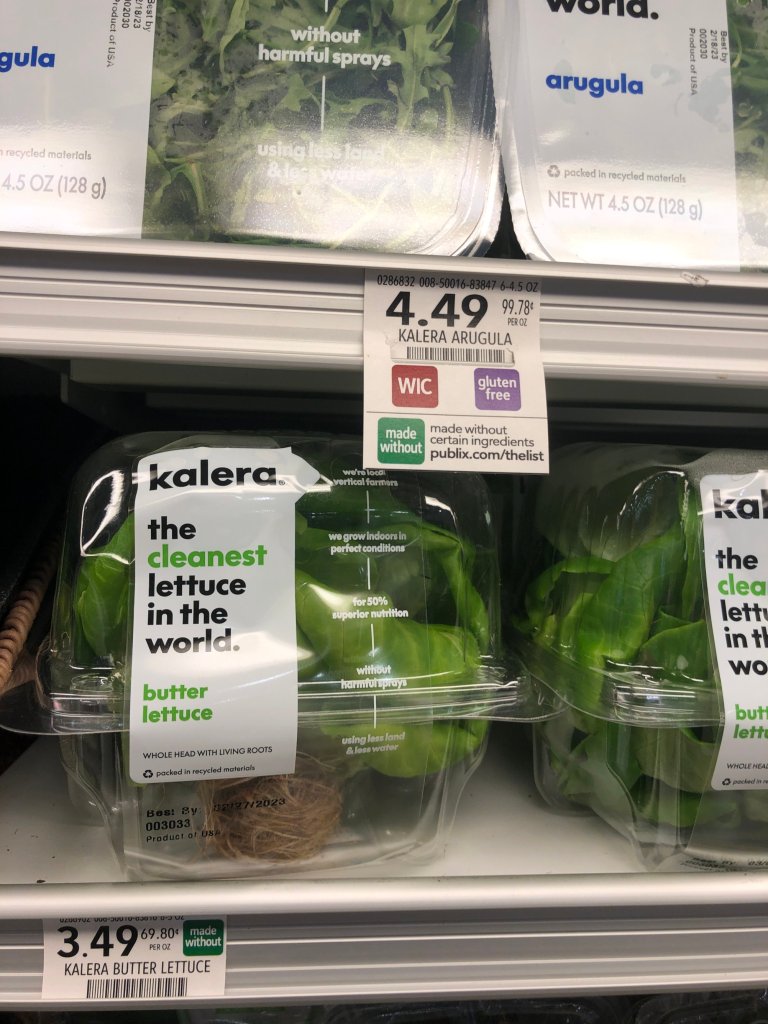
While looking for BOGOs in the produce section, this label caught my eye: “The cleanest lettuce in the world.”

That’s quite a claim. How do they know? Who studies this? Does it really matter when you wash your vegetables at home? What about the lettuce package that boasts, “Triple washed”?

Skeptical, I did a little bit of research. Kalera brand lettuce is hydroponic. Rather than being grown in the dirt, it’s grown in water. As long as the water is clean, the product is clean from germination to harvest. In my research I did find a story about Kalera’s recall of lettuce in Florida in the fall of 2022 because of some salmonella contamination. The cleanest lettuce in the world isn’t necessarily germ-free.

My dad grew a lot of lettuce, spinach, and other vegetables in the big garden on the side of our house. He washed it, but it could still be a little gritty to the teeth. Definitely not in the running for cleanest. Sometimes we would just eat it right from the garden, along with green beans, peas, or a tomato. Wipe it off on your shirt and you’re ready to go. Dad didn’t use any pesticides, so that wasn’t a problem.

The label also claims the lettuce has “50% superior nutrition.” Hmm. Superior to what? To other brands of butter lettuce? To lettuce grown in soil? To Doritos? I did learn that butter lettuce is a good source of vitamins A, C, and K, along with minerals like iron, copper, potassium, and manganese. You’ll also get flavonoids and antioxidants in a salad made with butter lettuce.

It ain’t cheap, that’s for sure. With a unit price of $.70 per ounce, it goes for about $11.00 a pound. That’s more than a lot of the beef for sale. And even though the label doesn’t specify, I’m sure it is gluten-free, just like the arugula on the shelf above it. Just so you know.

I may not be doing myself any favors, but I generally choose the cheapest dark-leaf lettuce I can find. Never iceberg. Spring mix is a favorite. I used to find amazing locally grown lettuce at the farmer’s market near us. Sadly, that market closed.

I half-heartedly rinse it off, so I doubt if my efforts bring my lettuce anywhere close to being the cleanest.

Posted in Life

A croc in the water!

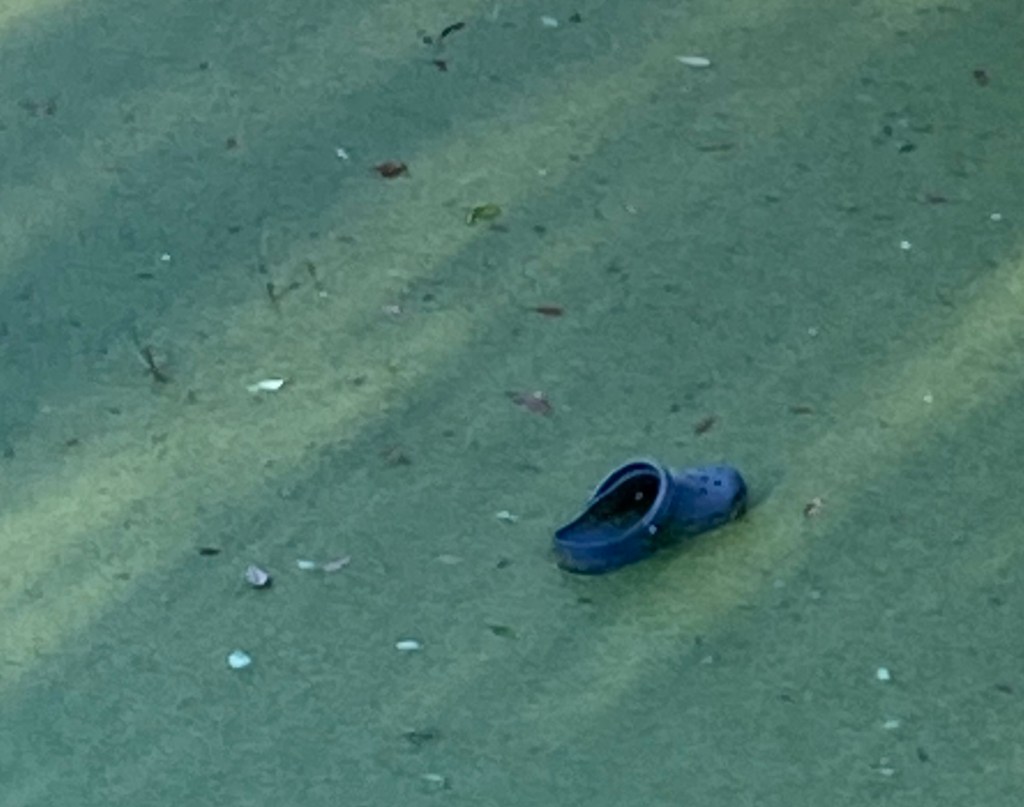
A croc floating in duckweed covered water at the zoo in Jacksonville, Florida.

I did a double-take walking through the Jacksonville Zoo. We had just passed the bongo and zebra enclosures and were just about to look at the lions. Underneath the wooden walkway, I saw this croc floating on the duckweed-filled water. Yes, a croc in the water! Not an unusual sight in Florida, but not exactly the kind you would expect.

Okay, so if you’ve read any of my posts, you know I always wonder about such things. What’s the story behind this? How in the world did someone’s croc end up in the water?

Perhaps it was a game of keep away. Someone stepped out of a croc, friends grabbed it and tossed it back and forth until it sailed over the railing and into the water. Yeah, you’re going home half-barefoot. Sorry about that.

Maybe it was a dare. “Hey, do you think there are any alligators in the water?” “There are alligators in every pond in Florida, doofus.” “I dare you to throw your croc in the water. Everyone will see and take a picture of a “croc in the water.”

It could have been an accident. Exuberant spring-breakers were kicking at each other. One kick missed, a shoe went flying, and suddenly there was a “croc in the water.” Maybe friends were slapping each other with flip-flops and other shoes, when one went astray and sailed into the water.

Maybe the rhino-ostrich-lion staff saw a chance to mess with the tourists. “I know. Let’s throw a croc out there in the water. They’ll freak out.”

We look for and often see alligators along the banks of every retention pond we pass by. We were not surprised to find a croc in the water.

Posted in cooking, Life

The joy of rhubarb

Photo by Heather Barnes on Unsplash

I had heard of rhubarb. My dad used to speak of it. I had seen a “rhubarb” break out at a ballgame when players poured out of the dugout to trade blows on the field.

But the first time I encountered rhubarb was in Iowa. I’m a city mouse, born and raised in suburban Philadelphia. Iowa was all about farming, where my wife, the county mouse, would feel at home. We moved into our Iowa home in the late spring of 1991. As soon as the snow melted and the days got longer in 1992, the rhubarb sprouted in our backyard. The red celery-like stalks and large green leaves baffled me. What was this?

We lived in Iowa for five years and learned that you don’t have to do anything to grow rhubarb. It sprouts and grows every spring and produces magnificent plants. The big question: what do you do with rhubarb?

The easy answer: make a pie. Rhubarb pie. Strawberry rhubarb pie. My wife makes an incredible pie crust using her grandmother’s recipe. And she made some incredible rhubarb pies. The second secret to a great rhubarb pie? Lots and lots of sugar. (The first secret is to use ice water when you make the crust.)

A straight rhubarb pie is delicious. But beware, it will clean you out. (You know what I mean.) Strawberry-rhubarb is delicious, too, with a little more natural sweetening and a little less natural fiber.

Fast forward to 2023. We’ve been living in Florida for 26 years. Rhubarb doesn’t grow in Florida. But strawberries do. And they are ripe and plentiful in March. We went to a strawberry festival last weekend and bought a flat. that is twelve pints of strawberries. I bought that flat with my wife’s promise, “I’ll make you a strawberry rhubarb pie.” Deal.

So I head off to the store to buy rhubarb. Every once in a while I can find frozen rhubarb in the freezer section of the store. No such luck on this trip. Well, maybe it’s in the frozen vegetable section. Nope. I finally asked a manager, “Sometimes you have rhubarb – where would I find it?”

He whipped out his smartphone and checked the inventory. “We’ve got fifteen pounds in produce.”

“Ok,” I said, “I’m headed over there.” At the other end of the store, I asked another manager, “Do you have any rhubarb?”

He disappeared into a cooler and came out with a huge box. “How much do you need?”

“Not that much,” I replied. “How about a pound?” He cut and wrapped up about 8 nice stalks and I was on my way home with fresh rhubarb.

The secret to baking rhubarb, besides lots of sugar, is peeling the strings off the back of the stalks. As my wife laboriously peeled, she said, “That’s the virtue of frozen rhubarb – no peeling.”

This year’s strawberry-rhubarb pies (a big one and some little ones) are in the oven. I’ll let you know exactly how delicious they are!