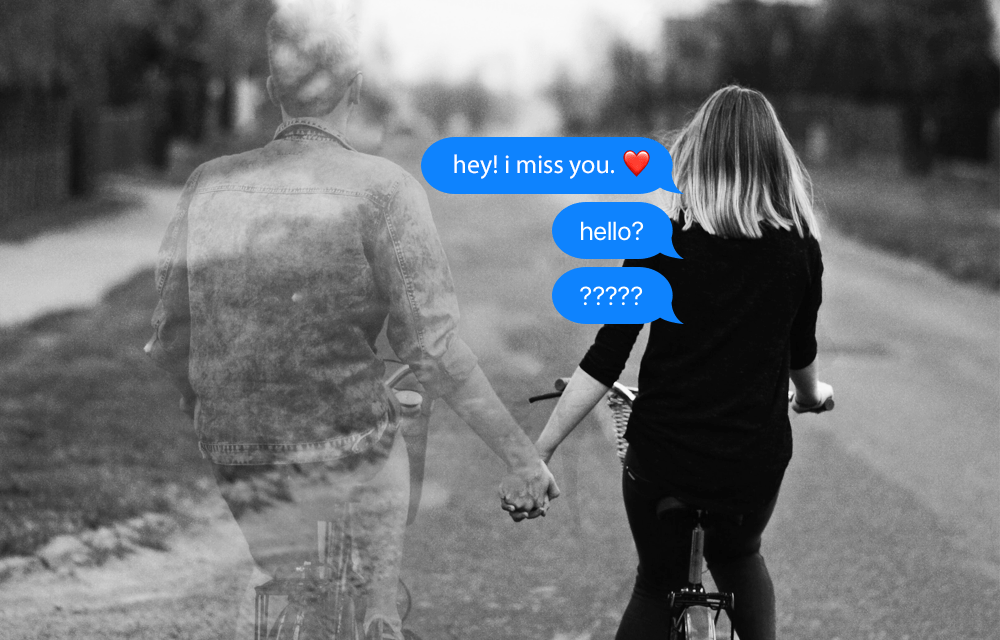
Yep, it happened again. Been there. Done that. And it won’t be the last time, either. But now, I have a word to describe the experience: ghosted. You’ve been ghosted when someone you know suddenly breaks off all contact with you and disappear, like a ghost.
My most recent experience was with an older woman who worshiped with us for about four weeks. A few weeks gets you a phone call and a post card. Three or four weeks, and I call to thank them for coming and ask for a visit. this person, pretty quiet on a Sunday morning, was hyper-talkative when I called. I learned so much about where she’s lived, her husband who died about nine years ago, and her recent experiences with churches that prompted her to visit us. She had grown up Lutheran, felt at home, and asked me, “Can I join the church?”
“Sure,” I said. “We’d be glad to have you. I’ll see you Sunday.”
That was the last time I talked with her. She never returned to worship. Did not answer phone calls or reply to voice mail messages. I had been ghosted. Just like that.
Her elder said to me, “I talked with her. She isn’t interested in coming to our church anymore.”
On my side of the equation, I was puzzled. Confused. Annoyed. Okay, I’ll admit it, angry. Why would you say that? Why would you do that? If you don’t want to worship with us, that’s fine. Go where you feel comfortable. I’m OK with that.
Maybe I need to imagine myself in her shoes. Her last church hurt her. We were her “rebound” church. Nice for a time, but certainly not for a lifetime. We were just a rest stop in her spiritual journey.
And that’s OK. We are here to proclaim, to serve, and to minister to all sorts of people looking for hope, light, peace, forgiveness or direction. They may stay for a long time. They may just stop in for a moment. We may simply be a stepping stone. A motel.
Some church will be blessed because we preached the gospel, we made her feel welcome, we recharged her batteries for her next endeavor. They will be blessed by her presence, her worship and her prayers. It’s like an assist in basketball or hockey. People keep close track of those things, because you can’t win without them.
One of the hardest things to do is wait for an opportunity to proclaim the gospel. As a pastor, I have that opportunity every Sunday morning. But the rest of the week, I have to listen for what I can best describe as door left ajar, a question or a comment that immediately shouts, “Tell them the gospel!” I love it when God simply cracks a window or creates a moment. I had that happen two times in the last month.
The first was a conversation with Brad (not his real name) who was dying, hard to understand, but still hanging on to life. i don’t know if it was a test or a genuine inquiry: “How good do you have to be to get into heaven?” O boy, when I hear that question, I have to take a breath and pull myself together to give them some very good news: you don’t have to be good. Jesus was good enough for you. His righteousness is yours. Heaven is your eternal home because of him. Sentences that fill me with joy; sentences I hope filled him, too.
Moment number two. Visiting Andy, also dying, I asked, “Are you ready?” He said, “I’m scared.” I asked, “What are you afraid of?” He said, “The darkness.”
Once again, I had to take a deep breath and pace myself. I had so much to say, but most importantly, “In [Christ] there is no darkness.” He knew that. He had been faithful for ninety-plus years. He just needed to hear it again.
Short, simple conversations filled with gospel hope. Thank you, Jesus, for being the answer to so many worries, concerns and questions!
I do my best creative work and writing in the mornings. For me, ideas and content flow effortlessly before noon.
My brain starts to get mushy after lunch, so that’s when I need to get out and do something else. So I use my afternoons are better for visiting folks at home, in the hospital, in nursing homes, for wherever.
There is a part of my brain, however, that suggests that I take a nap after lunch. Sometimes I do that. But I try not to do that when out for a visit. That’s where caffein comes in. In fact, as I’m writing this, I’m slamming a tall Pike before a visit to a homebound member.
You see, I’ve been visiting this person for a long time. After a certain number of monthly visits, I’ve heard most of the stories. However, I must listen to them again. And again. And again. That is when active listening becomes difficult, my eyelids begin to feel heavy, and I start to get very, very sleepy…
It’s embarrassing to do that little head jerk when a blink of an eye turns into a few seconds and suddenly your mind yanks you back into reality. To fend that off, I’ll try flexing my biceps and quads, squeezing the arm of the chair, and sitting forward, leaning in to listen more attentively.
Oope. I probably shouldn’t have revealed that. Some who read this may notice the tightening of my arm muscles or me leaning forward with my arms on my knees. You’ll see my hands clench on the chair and you’ll know I’m trying as hard as I can to stay awake.
Here’s the thing. Some of the folks I visit don’t often have someone to talk to. Even the married ones. So they have many things to say. Many things. And they have mastered the art of weaving their story together into one long, continuous sentence that is very hard to interrupt. Those who are good at this can go thirty minutes or more, as each part of their story reminds them of another person or another place that leads to other memories and details that connects to yet further events and recollections from the past.
I listen as best I can. I really do. Someday, I know the tables will be turned and I will be starving for someone to talk to, and I will keep my guest as long as I can by weaving together a complex tapestry of the story of my life to keep them there just a few more minutes.
Occasionally, I get caught with my eyes shut. Uh-oh. That’s embarrassing. It’s just a moment, but I got caught just the same. Graciously, my visit-ees usually say, “You look tired, pastor.” I guess you could make sure you have some coffee on when I come to visit. Just remember it’s got to be strong, black and hopefully not Maxwell House or Folgers.
So, for those who aspire to ministry that includes the care of souls, here my tip number whatever: caffeinate early and often.
Why are we so surprised when God answers our prayer in just the way we wanted? OK, why am I so surprised?
It wasn’t a complicated request. It wasn’t even for me. It was for a friend of mine who needed a medical procedure, but couldn’t get scheduled for three months. I told them I’d put in a request for them, and simply prayed that God would bump up their appointment.
A few days later, I got a call, and they let me know that an appointment opened up just three weeks from then. They were so tickled that they called me right away to let me know. I was pretty tickled, too. Amazed, actually.
But why be amazed? Why doubt for a moment that God knows and deeply cares about the things that weigh on our hearts and minds? I guess there are many possible answers to that question.
I guess a part of us feels like it’s a long shot to ask God for something. Why would he do anything for us? After all, what have we done for him lately? He’s got to wade through a lot of prayer requests from a lot of faithful people who have much bigger issues than a doctor’s appointment.
Either that, or a part of me feels like I don’t deserve any favors from God. Which is entirely true. I know what I deserve, and it certainly isn’t good. But we ask anyway, because scripture tells us over and over again that God is merciful, that God hears and that God cares deeply about my worries, concerns, fears and desires.
Even though I pray for a lot of people and about a lot of issues, I rarely find out how those prayers were answered. We should share these blessings more often. It’s good to be reminded of and tickled by God’s grace. It’s awesome to be surprised by his love and goodness.
And I like to believe he’s tickled when he surprises us with a blessing, too!
After the recent death of my 95 year old father, I stopped to list my top ten memories of him. Most of them are from many years ago, but they are all vivid in my mind.
10 – My Dad usually got paid on Fridays, which for him meant going to the bank to cash his check. I remember watching him divide up that cash into various envelopes for church, food, mortgage, clothes, etc. He was raised and lived most of his life in a cash world without credit (or credit card debt). When I read about money-management systems that emulate cash envelopes, I always think about Dad. He was either ahead of his time, or there truly was nothing new under the sun.
9 – One summer, instead of going somewhere for vacation, Dad put an above ground pool in our backyard. Since much of our yard was on a giant hill – great for sledding in the winter, tough to mow in the summer – it was a major project to level out a 15 foot diameter level circle for the pool. But we loved it! You can do a lot of laps in a 15 foot pool without surfacing to take a breath. You can do a lot of snorkling too. I believe that was one of our best summer vacations!
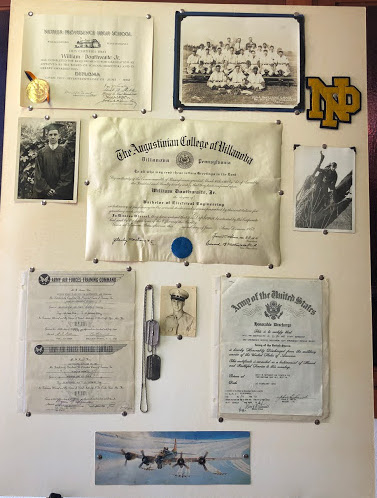
8 – My Dad was an electrical engineer in the 50’s through the 70’s, which meant he went to work in a white short-sleeved shirt and tie. My mom would send his work shirts out to be washed, bleached, starched and pressed at the local cleaners. When they picked them up and brought them home, each was folded around a rectangular piece of cardboard. As kids, we loved those pieces of cardboard for drawing and coloring.
7 – In the summer, Dad would often sit on the back steps and smoke a cigar. Usually a Phillies blunt. Sometimes I would sit out there with him and just talk about whatever, throw a ball for the dog, or just watch the sunset yield to the night. Just before the ash fell, he would tap it into his palm and toss it out into the grass. It was all about the timing.
6 – One summer, when I was in elementary school, Dad went to a salvage yard and bought a whole bunch of wooden planks. After we pulled all the old nails out of those planks, he helped me and my neighborhood friends build a “fort” at the bottom of the hill in our backyard. It certainly wasn’t fancy, but it did have a window and door, shingles on the roof, a dark green coat of paint, and a door. My friends and I spent a lot of time playing in that fort.
5 – My Dad had played some high school baseball and had a glove from the 1930’s that was much different from the baseball gloves of the 1960’s and beyond. The baseball gloves of my generation were huge baskets, but his was little bigger than his hand. His glove meant you had to use two hands to catch. The gloves of my generation let you use one hand to grab the nastiest grounders. Dad spent a lot of time teaching me to throw and catch, a skill that kept me busy with friends for many years.
4 – My Dad commuted to work in Camden, NJ and Philadelphia, so he was usually the first one up in the morning. His go to breakfast was Wheaties. Every morning, he would be up about 5:30 am he would be up eating a bowl of Wheaties with milk before he got dressed and caught the train to work. I remember getting up early just so I could sit with him and have a bowl of cereal and enjoy his company before he went off to to work and I walked to school.
3- Speaking of vegetables, Dad always had an all-star garden. He grew tomatoes, peas, green beans, peas, beets, carrots, kohlrabi and radishes. In front of our house, though, he planted and cared for beautiful flower gardens. From tulip and hyacinth bulbs in the spring to gorgeous azaleas and mums, the front our house was a gallery of color.
2 – My Mom was a pretty good piano player, and she would sometimes play classic sing along tunes that my Dad would harmonize to. The song I especially remember is “Moonlight Bay.” Sitting in church next to Dad, we learned to harmonize to many church hymns.
1 – When my brother and sister were old enough, Mom went to work on weekends. She was a nurse and picked up weekend shifts at the local hospital. My Dad had to make supper and feed us. His go to meal was Hamburger Helper, or sometimes, just browned hamburger and brown gravy. We ate this along with bounty from his garden, which usually included green beans, tomatoes, radishes, kohlrabi, carrots and in the early spring, lettuce. He also made some instant mashed potatoes for the gravy. We grew up thinking he was a pretty good cook!
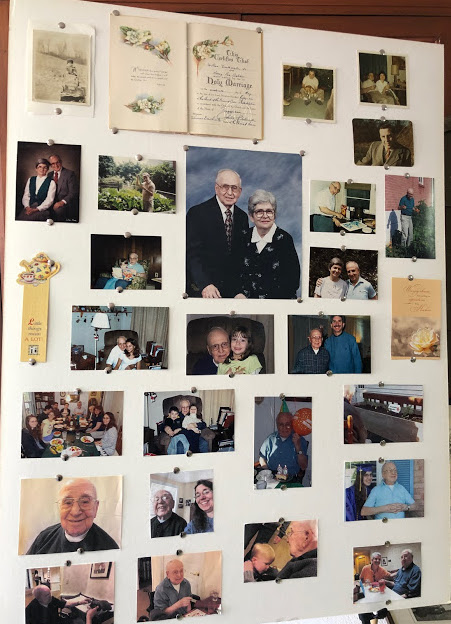
There you go – my memories of Dad, each of which brings a smile to my face!
After I recently booked a flight on an airline website, they gave me the option of renting a car, which I would need for a few days at my destination. To my surprise, the most affordable option that popped up was from Hertz. Usually they are the highest priced rentals, so I usually go with Alamo, Thrifty, Budget, whatever. I was taken in by a nice low daily rate, and also the promise of the “Manager’s Special.” I wasn’t sure what that meant, but it sounded good. I booked a car for a few days.
When I got to the airport and went to the rental counter, everything was in order and I was directed to the area where I could pick any car I wanted from section 3. I walked through aisles and aisles of cars in sections 1 and 2, and finally arrived at section three, where just three cars were parked.
The first one I went to, a Hyundai Accent, didn’t look too bad. But when I walked around, I saw it had a cracked tail light. So I decided to check out the small Toyota just a few spots away.
It was an iA. Never saw one of those before. When I tried the doors, though, they were all locked. The keys were inside the car, but I couldn’t get in. I looked around to see if anyone could help me. The little rental hut for Hertz was about a mile away, and there was no other human being in sight. So forget that one.
I still had a third choice. An even small white Toyota Yaris was parked at the end of the row. It was a little smaller than I wanted, but it was just for a few days, so I figured why not. When I reached in to get the key, it was just that, a key. No fob, no automatic locking doors. Roll up windows, too. When I tried the key in the hatch to put my suitcase in, the key wouldn’t even turn in the lock. My experience just kept getting better and better.
I went back to the first car and made sure the tail light still worked. I also made sure to show it to the attendant at the exit gate. She didn’t seem all that concerned. She made a note on the rental agreement, and without a smile said, “Have a nice day.”
Now that I understand how the “Manager’s Special” works, I’m pretty sure I’ll be passing up that offer in the future.
I was the third of three preachers at my Dad’s funeral. My son Adam (pastor at Our Redeemer Lutheran Church and School, Dallas, TX) went first, followed by my brother Jim (Pastor at St. Athanasius Lutheran Church, Vienna, VA), and then me. Here’s what I said.
“[The women] departed quickly from the tomb with
fear and great joy, and ran to tell his disciples. And behold,
Jesus met them and said, “Greetings!” (Matthew 28:8,9).
That’s a game-changer, isn’t it? It’s a life-changing moment
for the women who came to the tomb early on the first day of the week. It’s a
life-changing moment for Jesus’ disciples who were hiding in an upper room.
It’s a life-changing moment for us who have gathered here today in the name of
the one – Jesus – who met them and said, “Greetings!”
Just like us, those women and disciples were dealing with
death. On Friday, Jesus had been crucified. Some had heard the sound of nails
driven through his hands and feet into the wood of the cross. Some had been
there through the three hours of darkness. Some had been there to hear his last
words and witness his last breath. Others had wrapped his body in linen and
laid it in a tomb. A few witnessed the rolling of a huge stone across the
opening of the tomb, to seal it shut. It was a dark day. A sad day. A
tear-filled day. A Friday.
But these words are from Sunday, the first day of a new
week. The earth shakes. An angel comes rolls away the stone from the tomb. The
guards pass out. And the angel says to the women, “He is not here, for he
has risen, as he said.” (28:6). The tomb no longer contains a corpse.
It is empty. Jesus is no longer dead. He is alive. Jesus’ words about death and
resurrection are no longer a prediction. They are now a reality.
This moment really does change everything.
Jesus is clearly not just a man or a great
teacher. He is truly the eternal Son of God.
We can believe every word Jesus says.
We are not simply sinners who will always fall
short of God’s glory. Jesus died in our place to pay for our sins. We are
forgiven. We’ve been declared righteous. We will share his glory.
The
grave cannot hold God’s people. Not for very long. “For the Lord
himself will [one day] descend from heaven with a cry of command,
with the voice of an archangel, and with the sound of the trumpet of
God. And the dead in Christ will rise” (1 Thess. 4:16).
These truths certainly changed everything for Dad.
Baptized ninety-five years ago, he became a
child of God.
He sought and found the truth in a lifetime of
hearing and reading God’s Word.
Words of absolution from his pastors (and his sons) continually and consistently announced God’s forgiveness for all his sins.
And now he waits, along with us, for that day, for that voice, for that trumpet and for the resurrection!
These truths have certainly changed things for me! Just
about every day I look at the picture of Mom and Dad holding me on my baptism
day, September 29, 1957, and remember that I too am a child of God.
Next weekend, when I am back in the pulpit, I’ll be
preaching about God’s discipline. The writer of Hebrews says that’s how you
know you’re a child of God. Discipline was a little bit different when I was
growing up, but Dad never hesitated to remind me that I was his dearly loved
son!
I’m not sure how he did it, but somehow Dad got us to fight
over who got to read the bible at family devotions. We had to keep a calendar
to keep the peace. I don’t remember ever doubting that God’s Word was
true.
One of the greatest gifts Dad ever gave was making sure we
met Jesus on the way. In the Word. In worship. In song. In prayer. In life. And
in death.
Very few people will ever hear of Dad’s faith. Yet his quiet faithfulness, left a legacy. Three pastors – so far. Three generations of children, grandchildren and great grandchildren – all zealous for the Lord. What a great gift to receive. What a great gift to pass along. And what a great gift to celebrate today!
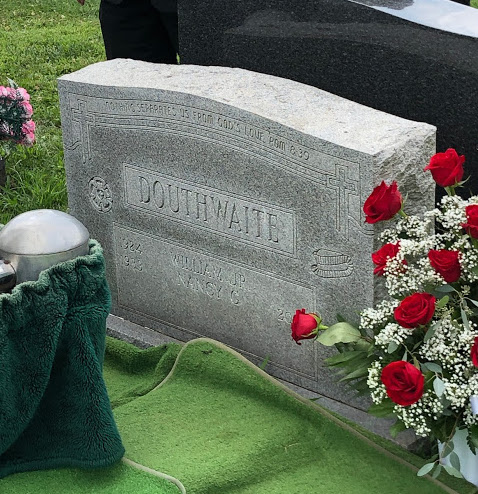
Preached at the funeral for William Douthwaite, Jr. (1924-2019) at St. Mark’s Lutheran Church, Ridley Park, PA on Friday, August 16, 2019. The entire service can be viewed here.
Funeral for William Douthwaite, Jr. St. Mark’s Lutheran Church, Ridley Park, PA
We had been getting ready for this funeral for three years.
That’s how long it had been since my Dad fell, his kidneys failed, and my
brother, sister and I gathered to say goodbye to him at age 92. By the time I got
there, though, he had rebounded and returned home after a few days in the hospital.
Rather than a funeral, we started making arrangements for assisted living.
Two years ago, still in the memory care unit of a very nice
assisted living facility, Dad stopped eating. Rather than another trip to the
hospital to find out what was wrong, we admitted Dad into hospice so he could
stay where he was. Once again, we gathered for what we thought would be the end
of his ninety-three year earthly journey. However, his appetite soon returned,
especially for ice cream and other desserts, and we did not need to make any
arrangements.
This summer, after about three days into the Dallas portion
of my vacation, I got the call that Dad had a fever that wouldn’t break, and
was less and less lucid each day. The hospice nurse predicted he would only
last a few days, if not a few hours. I quickly booked a flight as my sister
boarded a train, and we once again gathered to be with Dad.
This time was indeed different. Dad was on oxygen, was not
responsive, and indeed looked like he was at the end. My sister and I spend
three days there, watching and listening to his rhythmic breathing. We read to
him, sang some hymns, and agreed that even though this might be the end, we
would never bet against Dad recovering.
At the age of ninety-five, though, his body just couldn’t
fight the infection. No eating or drinking for days took its toll on his
strength. But not till he stuck around for another six days. I had returned to Dallas
and then home. My sister had gone home and returned over the weekend.
The call from my brother came early Monday morning, August
12. We had gotten home late, so we didn’t hear the phone buzz the first ten
times. Finally, I heard something about 4 am, and my brother confirmed that Dad
had died shortly after two, with him, my sister and sister-in-law holding his
hand. Calm, peaceful, and pain-free, accompanied by families on this side and
angels on the other. Not a bad way to go at all.
Over the next few days, my brother made arrangements for the
funeral that had long ago been planned for Dad’s long time church in Ridley
Park, PA and internment next to Mom at a cemetery in Aston. I booked flights
for my wife and I, my son, and one of my daughters who brought her youngest
along.
That Friday (August 16), a few family, friends and church
members gathered to worship, remember Dad’s life, and look forward to the resurrection.
My son, a pastor from Dallas, my brother, a pastor from Vienna, VA and myself
co-officiated the service and all took a turn preaching. My sister played the
organ and my nieces played violin. It was a unique and fitting moment for a man
whose quiet faithfulness had left a legacy of three pastors (so far), and three
generation of faithful children, spouses, grandchildren and great-grandchildren.
When you live to be ninety-five, you outlive most of your family
and friends. Dad was the youngest of seven children. His last remaining sibling
had died some fifteen years before. Five of my cousins who were still in the
area joined us that day. About half-a-dozen members of the church who had known
Dad were still around and attended the service. A few folks from my brother’s church
and some area clergy friends also attended.
While neither my brother nor I wanted to preach at my Mom’s
funeral fourteen years ago, we both wanted to speak for Dad’s. I didn’t know
how I would feel. You never really do, until you’re in the moment. My voice
cracked just once, when I spoke of Dad, along with us, waiting for “that day,
for that voice, for that trumpet and for the resurrection!” (1 Thessalonians 4:16).
My brother Jim spoke on Dad’s favorite verse from Romans 8, that nothing can
ever separate us from God’s love in Jesus Christ. My son Adam reminded us that
even though our hearts and minds are filled with great memories, the best is
yet to come when we get to be with the Lord.
My brother and I draped Dad’s casket with the funeral pall as my son reminded us of Dad’s baptism. We took turns reading scripture. Isaiah 55:6-13; Philippians 1:18-26; Romans 8:26-39; Matthew 28:1-10. We preached around some great hymns. “For all the saints,” “The Lord’s my shepherd I’ll not want,” “My hope is built on nothing less,” “I know that my Redeemer lives,” and “Jesus lives, the vict’ry’s won.” It sounds like a lot, but only lasted a little more than an hour.
The procession to the cemetery had to navigate some
interesting interstate traffic, but we all made it. After a brief committal and
military honors, many of us gathered at a nearby restaurant for lunch, memories,
laughter and a few pictures.
I had to get my son back to the airport for an evening flight
home. My brother’s family, my sister and my family then hung out at our hotel
suite that evening. That night was much more relaxed.
And just like that, it was over. Everyone returned home safely
the next day.
I’m still trying to figure out how I feel. I don’t feel sad,
but I know I’ll miss Dad. Our recent visits weren’t much. It’s not like I’ll
miss our conversations. He typically sat and snoozed while I sat and visited
with him. I’m a bit relieved. I didn’t get up there to visit him very often,
and I always felt a little guilt about that. My brother, on the other hand, was
there every day. This will leave a bigger void for him. We didn’t shed that many
tears. Smiles and laughter predominated those last few days and the funeral
service. Dad always made us laugh before, so why not now?
Most of all I’m just thankful. I’m thankful for what he
taught me, for my memories of him, and for the faith he and Mom passed along to
us kids.






 Waite for it...