Ed Stetzer has written an interesting article for Q ‘How Christian Consumers Ruin Pastors and Cheat the Mission of God’. I have often struggled with those folks who simply come to church for a product or service, not unlike taking your car to an auto mechanic or hiring a contractor to work on your home. It could be a baptism, wedding, funeral,counseling or some other type of inspirational entertainment. We pastors step in it all the time, willingly providing what we think people are looking for, fearful of what will happen if we do not continually attract and retain an influx of new people at church. How effective and healthy can ministry be if that’s the model?
In retrospect, it was so good to get away to Haiti for nine days. Even though it was an intense, tiring week, the only expectation was that I be a pastor. “Do justice…love kindness…walk humbly with your God” (Micah 6:8). Help people, show compassion, pray and preach the word. No meetings, few demands, and countless opportunities to proclaim the gospel in words and actions.
You get spoiled real quick. It’s freeing to not be hounded by time and schedules. So when you get back to the real world, it’s hard — real hard — to take seriously some of the things you used to spend time and energy on. Like meetings that accomplish little if anything. Complaints and concerns about our facilities. Shopping and travel plans for Christmas. A whole bunch of people who live in tents in Haiti, including many of our friends, are now in the path of a hurricane in the Caribbean. Suddenly, it’s real hard to focus on that other stuff. And maybe that’s a good thing.
This will be my last segment on Haiti, just some random reflections to tie everything together.
One question asked of me: “What did you do?” Among other things I fixed Gail’s glasses, played the part of an IV pole, learned how to take someone’s blood pressure, colored with some of the kids, and learned how to count to five and say, “Go to the tent!” in Haitian Creole. Most of the local people laughed at my south Philly-Creole accent.
We worshiped at a Lutheran Church on Sunday. Enock translated Pastor Benoit’s excellent sermon for us, and we thoroughly enjoyed the music, which included a grooving rendition of “Thy Strong Word.”
The Cholera outbreak cut out trip short by a day. News of the disease reached us early in the week, but it was in a region to the south of us. We were already taking precautions with the water, so we weren’t too concerned. Then, as the numbers of fatalities grew, we became concerned that there might be a quarantine or have trouble traveling, so we switched out flight to a day earlier. Other than another three-hour kidney-jarring, teeth rattling ride in the back of an SUV, travel back went smoothly.
Another question asked of me was, “Did you have a good trip?” I always answer, “No. It was rough.” It was rough to see the conditions the people live in and rough to not be able to do a whole lot about it. How many stomach aches were simply hunger? How many other ailments were due to dehydration? It’s hard to say. If the clinic continues to serve the people in Poto, then perhaps we did some good. If the experience will help us motivate others for mercy work like this, then perhaps it was a good trip.
We are already planning on going back with more from our church through the efforts of Mission: Haiti and the Florida-Georgia district of the LCMS. We keep in touch with many of our friends through Facebook and email. As I write this, a hurricane is just a few days from Haiti. A storm would be especially horrible for the thousands still living in tents and under tarps. Needless to say, we are doing a lot of praying for them!
Each day in Haiti was pretty much the same for us. Wait for rides, people waiting for the clinic, long, hot, dry days. But each day there was also a new adventure.
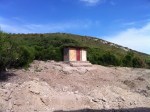
Like the outhouse. Up the hill from the church it didn’t look (or smell) too badly from a distance. But up close — watch out! Unable to last all afternoon, Gail decided to brave it, and could barely get in the door. Lisa gave it a shot on Thursday and it took just about everything she had to endure the “squat pot.” And that was before Quinton told us that he had gone up with a flashlight to look in the hole, and saw tarantulas crawling around in there. After that,
The outhouse: up close and personal
many decided it would be better to use the bushes around back. Safer — unless, like Jesse, you forgot to check for cactus.
The first few days, we got no lunch and there were few if any drinks brought in for us. Finally, we worked that out, but then faced another dilemma. How do you drink a soda or eat a sandwich in front of all these people who have so little to eat? Most of us felt like we had to take a swig or bite in hiding, because we couldn’t bear to do it with all those eyes on us.
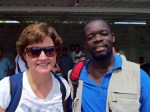
I asked one of our translators, Jean Enock, what he and his family usually ate when not helping out at the clinic. He told us he usually ate one meal a day, typically some rice and beans. That’s all. Known as Enock, he was in Port-au-Prince during the earthquake. He was taking a bath in his home when the tremors started, and he jumped out of the tub and ran outside naked before he pulled on a pair of shorts. I can’t imagine what kind of terror and panic there must have been that day. But that’s not the worst. Later that day, a wall fell on his father, killing him. Enock now helps care for his family, some of whom live in a tent next to the rubble that used to be his house. He was one of the most pleasant, helpful, thoughtful and easy-going people we met there.
When we were at the hotel, we were introduced to another unexpected bathroom custom. Even though we had flush toilets, you weren’t supposed to flush your toilet paper. You put it into a can next to the toilet, and they would empty it each day. If you remembered to give them your key in the morning so the housekeepers could get in there.
On Thursday, we discovered that the fish at the restaurant, red snapper, was pretty good and a good supper option. That day, a translator caught up with me and said a mother and her son wanted prayer. I later learned that the boy may have had leprosy, an ailment even the doctor hadn’t seen before. Another lady told her translator she wanted private confession, but then backed out before I had a chance to speak with her. Friday was the day we gave out lots and lots of toys, so much so that it looked like a carnival, everyone walking around holding large stuffed animals.
I forgot to mention in my last post that one of the people were glad to see at the airport in Port-au-Prince was our friend Lophant, who runs a children’s feeding program at numerous sites in Haiti. My wife, Lisa, met him on her first trip to Haiti last March, and our church has been receiving and wiring financial donations to Lophant to keep that program (and the kids) alive. Our visit was short, but we did leave him with a duffle bag full of clothes and other things for his family.
Back to our story. Having arrived at the hotel in Gonaives Monday afternoon, we hung out a little, had supper at the restaurant, did some devotions, and headed off to bed. The restaurant fare was limited: beef, goat, or chicken that first night, all of which was cooked very well. Every meal came with friend potatoes, fried plantain, a big plate of rice and some kind of beans, and a big bowl of sauce, which was actually pretty good. We drank a lot of beer while we were there, mostly Prestige, a surprisingly good Haitian brew.
On Tuesday morning (Oct 19), we were up early for breakfast, where the choice was either an omelet or spaghetti. Most of our Haitian friends eat their breakfast spaghetti with ketchup. We opted for omelets most of the time, and usually had avocados and bananas them.
Anxious to get started, we assembled at 8:30 to wait for our rides to arrive. At 9:30 we were still waiting for our rides to arrive. Thus we had our first lesson in “Haiti time.” Most things happened on a very relaxed schedule, so that took a bit of getting used to. Finally about 10 our rides arrived.
First stop: the guest house, where some medications had been stored. It turns out the guest house was under some major renovations, so we would be at the hotel for our entire time in Gonaives. The medical folks sorted through many boxes and totes full of medications, and packed up everything we thought we could use. Then we sat down and waited for our rides to return.
The clinic
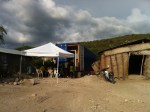
We finally got to the site of the clinic somewhere around 11:15, and unloaded our supplies. The “clinic” was a 40 foot shipping container that had been compartmentalized into three exam rooms and a pharmacy room. A generator supplied enough power for lights and fan, but no AC. The container was on a concrete slab next to an open air Lutheran Church built into the hillside. All set up, we saw the first patients about 11:45. The team worked till 6 pm, seeing 86 patients that first day.
Consider this process the next time you have to wait for the doctor. When someone arrived, they went into a thatched hut, received a number and waited. When their number was called they went into the church, signed in, and took a seat to wait. Next, they were seen by triage, and had vitals taken, and sent to another area to wait. When it was their turn, they were sent to a tent outside the container to wait to see the doctor or NP. After they saw the provider, they waited in the tent for medication. I think it took some people 4-5 hours to get all the way through the line. But I heard little complaint. They were very patient.
Feeling sorry for the waiters, I though, “Hey, I can be helpful.” I gave some blow up beach balls to some off the kids so they could play while waiting. The balls disappeared, but the kids returned with friends, looking for more balls. From that moment on, there was always a kid calling to me, “You!” and motioning his desire for a ball or bubbles or a toothbrush or whatever someone would give them. I wasn’t nearly as helpful as I thought I would be.
My role was chaplain for the group, as well as being available to talk to and pray with some of the people who came to the clinic. I did very little of the latter and not a whole lot of the former. I was more of a gopher, usher and utility infielder during the week. I did get to help our pharmacist Jesse through one brief emotional moment. And I did a lot of watching, hoping to get some insight into what it was like to live here.
Writing about my recent trip to Haiti will take multiple posts, so I guess I better get started. The problem is, it’s hard to know where to start. Someone advised me to come up with a short answer to the question, “So how was your trip?” My short answer is “grueling.”
I really can’t complain. Since the guest house where we were supposed to stay was being renovated, we had rooms at the Haberson Paradis Hotel in Gonaives, Haiti. So we had beds, shower, and meals. Not five star, but better than sleeping on the floor, in mosquito nets, in the heat.
Our medical mission team rendezvous-ed at a hotel right next to the Miami airport on Sunday, October 17. First time I’ve missed church in a long, long time. Our team consisted of myself (an LCMS pastor), Jacob (the team leader from Lutheran Church – Missouri Synod World Relief), Nancy (an MD), Nancy (a Physical Therapist), my wife Lisa (a nurse practitioner), Barb (an EMT/Paramedic), Barb’s son Quinton (a 16-year-old EMT in training), Gail (an RN), and Jesse (the pharmacist). Our mission was to staff a clinic in Poto, a rural area not far from Gonaives, stocking and equipping it to continue to serve the people of that area.
We met each other and shared some info about ourselves. Some had been to Haiti before, in the aftermath of the January 2010 earthquake. Our doctor had been to Peru and Lebanon on a similar mission. And some, like myself, were rookies. I would be serving as chaplain for the group as well as ministering to those coming to the clinic for care. Our discussion the first night revolved around what medications we brought, what we would need, and what kind of pizza to order for supper. We’d be up early the next morning for our flight to Port-au-Prince the next day, so we didn’t stay up too late.
When we met in the lobby the next morning, we realized that we had way too many bags to fit on the hotel shuttle. Each person had two bags to check, plus at least one carry-on each! But we squeezed everything onto one shuttle, and took off for the airport. Checking our bags and getting through security turned out to be pretty easy, so we were at our gate with over an hour to wait before out flight. Most of us set out in search of some breakfast and decent coffee. (The coffee in the hotel rooms was pitifully weak.)
After a somewhat turbulent flight to Port-au-Prince, we then had to get our bags out of the airport to the place where our rides were waiting for us. Like it or not, a swarm of porters was there to “help” us with our luggage. Swatting them away like pesky flies was marginally effective; we had to tip some of them. Finally we got loaded up in a pickup and two SUVs, and we set out for Gonaives.
Driving in Haiti is a little different than driving in the US. You mostly use horn and gas, only braking for holes in the road. The drive to Gonaives took about three hours and countless bumps in the road. Some of the scenery was gorgeous. Some was heart-breaking as we got our first glimpse of endless tent-cities in Port-au-Prince and a taste of what poor really looks like.
I get the feeling that the church has turned an amazing corner. All I heard about twenty years ago or so was how important it was for the church to grow. Most of our conversations at meetings and conversations were about how to make that happen.
Now it seems that we’re not so much concerned about how we grow, but where we go. Size isn’t as important as our presence in homes, community and in places where ministry is needed. The number of new ministries outside our walls rather than the number of new members is what we listen for in meetings and conference. Our energies are focused more into mission trips, shelters and food pantries, and community organizations than attracting people to our particular congregation.
As I think about that, I can’t help but wonder when we turned that corner. And what factors led up to that? Was it the economic crises of 2008? Was it a proliferation of natural disasters around the world that forced us to look outward? Was it fighting a war on the other side of the planet? A combination of these things?
If I had known our focus was changing, I think I would have spoken more against the new sanctuary we built in 2004-2005. We were growing at the time and felt like this was something we needed to do and do well. Just a few years later, handicapped by a much bigger mortgage than we had before, we couldn’t go quite as freely as we wished. Yes, we’ve been blessed by our facility. But how many others could have been blessed had we scaled back or stayed where we were?
Life is so much different now than it was five years ago. From the economy to social media to the administration in Washington, few could have predicted what the world would be like in 2010. Five years from now, we’ll probably say the same thing.
I am working on the gospel, Luke 16:19-31, for the sermon this week. It’s a tough passage that generates enough guilt on its own that you really don’t need to preach too much law. A rich man who enjoys life in this world ends up in a place of torment. A poor man, Lazarus, who lives a miserable life in this world ends up in a place of comfort. It’s a story that makes you realize how often you look right past the poor in pursuit of your own extravagant life-style. Extravagant at least in comparison to most of the world.
We were talking about this in Bible class last week, too, studying The Hole in our Gospel, by Rich Stearns of World Vision. We hear about the poor, empty food pantry shelves, and the needs all around us, but we really don’t see the poor. We know statistics, but we don’t really don’t know the people they speak of. For example, a public school teacher in the class shared that 56% of the children in our school district get free or reduced lunches. I didn’t know that, even though I know lots of money is being spent for that program. Those children are for most part invisible to the average eye, except to those who spend every weekday with them.
The bottom line in Jesus’ parable is to listen to “Moses and the prophets,” the Word of God. What the Word reveals is a God who steps into our world with mercy, justice and love. When we see what God is doing, we see who He came to save. The targets of His mercy suddenly have names, faces and lives. In this way He still opens eyes and invites us to join Him in this mission that supplies both physical and spiritual life in this world. Isn’t it amazing how His Word and Sacraments still open the eyes of the blind, the ears of the deaf, and heal the legs of the paralyzed!
Last night I had a free half-hour before my small group met, so I got to make a few phone calls to see how some folks were doing. During the first call, the person said, “I was just thinking about you. In fact, I was going to call you tomorrow.” I’ve found that to be the case too many times to be a coincidence. Somehow God brings to mind just the right person at the right time.
Anyway, they were going to call me with the idea to have our congregation write our own Advent devotional booklet this fall. Not necessarily a new idea, but a new idea for us. It’s a project I’ve sometimes dreamt about, but never implemented. You don’t know how nice it is to hear someone say, “I’d like to organize it.” All I need to do is give her a list of twenty-seven Bible verses, organized around an Advent theme, and she’ll do the rest: enlist writers, gather devotions, and get the collection to our office for duplication and distribution. Pretty cool.
Of course, that means I have to start thinking about Advent, which begins November 28 this year. I’ve found that advance planning sometimes makes you feel like a time of year is already upon you when it really isn’t. Kind of like a time warp. I have to remind myself it’s only September. Whew. But not too early to plan for the busy month of December.
So if you’re a Shepherd of the Coast reader, you read it here first. You’ll have a chance to share a little of your Advent and Christmas thoughts to help others zero in on that time of the church year. Last year we introduced Advent Conspiracy, and challenged ourselves to worship fully, spend less, give more and love fully, all gifts from God. I think we’ll take that to the next level in some way so that Christmas can continue to change the world.
Lately I’ve had a lot of walk-in business. Just like the hair salon where someone walks in without an appointment for a haircut, I’ve had a number of people walk in (literally, or by email, or by phone) in search of what I’ll call “spiritual services.” A number of people I’ve never met have called to ask, “Can you perform our wedding?” Or “Can my child(ren) come to confirmation class?” Or, “Can I do some community service hours at your church?”
My first response is, “Who are you?” Well, maybe not in those exact words. But I am always curious how people decided to call me. Remember, these are folks who have had no affiliation with our church and who have never met me. I’ve come to recognize that the church has become for many a place where you go to get certain spiritual services, just as you might go to Jiffy Lube for an oil change or to a chiropractor for an adjustment. There will probably be no lasting connection, but for the time being, you’re the right man for the job.
Sometimes there is a connection, albeit remote. “My friend’s grandnephew had a friend who knew someone whose wedding you performed on the beach.” Another interesting connection: “My daughter went to your church’s preschool years ago.” Or sometimes I get the call by accident. They thought I was someone else or our church was the one on the other side of the interstate.
So what do you do? How should I respond? Chances are once the service has been performed, I will never see them again. Am I just a technician who’s been certified in spiritual ceremonies? Over the years I’ve gotten a little more accommodating. I’ve come to accept each request as an an opportunity. The Holy Spirit must be at work in there somewhere. I may be part of a much bigger project to connect someone to God’s grace. I might meet someone else in the process who needs some good news (of which I have plenty to share). So I usually give them the benefit of the doubt. I’ll marry you. But you’re going to learn something about Jesus in the process. I’ll help you teach your kids. But we’re going to talk a lot about Jesus.
Lots of people came to Jesus for his healing or demon-casting-out services. But they came face-to-face with the Son of God. You never know.
 In retrospect, it was so good to get away to Haiti for nine days. Even though it was an intense, tiring week, the only expectation was that I be a pastor. “Do justice…love kindness…walk humbly with your God” (Micah 6:8). Help people, show compassion, pray and preach the word. No meetings, few demands, and countless opportunities to proclaim the gospel in words and actions.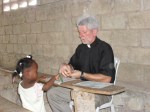



 Waite for it...