As my friend and I chatted over the last of our coffee, I absent-mindedly peeled open one of the foil wrapped chocolates the waiter had left on our table and popped it in my mouth. “Wow, that’s delicious!” I said. “Want yours?” He shook his head, so I went ahead and enjoyed the second one.
The breeze gently rustled the umbrella over our poolside table. Our waiter took our plates and left the check. I picked it up, quickly glanced at it, but then took another, longer look. Seventy dollars? That can’t be right. Oatmeal, omelette, side of bacon and a couple of cups of coffee. There must be some mistake. When our waiter passed by I asked, “Are you sure this is right?” He took a quick look and pointed out that the chocolates were $25 each! Really? They were good, but not that good! I thought they were free, just like the little Andes mints at Olive Garden.
When I took the check up to the register to pay, I mentioned that the price of those chocolates was a bit steep. The manager pointed to a little sign by the register in very tiny print, “Chocolates, $25 each.” Fine. I handed him my card. He slid it through the machine, handed it back to me, and then said, “Uh-oh. I’ll have to slide that again.”
“Not so fast,” I said. I pulled out my phone and opened up my bank app. “No way I’m going to pay for this meal twice!” I want to see if that charge was on my account before I let him try again.
And then I woke up. Yes, it was another of my recent, vivid, unusual dreams. I think taking melatonin to help me sleep also revs up my mind’s dream factory. But I’m always going to check twice before I eat some chocolates!
Behold Zion, the city of our appointed feasts! Your eyes will see Jerusalem, an untroubled habitation, an immovable tent, whose stakes will never be plucked up, nor will any of its cords be broken. (Isaiah 33:20)
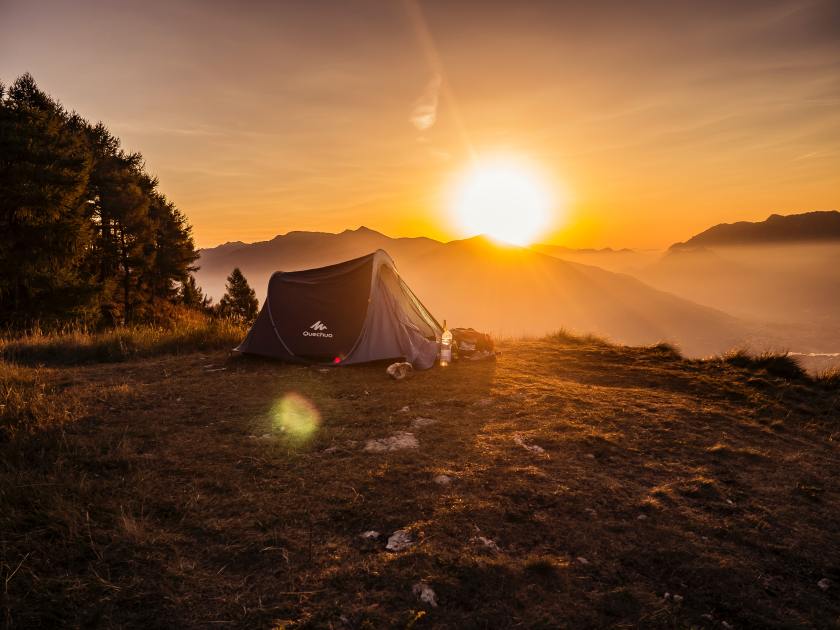
I’ve always liked the idea of crawling into a tent for the night. It feels snug. Secure. Even in a rainstorm. Isaiah’s prophecy made me think of some of my tent experiences.
While working at Bell Labs in West Long Branch, NJ, a few colleagues and myself decided to do an overnight century ride through a hilly central part of the state. My friend Ted mapped out a loop that included a place where we could camp at around the fifty mile point of the one hundred mile trip. We each brought a small personal tent and sleeping bag, some cooking gear and freeze-dried food and set out with everything tied to our Blackburn rear wheel racks. Nothing fancy, just what we needed for the night. It was cool to crawl into the two-foot high tent and zip up for the night, then roll it all up and head back home in the morning.
I went along to chaperone two trips to the Florida Keys with my son and daughter when they were in middle school. Their science teacher Mrs. T. led a trip every other year for seventh and eighth graders in a program for gifted learners. The campground was on Marathon Key, just before the seven mile bridge. Each time we took a bigger tent that was pretty comfortable for two people. Another chaperon brought his boy scout troop’s camping trailer, and we set up our own little mess in the center of our little tent community for the week. The most exciting part of the first trip was a tremendous thunderstorm that tore through the campground the morning we were scheduled to leave. We were pretty secure in our tent, but I remember unzipping a few inches and peeking out to see other tents, some still occupied, being blown across the clearing. It was actually pretty funny watching people stumble out into the storm. Thankfully the storm lasted less than half-an-hour, and we were able to pack up all our soaking wet stuff and head home.
I got my first taste of Disney World in the summer of 1994 when our family spent a week doing all the parks. We traveled in my in-laws RV and camped at Fort Wilderness for the week. The RV wasn’t quite big enough to sleep all of us, so my son and I slept in a tent. We had a great time, even though torrential rain showers came through every afternoon. One night the rain waited until dark, and the downpour pummeled our tent. We pretty much stayed dry. The RV, however, leaked! Life can be ironic.
I know we did a tent camping trip to Cape Cod sometime during my first few years in Connecticut. We either had one or two little ones with us. What I remember are the sights and sounds of Provincetown, not unlike the unique folks and lifestyle one experiences in the Florida Keys. The tent, cookstove and lantern were wedding gifts that we still stored in the attic thirty-six years later.
I count our popup camper outings as tent-camping experiences as well. We had a twelve-foot that we pulled with a Chevy Astro van. When cranked up and pulled out, we had plenty of sleeping room for our family of five. We took short trips to the Keys, Savannah, GA and Orlando, FL. Then we took our big trip to Maine, stopping in North Carolina, the Pocono mountains in Pennsylvania, somewhere in the eastern Connecticut hills and finally in Old Orchard Beach and Bar Harbor, Maine. That was a fun trip, even if it seems like we were always setting up or breaking down camp in the rain. Being up off the ground is definitely a more comfortable experience. Coming home we stayed at my parents’ house in Philadelphia and then a hotel somewhere in Virginia rather than campgrounds.
It’s been eighteen years since that trip. We sold the popup soon after. Now we’re getting back into it, sort of. We just bought a hybrid travel camper. It looks like a travel trailer, but the ends fold down to magically create screened-in canvas sleeping areas. It the best of both worlds since it feels like a tent, but also has a kitchen, dining and bathroom inside. I’ve got much to learn about pulling and parking something this big, but a few short initial trips will give me practice before we head out for something longer.
The bible often mentions tents. The tabernacle was basically a big tent. The Hebrew people celebrated the Festival of Booths by living in tents. Jael became a hero when she killed the enemy general Sisera who fell asleep in her tent. Psalm 91 promises no disaster will come near your tent. The apostle Paul worked as a tent maker. Our bodies are referred to as the “tents” we occupy in this life. A better tent awaits at the resurrection. The Word became flesh and “tented” among us.
I’ll be thinking about all that when I once again crawl into my “tent” for the night.
I usually do. I get up early on purpose, because I want to have the room to myself. I want to practice my sermon in an empty sanctuary before I deliver it to a living, breathing congregation. I need to hear my voice. I need to listen to the stories. I have to know what it sounds like before worshipers gather to sing, pray and receive my message.
I’ve got my routine. Unlock the doors, turn on a few lights, fire up the sound system, and fill up my water glass. I could do it in my sleep.
Five minutes into my rehearsal, I saw him. Back row, left side, on the aisle. Who in the world would be here this early? The musicians aren’t even here yet. I didn’t stop. I continued making points, adding illustrations and pointing out applications.
As I finished, I turned off the timer and walked back to meet this predawn arrival. Before I could say, “Hi,” he said, “I need you to open the safe.”
If was still a little sleepy before, I was wide awake now. “Well,” I said, “First of all, we don’t have any money here. Second, I don’t even know the combination.”
As you can imaging, my answer was not well received. He growled, “Well then, you better call someone who does!” I didn’t see a weapon. Maybe he had one in his pocket. I was still about ten feet away. No one else would arrive for at least half an hour. What were my options? Run? I can run. I would leave this guy in the dust. Give him my wallet? Sorry, no cash in there either. Stall? Sometimes the local deputies meet in our parking lot. When I glanced out the window, though, I didn’t see any cars. Call someone from the congregation who knew the combination and use a code word so they would call for help? I don’t think we have a code word.
Startled, I woke up. First the buzzing then the soft thudding my my phone alarm was going off. I reached over and turned it off. 4:30 am. My heart was racing. But it was a dream.
For the next several weeks, I carefully scanned the parking lot before I got out of my car in the predawn hours of a Sunday morning. I kept all the doors locked while I prepared for morning worship. I thanked God for the deputies conversing under the portico. I was also grateful for those long days of summer, when the sun arrives before I do.
Why were my dreams filled with such images in the middle of the night? I’ve never had a problem, never been threatened, never even thought about the possibility of being in danger. I’ve probably been watching too much police and detective TV, where such things happen daily in the lives of innocent people.
Anyway, if you were going to rob a church, wouldn’t you do it after the offering?
Have you every prayed that God would do something terrible to someone? I haven’t. Not ever. I didn’t think you were supposed to do that. But a few months ago, I was reading Psalm 109 and the author is asking God to do unthinkable things to folks who have lied, accused and attacked him:
Kill him, so his wife is a widow and his his kids to wander around begging for food!
Curse his ancestors and don’t let there be any future generations!
Let the banks and even strangers help themselves to everything he owns!
Make sure no one remembers that he even existed!
It’s one thing to pray and ask God to protect you from your enemies or make them go away. It’s another to petition Him to not only end his life, but make his family miserable, too!
Other prayer requests in the psalms call for horrible things to happen to bad people:
“Break the arm of the evildoer” (Psalm 10:15)
“Break the teeth in their mouth!” (Psalm 58:6)
“Let them be like the snail that dissolves into slime” (Psalm 58:8)
“Terrify them with your hurricane!” (Psalm 83:15)
“Let burning coals fall upon them! Let them be cast into fire.” (Psalm 140:10)
I don’t remember ever learning about this in classes on prayer. Nor do I teach anyone to do that. But these imprecations pour from the hearts of those who brought their petitions or sang songs to the Lord. That is why they are referred to as “imprecatory psalms,” which call for misfortune to happen to an enemy.
I don’t think these psalms show up very often in the propers of the day. Yet they are still very much a part of the inspired Word of God. They are also songs, lyrics that express the emotions and yearnings of God’s people. The authors are laying open their hearts in difficult times, turning to the one who declares, “Vengeance is mine” (Deuteronomy 32:35).
These kinds of psalms reveal our very human, very sinful nature. Sometimes we don’t feel like loving our neighbor, much less our enemy. We cry out for justice. We may not cry out to God, but we expect it from the governing authorities. So much is wrong in this world and we want a fix.
The “fix” isn’t always punishment, though. Sometimes the fix is mercy. Or forgiveness. Or kindness. Or sacrifice. Or redemption. When Jesus came, he brought with him some other options that aren’t as violent. He will take care of our enemies one day. Maybe not today, but one day. Just remember that the real enemy isn’t flesh and blood. The real enemy is spiritual. And He’s already won that victory.
I know it hasn’t been that long. It just feels like it. This is July. It was back in March when we first became concerned in our community. Churches stopped gathering for worship, restaurants closed, doctors cancelled appointment, nursing homes and hospitals restricted visitors, toilet paper flew off supermarket shelves and we started wearing masks.
It’s been four months. We’re worshiping at church, but at a distance. A few can go to restaurants. I’ve caught up on doctor appointments. There’s plenty of toilet paper but hardly any hand soap at the store. More people are wearing masks. And the news is still mostly about Covid-19. It feels like it’s been four years. I feel like Bill Murray in Groundhog Day. I wake up every morning to the same news. More people are sick, more people are dying, more people are wearing masks, and more people are angry about wearing masks.
Is there an end in sight? Yesterday I read that most of the research to find a cure or produce a vaccine has yielded little if any results. Those who like to make predictions estimate it will take five to ten years to get past this. If we do at all. It already feels like we’ve been doing it that long.
During a phone conversation today, though, I realized it’s almost been a year since my dad died. A whole year? Already? Those eleven months have flown by. Time is time. It passes at a constant rate. So why is my perception of time so different when applied to different chapters of my life. Why does time sometimes seem so long, like the line to get on the roller coaster, and other times short, like the ride itself? Why do the first hundred miles of a long trip pass quickly, while the last 100 seems to take forever?
Plenty of people have asked that question. How many have come up with an answer? None that I know of. I do know that time passes because I measure it. I watch the clock, I have a schedule, I have events on my calendar and appointments to keep.
Sometimes on my day off, I take off my watch. I don’t worry about the time. And when I do that, time doesn’t bother me, either. On those days I’m never late, I’m never rushed, it’s OK if I have to wait for something or someone. I find that fascinating. It’s like I can step away from time when I need to. I should probably do that more often.
I got invited to a virtual tea party the other day. I joined my grandchildren in Texas for a few moments as I had a cup of coffee and they ate homemade cookies and drank some tea with plenty of milk and sugar. As I watched them enjoy their afternoon snack, I was impressed by how focused they were on the task at hand. 100% of their attention was focused on eating freshly baked snicker-doodles. I sipped my coffee, chatted with my daughter-in-law, took note of a message that popped up on my phone and tried to snap a few screen shots of our long distance time together. For the little ones, though, it was as if nothing else existed except those cookies.
I am jealous of their youthful ability to focus. I think I’ll enlist them to be my productivity coaches! My world is filled with distractions as I try to get things done. I’m often trying to do too many things at one time. I eat while watching TV, clean while listening to music, talk on the phone while watching the dog. Even though preschoolers can have a short attention span, I took away these lessons on focus from that occasion.
Just have one thing in front of you. They had nothing in front of them except two cookies on a paper towel and a cup of tea. No crayons, books or toys. Just the snack. And they enjoyed every bite. It wasn’t till after they were done that we chatted.
Set a time. The tea party was scheduled for 4:30 pm, so that’s what we did. Block out the time. Put your task on the calendar.
Have a goal. Know what you need to get accomplished. Eat two cookies. Drink one cup of tea. For me it might be writing a certain number of words or making a certain number of phone calls or making a lesson plan.
When you’re done, you’re done. When the cookies are gone, it’s time to play. Or color. Or build legos. Finish one task, then move on to the next.
Be in the moment. They savored every bite and sip. They had just one thing to do: enjoy the snack!
I don’t know how many articles and books I’ve read about focus and productivity. I’ve learned a lot from many sources. But lately, I’ve learned even more from the little people in my life!
As a parish pastor, the majority of my conversations contain some reference to God. Lately, the majority also include information, comments and opinions about the Covid-19 pandemic. And many of the folks I talk with want to know if there’s a connection between the two.
Some interpret the millions of positive tests as a sign of the end, since biblical images of the end times includes pestilence. Some view the virus as punitive, God’s judgment on an ungodly world. Still others see it is a call to repentance, urging unfaithful people to turn back to God.
I’m extremely cautious about trying to connect the dots between current events and the actions of God. I remember a few guys in the Old Testament who tried to figure out what God was up to. Job and his friends thought they had all the answers. Boy were they wrong!
At the beginning of the book of Job, God grants Satan permission to test Job’s faith. Satan thinks Job is only faithful because he is blessed. Take away the good stuff, and Job will fold. He’ll curse God to HIs face. God says, “OK. Give it your best shot.” Job suffers the loss of his house, all his livestock and his house. In response, Job went to church. He worshiped God.
Satan raises the stakes. If you take away Job’s health, Job will curse God to His face. God says, “He’s all yours. Just don’t kill him.” Job breaks out in sores all over his body. He is miserable. Yet he still doesn’t say one bad thing about God.
Three friends come to sit with Job, and for the first week, no one says much. But then they all begin to offer explanations as to why Job is suffering as he is. Their theories don’t sound that bad.
Job must have done something to deserve this. God must be disciplining Job. Get your act together and God will once again bless you.
That theory makes sense to me. If you get caught speeding, you get a ticket. Pay the fine, go to traffic school, drive more carefully in the future. Case closed.
Job’s not buying their diagnosis. His big question is, “What did I do wrong?” He follows up by asking, “What did I do to deserve this?” He my not be perfect, but did Job really deserve so much misery? And finally he wonders, “If I’m that bad, why doesn’t God save himself a lot of trouble and just let me die?”
Job’s words make sense, too. At the very beginning of this book, wasn’t God just boasting about what a good guy Job was? Surely there must be others that needed discipline a lot more than someone like Job. Job makes a good point when he points out many despicable people that aren’t being disciplined. It just doesn’t add up.
In the end, they are all wrong. They have no idea what they are talking about. Every attempt to explain God and how things work is misinformed. They are oblivious to what is happening in the spiritual realm.
I am very aware that I am not aware of everything God is up to. For me to speculate about God’s judgment on some and not others is far above my pay grade. My best guesses about the end would be ridiculous. All I know for sure is what God has told me in His Word. I know I deserve to punished for my sins. I know I’m not punished because Jesus was crucified for my sins. I know I’m going to die one day. I know I’ll be resurrected one day.
Those truths get me through good days and bad days, health and illnesses, hurricanes and beach days, unexpected bills and unexpected blessings. What is God up to on days like that? Who knows?
A few months ago I swallowed my pride and apologized to someone because I had hurt their feelings. I said “I am sorry,” and they replied, “I accept your apology.” I was relieved to hear that and we were able to move on.
Thinking back to that moment, though, I believe there is a difference between saying, “I accept your apology,” and “I forgive you.” Accepting my apology simply receives my admission of guilt but gives nothing in return. But when someone says, “I forgive you,” they have given me a priceless gift.
Forgiveness is costly. God’s forgiveness costs the life of Jesus on the cross. After our confession, the words of absolution, “I forgive you all your sins,” are His precious gift to us. “Apology accepted” would leave me wondering how God felt about all this. Forgiveness, on the other hand, leaves no doubt. We’re good!
In a similar way, when I say, “Thank you,” I mostly hear the reply, “No problem.” When I get a “You’re welcome,” I do a double take. “No problem” simply receives your gratitude as if it were no big deal. I simple “You’re welcome” raises the value of your appreciation.
Maybe it’s not a big deal. But since that moment, I have consciously and deliberately said, “I forgive you” and “You’re welcome.” In a time when I am more likely to hear impatient, angry and abusive words, I want people to know I value and appreciate them.
My vicarage congregation Berea Lutheran Church on E. Oliver Street, Baltimore, MD with our house in the background. Photo is from 1985
I’ve wanted to and needed to write this post for a while, but just had way too many thoughts and questions running through my head.
Racial justice is a big deal. It has been for a long time. I instinctively want to deny any trace of racism in my thoughts, attitudes, words and actions. I want to claim that I do not treat anyone differently because of the color of their skin. But I know that’s not true. I may not even be aware that I am doing it. But I know I am not immune from it.
I grew up in a suburb of Philadelphia knowing few people of color. Communities just to the east and west of ours were very different, but we rarely ever ventured there. Glancing through my high school yearbook from forty-five years ago, our football, basketball, baseball and wrestling teams were all white. I heard about discrimination, prejudice and racial tensions, saw a little bit on TV, and talked some about it in school, but that was about as close as I got.
The student population at college was a little more diverse. However my cultural education there came mostly from friends and classmates who grew up in the Jewish faith, which I knew little about. I had a smattering of friends from different cultural backgrounds, but our primary focus on academics blurred most distinctions.
My first job with Bell Labs brought me into a little more of a multicultural setting. My department included a variety of engineers from India, Pakistan and the Middle East. As I struggled to tread water in that sea of genius, I was in the minority as a humble “code jockey.”
A few years later, I found myself at the seminary, making a significant career course correction. Though you’ll find them all over the world, the Lutheran church is predominantly white European and Scandanavian in tradition. I had a few black classmates, but as I struggled to tread water in another sea of genius, this time theological, race was the least of my worries.
And then came vicarage. For those unfamiliar with that term, a vicarage is an year-long internship at a church half-way through residential seminary education. A coalition of ten churches in Baltimore secured a grant to host five vicars a year for three years. Would I be willing to go to the inner city for a year? “Sure, why not?” said this naive suburban white student about to marry a young lady from rural southern Indiana. That’s when it got real.
The two churches we would serve put us up in a row house in a neighborhood where we were the only white people for miles. The only exception was two other vicars who lived next door to us in an adjoining house that year. The house had been burned out during a riot a number of years ago. With a little repair and paint, it was inhabitable. (Note: Were she to describe it, my wife would not use that adjective.) On the other side of our house, across a small yard, was a black Lutheran congregation where I would learn to preach and teach. Across the street was an elementary school attended by at least six hundred children all from black families.
The culture shock was seismic. I was told to wear my clerical shirt most of the time. At that time and in that community, the clergy were held in high regard. Our neighbors knew who we were and why we were there, and they looked out for us. The children quickly discovered our dogs and came over often to run around the yard with them. The sounds of the street lasted into the early morning hours, including music, loud conversation, even louder cars and gunshots. The church doors were shut and locked when it was time to start worship.
It took months to get used to our situation. I felt safe enough to go for a run in the early morning when no one was yet out on the street. We became comfortable shopping in local grocery stores, tasting unfamiliar foods and patronizing local businesses. Having two large dogs made us feel more secure. (Large dogs were also well-respected.) I cut my preaching teeth by preaching every other week while my wife got some experience in social work. I learned much from other pastors in black clergy caucuses whose meetings I attended. I had so much fun tutoring neighborhood children and taking some of the teens to summer camp.
Sometime during that year, something clicked. It wasn’t really racial distinctions we were adapting to. It was life in an inner city. It was life in the south (south of the Mason-Dixon line). It was life in an industrial urban setting. The foods we learned to eat were local blue crabs and oysters as well as greens and sweet potato pie. The choir sang pieces from a rich southern gospel tradition, creating harmonies we never tired of hearing. Not only did we grow comfortable in that setting, but we missed it after our year there was up. I am so grateful for the pastors and people of that community who taught us so much.
We had no idea where ministry would take us. My wife had no idea she would one day be sleeping in a small bug hut on a concrete floor in Haiti, just six months after the devastating 2010 earthquake. We had no idea that we would find ourselves out in the middle of Kenya and Madagascar, sleeping under mosquito nets, eating interesting food, not daring to drink the water and hoping we didn’t have to use the squat pot out back. Each and every time we would reminisce, “If we could survive that year in the city, we can do this!” Each and every time, the people we met and helped were so gracious, so appreciative, and so caring.
To tell you the truth, I think we had a harder time adapting to life at my first church in eastern Connecticut. It took us longer to get used to the New England attitudes and culture, where the population was all white. I also think it was harder to truly feel comfortable at my second parish in Iowa, where life revolved around agriculture. My experience just didn’t equip me to talk intelligently about hog farming, soybeans, hail insurance or commodity futures.
My third and current church in Florida was a refreshing change. The congregation and community was well-seasoned with people from Jamaica, Honduras, Barbados, India, the Philippines, Russia, Germany, Cambodia, Suriname, and Canada. And that just felt right. It still does.
So where am I going with all this? There are times when I feel suspicious or negative about someone whose skin color is different than mine, which some would call a racist attitude. But in such moments I have learned to pause and ask myself, “Why?” Why do I feel that way? What do I really know about that person? Are they in any way a threat to me? Most of the time, they’re not.
More importantly, I’ve learned to ask, “What’s that person’s story?” And, “What can they teach me?” I am grateful for all who have shared their stories and taught me much over the years. Those simple questions do not pretend to ignore the differences but instead leads me to value and appreciate them. Maybe that’s a good place to start.