I don’t remember the exact sermons in which I used these words. I only remember being called on the carpet for using these words.
You’re curious, aren’t you? You can relax. I doubt these words will shock you, not compared to the language you hear everyday on the air, in podcasts, or in movies.
I used the first phrase when I was speaking about anger. I said something like, “He was really pissedoff.” I thought that was a familiar euphemism for being upset.
A few days later, a couple came by my office to talk to me. They were visibly upset and told me in no uncertain terms that they wouldn’t attend a church where bathroom humor was used in the pulpit. I had no idea what they were talking about until they explained to me their offense at the word pissed. I apologized and never used that word again in my preaching.
The second word I was called out on is slut. I must have been talking about one of the women in the bible with a “reputation” and referred to her as a slut. One couple in attendance couldn’t believe I had exposed their teenage granddaughter to such language. Having worked with youth for many years, I’ll bet she had a much broader vocabulary than her grandparents realized. But I apologized and never did use that word again in my preaching.
Of course, there are many other words a preacher should never use in a sermon. But those are the only two times I was challenged. I apologize for the click-bait title. You’re probably pissed off you didn’t get to read about something a little juicier than “slut.”
I figure I preached 2,000 sermons in thirty-six years of ministry. At around 2,000 words per sermon, that would total four million words from the pulpit. Two bad words? That’s not too bad.
While walking the dogs the other day (we take them out about twice a day), my mind wandered to some of the meals I ate while visiting new members and homebound folks. Coffee and cookies were pretty common. Sometimes good. Sometimes not. Sometimes out of a package. Sometimes homemade.
And sometimes I got a meal. Kathy was one I visited many times, while she was taking care of her father at home and then later when she couldn’t get out and around. But she could cook.
On one occasion, I had a vicar (pastoral intern) in tow when we went to visit her at lunch time. She roasted two whole chickens for us. These were surrounded by mashed potatoes, green beans, salad, and rolls. All this was followed by a Klondike bar for dessert. She always had six or seven varieties of Kondike bars in her freezer. That’s why you couldn’t find many in the store. It was enough food for a dozen people.
Pastoral ministry tip: just take a little bit of everything. Pace yourself. When pressured to get seconds, take even smaller spoonfuls. And, of course, leave room for dessert.
The day would come when Kathy couldn’t prepare meals for me. So she would have me take her out for lunch. We hit Olive Garden, Red Lobster, Alfie’s (on the beach in Ormond Beach, FL), TGI Fridays. She always paid, even though she was living off an impossibly small monthly income. She never ate much, but took home leftovers for the rest of the week. She also took home all the packs of butter on the table to go with the rolls.
When Kathy couldn’t physically get in and out of my car, she would have me stop and bring lunch. Her favorite was Chinese take out. While I would get General Tso’s chicken and fried rice, she would always request a large container of egg drop soup. When I arrived, she would drop a whole stick of butter into the soup container, and stir it until it all melted. I know, I little rich for me, too.
She also got meals on wheels each week. I got to try one of those meals. The microwavable meal was some kind of meat (the label didn’t specify), green beans, mashed turnips, and a roll. As I ate the meal she graciously shared with me, I remembered that I had eaten goat in Haiti, and banana soup and ugali in Kenya. I’ll live.
When she could no longer cook, Kathy offered me a pork roast out of the bottom of her freezer, underneath all the Klondike bars. When I asked how long it had been in there, she said, “I think it’s from last year.” It was over a year old.
That I said, “No thank you.” I wasn’t sure I’d live through that. One needs both faith and wisdom to survive in this world.
Another member I went to visit, S., had grown up in Cambodia. She escaped in the 1980’s, found refuge through a church in Michigan, and there met her husband. For my visit, she prepared enough food for twenty people. She deep fried two-dozen homemade spring rolls over a small backyard burner. To this she added multiple vegetable, noodle, and sesame seed side dishes. All for me. She didn’t even eat. She just watched me. I brought home a nice container of leftovers from her house.
And then there are many visits to ninety-eight year old B., who lived with her daughter, B2. Before Covid, B. would be awake most of the night and sleep late into the day, so she didn’t make church very often. It was a three-hour event when I came to visit. B2 always prepared a wonderful meal. I had chicken parmesan, tilapia, short ribs, meat loaf, pork loin chops. The sides were all kinds of vegetables, potatoes, rice, and bread. And of course, a dessert, most often some kind of cake or pie, with a scoop of ice cream. B. and B2. had lived in Bolivia back in the seventies, and had an arsenal of South American cuisine to draw from. Yes, it was always delicious. But it was also enough food for eight to ten people. I never had to worry about supper on the days I went to visit this family.
Every once in a great while, I would visit a family who offered me a beer. One such family thought I was German, so I had a choice of six imports that day. I only had one, since I still had to work that day and I also had to drive home.
P. who was a non-drinker, had the most extensive selection of beer and liquor in town. Whenever I visited him after his wife died, he always offered me a “bump and boost.” I think he meant a shot and a beer.
For me, the coffee (strong and black, please) was the best part. Caffeine is an essential part of an afternoon visit, if you catch my drift.
If I think of more snack and meal reviews from my time in ministry, I’ll be back to write a sequel.
I glanced at my buzzing phone on a Tuesday night and saw that one of my elders was calling.
“Hello, Pastor. I have bad news. I was making my regular monthly calls and found out that B. died last week.”
I’m not often blind-sided, but that news caught me off guard. “What? What happened?”
“I was just talking to M. and I asked how her husband was doing and she said, ‘He’s dead.’ He passed a week ago. I know, I was shocked, too. He had complications after open heart surgery. I wanted to be sure you knew.”
“Thanks. I’ll get in touch with her.”
I called her right away. I said I was so sorry to hear the news about B. She explained that he came through the bypass surgery just fine, but had problems after he came home. It was probably a blood clot, followed by liver and kidney failure, and then death. He didn’t want any kind of service, but the family might do something in a few months when everyone could get together.
On the following Thursday morning, at a men’s bible study, I let the group know what happened so we could pray for the widow and her family. A retired pastor who is a part of our group and knew her said, “I spent an hour and a half on the phone with her yesterday. She said they are having a service on next week and asked me to do the memorial. I told her, ‘Why don’t you ask Pastor Bill?’ She explained, “We don’t go to that church anymore.'”
I was puzzled. Didn’t I just see them in church a few months ago? Okay, they were one of the Covid-cautious members who I didn’t see often. But I had spoken to them regularly over the past two years. In fact we had a great conversation the last time we talked.
I learned a long time ago not to take something like this personally. She was grieving to be sure. People deal with death in many different ways. M. also hadn’t reached out in any way when her husband had surgery, was recovering, had problems, or was dying. If you let me know, I go. I go to the hospital, to your home, to hospice, wherever. But you have to let me know.
As I learned from experience, those who show up in your congregation from another church will eventually disappear. It might be months. It might be years. But they will move on.
I want to say this didn’t bother me, but here I am writing about it three years later. I’ve had it in my drafts for a while, wondering if this was a story worth telling. Someone once told me that our ordinary moments will fascinate others. Maybe this is one of those moments.
Those were the words of a retired pastor friend of mine who began attending our church after about fifty years of ministry. I appreciate his candor, but I really didn’t understand what he meant.
Until now.
Now I am retired from full time pastoral ministry, and for the first time in thirty-six years, my wife and I have had to pick a church to attend. We did not move after my retirement. We have a lot of family in the area, plus we already live in a place where many retire to (Florida). My denomination asked that we not attend the church I retired from, to let the next pastor and congregation get used to each other.
So for the first time in forever, we got to pick where we worshiped on Sunday morning.
Here is the challenging part of this whole experience. I have found it hard to not critique the preacher, music, facility, and experience in the places where we have gone to worship. I have always wanted God to be the focus of worship. But when I walk into a church, he’s the last person on my mind.
Were the people friendly? Was the preacher engaging? Was the sermon biblical and applicable? Was the music well done? Did I know the songs so I could sing along? What would people say if they knew I worshiped at this church? What did this church believe, teach, and confess?
I had so many questions. And you’ll notice, none of them had anything to do with the one I was there to worship.
Did I encounter the one true God? Was my mind renewed? Did I offer up a sacrifice of praise? Was I assured of God’s grace? Did Christ’s love compel me to love, serve, and witness to others people? How was I encouraged? How was I challenged?
When I was the preacher, I was occupied with the logistics, the message, and connecting with those who came to worship. Now, as the worshiper, none of those things were on my plate. Now my job was to listen, confess, repent, and live a new life.
In hindsight, I now realize that I should have taken more time off to be a worshiper in the congregation. I should have taken time to remember what it was like to listen, to question, to take God’s word to heart, and set out to live a new life. I believe a sabbatical would have been an asset to my ministry.
So I am learning how to worship again. I am forgetting what is behind – a career of pastoral ministry – and pressing on into retirement as a listener, a worshiper, and a member.
I mean, I go to visit people all the time. I visit folks who are first time worshipers with us. I visit others who are struggling with problems. I visit some who are recovering, sick or dying. I visit some just because that’s what pastors do. On site pastoral care is part of the job. But sometimes I learn the reason for my visit after I arrive.
I recently thought I was visiting a couple who had decided to join our congregation. Because of travel, hurricanes and family deaths, our meeting had been postponed for a while. We finally got together and had a really good conversation about church, ministry, the future and some of the uncertainties of life.
As often happens, ninety minutes passed like a moment. As I prepared to bring the conversation to a close and head home, something blipped on my radar. We had both lost a father in past three months. Her brief comment about grief, stress and sadness made me pause. I believe the Holy Spirit nudged me to stay, inquire, and listen to my friends talk about their loss. That’s the reason I was there.
Everything else we talked about, everything else on the agenda faded away as we shared stories about the last days of our fathers. She needed to speak. I needed to listen. Stories needed to be told. Stories needed to be heard.
I am thankful that I decided to simply listen. I wasn’t there to process a new member. Or answer their questions about our church. Or find out how they wanted to be a part of their ministry. I was there to listen to a grieving daughter mourn, remember and thank God for her father.
And I was there to mourn, remember and give God thanks for my father, too. Sometimes I forget that I am still processing this life-changing event from just a few months ago. Life moves on at such a fast pace that it’s easy to forget that we need time to figure all this out.
So, was this visit more for me or for them? Who knows? Probably both.
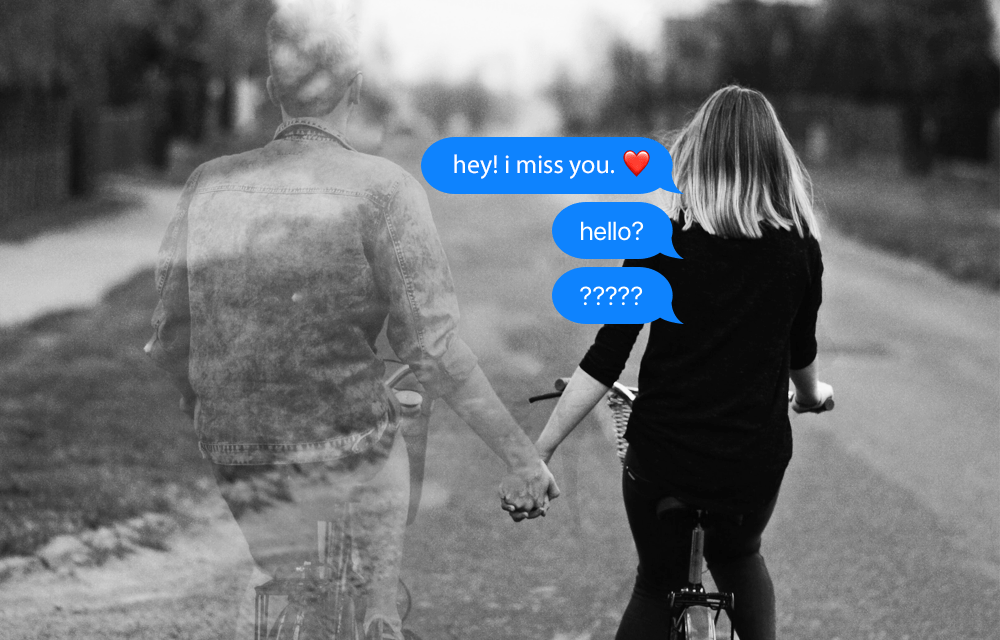
Yep, it happened again. Been there. Done that. And it won’t be the last time, either. But now, I have a word to describe the experience: ghosted. You’ve been ghosted when someone you know suddenly breaks off all contact with you and disappear, like a ghost.
My most recent experience was with an older woman who worshiped with us for about four weeks. A few weeks gets you a phone call and a post card. Three or four weeks, and I call to thank them for coming and ask for a visit. this person, pretty quiet on a Sunday morning, was hyper-talkative when I called. I learned so much about where she’s lived, her husband who died about nine years ago, and her recent experiences with churches that prompted her to visit us. She had grown up Lutheran, felt at home, and asked me, “Can I join the church?”
“Sure,” I said. “We’d be glad to have you. I’ll see you Sunday.”
That was the last time I talked with her. She never returned to worship. Did not answer phone calls or reply to voice mail messages. I had been ghosted. Just like that.
Her elder said to me, “I talked with her. She isn’t interested in coming to our church anymore.”
On my side of the equation, I was puzzled. Confused. Annoyed. Okay, I’ll admit it, angry. Why would you say that? Why would you do that? If you don’t want to worship with us, that’s fine. Go where you feel comfortable. I’m OK with that.
Maybe I need to imagine myself in her shoes. Her last church hurt her. We were her “rebound” church. Nice for a time, but certainly not for a lifetime. We were just a rest stop in her spiritual journey.
And that’s OK. We are here to proclaim, to serve, and to minister to all sorts of people looking for hope, light, peace, forgiveness or direction. They may stay for a long time. They may just stop in for a moment. We may simply be a stepping stone. A motel.
Some church will be blessed because we preached the gospel, we made her feel welcome, we recharged her batteries for her next endeavor. They will be blessed by her presence, her worship and her prayers. It’s like an assist in basketball or hockey. People keep close track of those things, because you can’t win without them.
After writing about ministry moments from the past thirty years, I thought of a few more that didn’t make the top ten list.
Representing the circuit at the 1998 LCMS Synodical Convention in St. Louis, MO. It was very interesting to see the synod at work, and a great opportunity to meet up with friends from all over the country.
Giving the opening prayer for the opening session of the Iowa state legislature. Our church was issued an invitation, the senior pastor had done it before, so I got the nod.
In 2004, while our sanctuary was under construction, my good friend and Embry-Riddle flight instructor Jim Petrucci took me up in a single engine training airplane and we flew over the nearly completed building where we worship today. I got some cool pix.
For several years, my dear homeless friend Eric Zimmerman would meet me when I arrived to open up the church at 6:30 am on Sunday mornings. Intelligent and inquisitive, Eric still reminds me that the homeless have a name, a face, a family and faith.
Sharing a year of ministry with vicars from the seminary 2005- 2008. Thank you Brett, Eric and Brian for letting me be a part of your seminary education.
Getting “pied” several times over the years, including Lauren and Kirsten Perrotta’s first Sunday at our church.
Those are some that immediately come to mind. I reserve the right to add to this list in the future as I remember some more.
Well, as Thanksgiving came and went, I knew it was time to make a decision. Acutally, by the time my family gathered for Thanksgiving, I had mostly made up my mind that I would be staying. How did I decide? That is a very good question. Continue reading “The Call (part 3)”→
David Hayward recently wrote a few blog posts about being visionless. The way I read this, rather than being a church that is driven towards goals by mission and vision statements, a church could instead just be the people of God who freely shared forgiveness, compassion, mercy and the gospel.
One of the reasons his posts struck in my mind is because I’ve never been good at “vision casting.” I don’t feel like I’ve ever been able to express a compelling vision around which the church can focus its ministry. However, I am very good at identifying when the church is being the church, when it is reaching both in and out, ministering to people in an amazing variety of ways.
For me, the most amazing part of this is that I had little to do with it. Recently, I made myself a list of the outreach ministries our congregation was involved in, ranging from stocking the shelves of a local food pantry to leading after school Bible clubs to distributing quilts and prayer shawls. I had very little to do with starting these ministries (which number somewhere abound a dozen), and I’m not a part of their ongoing work. This all comes from the hearts and souls of an amazing collection of people.
The only thing I can remember communicating was that if someone had an idea for ministry, they had to make it happen. If it wasn’t heretical or illegal, they pretty much had my blessing and support. Slowly but surely, they took me up on the offer. And maybe that’s what my vision was all along.




 After writing about ministry moments from the past thirty years, I thought of a few more that didn’t make the top ten list.
 Waite for it...