Posted in faith

Relationships instead of pamphlets

Out of the corner of my eye I see what looks like a stack of Benjamins. That can’t be legit. Not out in the middle of my driveway.

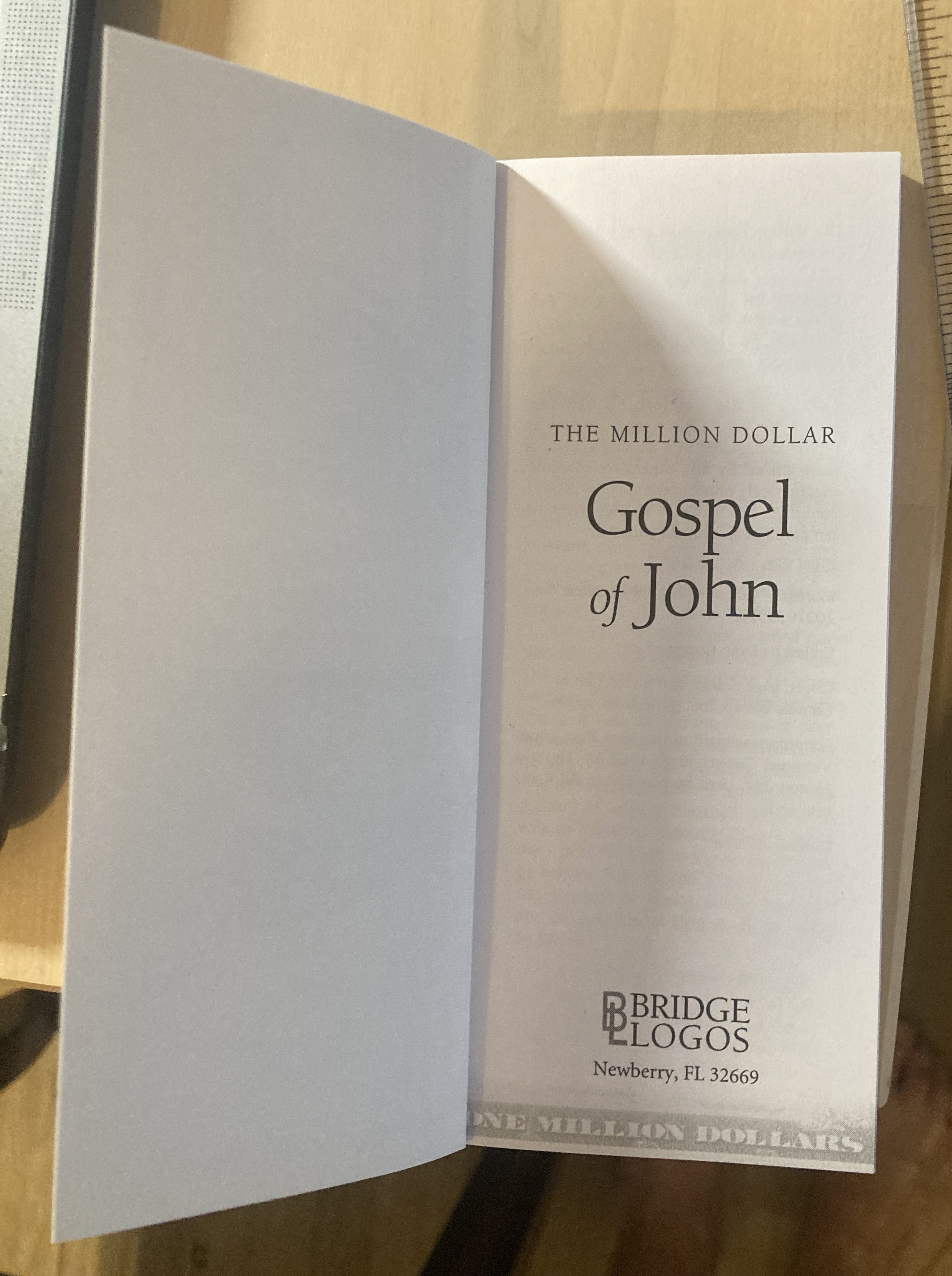
Sure enough, it’s a marketing trick. Small books with hundred dollar bill covers are in every driveway on our street. And it’s not just a wrapped stack of hundreds. It’s a $1,000,000 bill. Pretty clever. Gets your attention for sure.

The book? A King James Version of the Gospel of John. It’s an evangelistic effort by a group who wanted to get God’s word into every driveway in town. I can’t help but wonder: Is this what Jesus wanted his followers and his church to do?

A small shopping newspaper hits my driveway each weekend. I doubt that anyone reads them. They sit in driveways, week after week, simply disintegrating in the sun, rain, and traffic. Ironically, a cleaning company advertises their services by littering yards with zip lock bags of small stones and business cards. Few are opened, most end up in the trash.

So, lets add another small bag of trash to the landscape. Someone will open it, read it, and their life will be changed. If that happens, the verdict will be, “It was worth it.”

Really? Is that the best the church can do? Rather than engaging people in conversation, getting to know them, and talking about faith, we’ll trash up the neighborhood and hope that it makes a difference.

That’s not what the apostles did. They talked to people, helped them, and personally shared their faith with those who didn’t know about Jesus. They put themselves out there, like Jesus did, to disseminate good news.

I will never discount the power of God’s Word. But if you aren’t willing to get to know someone, care about them, and show them what love looks like, throwing a bunch of bibles at the world won’t do much good. The word of God became flesh for a reason. We need relationships much more than we need another book on the shelf or pamphlet on the street.

By the way, that weekly shopping newspaper finally went out of business. Thirty years ago, it was the place to learn about garage sales and contractors. In the last few years, it shrunk in size to just a few pages. Last week’s edition came with the announcement of it’s final printing. From now on, you could read it digitally. It also came with an envelope just in case you wanted to send money to the now unemployed delivery people.

Posted in Through the Bible Devotions

Tears of repentance and shouts of joy

Photo by Danie Franco on Unsplash

Once the walls of Jerusalem were repaired, Ezra publicly reads the scriptures (the Book of the Law of Moses: Genesis, Exodus, Leviticus, Numbers, and Deuteronomy) to a crowd gathered at the Water Gate. It was an emotional moment. “All the people wept as they heard the words of the Law” (Nehemiah 8:9).

I’m curious. When’s the last time you wept when you heard God’s word. How often do tears run down your cheeks during your morning devotion? Look around on Sunday morning. How many are weeping in church while scripture is read?

Why was this such an emotional moment in Jerusalem?

It’s been a long time since the last reading of scripture. These people have been in exile in Babylon for seventy years. Some in the crowd may have never heard God’s word before. The last time it was read may have been during Josiah’s reign in Judah, before the destruction of Jerusalem, nearly one hundred years ago. When King Josiah heard the words of a scroll they found when cleaning up the temple, he torn his clothes in grief and repentance, too (2 Chronicles 34).

When the word became flesh in the person of Jesus, some were brought to tears. A woman forgiven much would wet Jesus’ feet with her tears (Luke 7:38). Peter would weep bitterly after denying his Lord. Paul would write about admonishing the people in Ephesus with tears in his eyes (Acts 20:31). He wept as he wrote to the the church in Corinth (2 Corinthians 2:4). An encounter with the Lord who comes with great love can make us very aware of our great sin, which should touch our hearts in some way.

Apparently there was a little too much weeping as Ezra read. Nehemiah, Ezra, and the scribe had to tell everyone to cut it out. “Quit sobbing!” It’s a holy day, a “holiday,” and that calls for eating, drinking, and rejoicing. There is a time to weep, and a time to laugh” (Ecclesiastes 3:4). Plus, “The joy of the Lord is your strength” (Nehemiah 8:10).

Let’s circle back. When’s the last time you saw smiles and heard laughter when God’s word was read? Look around on Sunday morning. Is anyone filled with joy when the Lord speaks? Is anyone grinning or chuckling?

Why not? Okay, here’s a challenge. Let’s make an effort to respond to God’ word with tears of repentance or shouts of joy. I’m not talking about the sermon. Any preacher can stir emotions with stories and examples. If the reader stops and says, “Hey, can you tone it down a little,” you’re doing it right!

Posted in Advent devotions

Let ‘er rip!

What’s your reaction when you hear scripture being read? You know, like when you’re in church and the pastor reads a passage before a sermon.

Or what about this: how do you respond when you read the bible? You know, in the early morning when you are doing your devotions?

Do you laugh? Cry? Get angry? Feel guilty?

None of the above?

Do you feel anything?

That’s a penetrating question. It’s a bit convicting. I read scripture a lot. Every day, first thing in the morning. I read through the entire bible once a year. I’ve read the bible cover to cover at least three dozen times. I hear scripture read every Sunday in worship services. I listen to the bible through an app on my phone. I hear verses read aloud on Christian radio.

You know what? Most of the time I don’t feel anything. Most of the time, it’s an intellectual encounter with God.

Okay, so let’s compare that with how King Josiah reacted to a scripture reading. When workmen repaired the temple and found the scrolls of God’s Word, the king’s secretary read it to him.

“When the king heard the words of the Book of the Law, he tore his clothes” (2 Kings 22:11).

In Old Testament culture, that means he felt convicted. Josiah was distraught. Devastated. He was so upset that he tore his clothes, the ultimate expression of confession and repentance before God.

So maybe I should ask a different question when I encounter God’s Word. Instead of asking, “What does this mean?” or “How should I apply this?” or “What should I do (or stop doing)?” I could ask, “How does this make me feel?” Does these verses or chapter spark joy? Or do they make me want to throw my bible across the room? Should I be dancing? Or should my eyes tear up?

My dog’s tails betray their feelings. Depending on my tone of voice, their tails might be wagging with delight or be tucked under in submission.

Josiah gets a Jesse Tree ornament because he responded to God’s promises of a Savior. He knew he needed grace. I do too.

Posted in bible, faith

All-you-can-eat all-the-time?

Photo by Jill Sauve on Unsplash

Is it possible to do too much bible study? At first, it seems the answer would be, “Of course not!” How could anyone get too much of God’s Word?

I’ve discovered that you can overdo it. More is not always better.

A few weeks ago, I feel I overdid. First, I attended a Sunday morning bible class before worship. On Tuesday, I prepared for and participated in a Bible Study Fellowship zoom group discussion. That same Tuesday night, my wife and I gathered with our small group, which included bible study. On Wednesday night, I attended a men’s bible class at our church. In addition, I read scripture devotionally every morning. My wife does all of that too, prompting us to say, “It feels like too much.”

The thing is, I really enjoyed all of those moments. I look forward to my morning reading, journaling, and prayer. We’ve made great friends in our small group. The fellowship and support of the men on Wednesday night has been a blessing. Sunday mornings are great, worshiping with a larger group of believers.

But is it too much? Can a person taste and see that the Lord is good and get carried away, putting on a few too many spiritual pounds?

A colleague told me of a time when he invited a neighbor to come to church. His neighbor did, but didn’t return the next Sunday. He didn’t come the week after that, either. When he asked his neighbor, “Why haven’t you come back,” he replied, “I’m still working on all the great stuff I heard in the sermon three weeks ago!”

Perhaps we need time to process, ponder, and practice what we learn before we jump into the next chapter, study, or topic. Let it marinate overnight. Let the dough rise. Set it aside and then take a fresh look at whatever you read or listened to. Without that, you’re skimming across the surface of the water without ever considering what’s below. Don’t we need time to consider the “so what” of a passage?

Imagine reading a stack of owner’s manuals without ever driving the car or using the appliance. Imagine reading through a cookbook without ever preparing one of the recipes? That would get old real quick.

In 2011, Thom Rainer and Eric Geiger wrote Simple Church, encouraging Christians to pare down church involvement to one worship gathering, one bible study group, and one mission/service involvement per week. Doing too much church can detract from actually being the church. Good food for thought.

In the Old Testament, unless you were a rabbi or a scribe, you would hear God’s Word once a week in synagogue on the Sabbath. Recited daily prayers were taken from scripture. That was plenty for them. Maybe it’s enough for us, too.

I’m sure that someone can argue that most believers spend far too little time in God’s Word. You’ve got a point. But should we approach it as an all-you-can-eat buffet? That’s doesn’t sound healthy either.

Like many other things in life, it’s all about balance. What about the Goldilocks philosophy? Not too hard and not too soft. Not too hot and not too cold. Not too much and not too little. Just right.

Posted in Ministry, sermon

Sola scriptura

Transcription of Sunday, September 17, 2017 sermon. 

Sept 17 cover pic

October 31, 1517 Martin Luther posted 95 theses against indulgences in Wittenberg, at All Saints Church. That day is thought of as the beginning of the Reformation. As we get ready to celebrate the 500th anniversary of the Reformation in just a few weeks, we’re going to look at some of the phrases that grew out of that moment, which started a movement. All of those phrases include the word alone, or the Latin word sola. Like scripture alone, faith alone, grace alone, Christ alone, to God alone be the glory. Sola scriptura, sola fide, sola gratia, solus Christus, soli Deo gloria. We’re going to start with scripture alone, or sola scriptura.

As we’re talking about the Reformation, I know you’re going to have a lot of questions. It’s impossible to go as deep as we need in this short time we have on a Sunday morning. There’s a lot of history involved, a lot of politics involved, it happened a long time ago so the world was much different than today. It involved theology as well as economics. It can be a challenge to understand. But there’s good news. We’re going to start a new class on October 1, on Sunday mornings. An adult bible class where we’re going to unpack, unwrap these things so you ask questions. So sign up for my class. I already signed up. I was the first one on the list. I have to get ready anyway because I’m the teacher. But you’re all invited to come to my class about a Man Named Martin.

A good place to begin is why Luther posted these things to be debated in the first place. the answer is: he was very concerned about poor pastoral care going on in the parishes and churches in Germany. By poor pastoral care I mean that parish pastors or priests were not only encouraging but were profiting from the sale of indulgences. This is a simplified definition of indulgences. Basically an indulgence was a certificate of forgiveness you could receive for a donation to your church. It evolved into something you could receive for yourself or a loved one or even for a loved one who had already died, to make it possible for God’s grace to be applied to them. Basically, what was happening was that the pastors were selling forgiveness for contributions. This was approved and encouraged by the church. From Luther’s point of view, he just couldn’t make that line up with what he found in the bible.

In hindsight, as we look back we understand exactly what issues Luther had. In Hebrews chapter 10 the writers quotes the Old Testament prophet Jeremiah and talks about the covenant God makes with his people, “I will remember their sins and their lawless deeds no more.”  God’s promises to his people that he won’t consider their sins, they’re off the table, they aren’t an issue any more.

John 19, Jesus is hanging from the cross, suffering and dying, and its dark, everyone has abandoned him. Jesus says, “It is finished.” Sin has been paid for. The work of salvation is complete. It’s done.

The apostle Paul wrote to the Philippians about a righteousness that didn’t come from the law but came through faith in Christ, a righteousness from God that depends on faith (Philippians 3:19).

So all of these things in scripture make those indulgences unnecessary. But to say anything about that is to go up against the authority and hierarchy of the church which had tremendous power over people’s lives. The church had political, economic, and social power. To go up against that would take a lot of courage.

Eventually, Martin Luther finds himself standing before the emperor at the Diet of Worms in 1521, saying that his conscience was bound by scripture. What was in God’s Word had to be taken seriously and that every authority in the church was subject to what the scripture said. This would be the only rule faith and practice. Not traditions. Everything had to be measured against the scriptures. That’s where the phrase comes from. Scripture alone. Sola scriprura.

This is no shock for us, especially for those of you who grew up Lutheran or have been around the Lutheran church for a while. We’re familiar with the words of the epistle today where we read that “all scripture is inspired by God and is profitable for reproof, for correction, for training in righteousness, that the person of God may be complete, complete, equipped for every good work. Everything you need to know about God and to be God’s people can be found in the scriptures.


You can find out who God is and what he is like and how this world came to be. You can find out who Jesus is and where he was born and how he lived and how he is uniquely the son of a human mother and a divine father. You can find out what Christ did, what he suffered, why he did it. You find out how much God loves you and the future he’s prepared for you and what it means to believe. You faith can be complete just with the bible.

The important thing to remember is that at the time of Luther they didn’t have bibles. They weren’t walking around with bibles. The printing press had just been invented. Some churches didn’t even have a copy of the bible. All of their spiritual information came from their priests, who told them what they wanted them to know. No one could ask any questions, because no one knew any different. That’s why this is so revolutionary to actually have the scriptures and be able to measure everything against them.

From that idea we can ask ourselves the question: what’s your source of spiritual information? Where do you get the teachings that inform your faith?

The answer is amazing. You get spiritual information from me, your pastor, from other pastors you’ve know. From devotional books, bible study guides you use small groups. Maybe you’ve read commentaries, or used study bible, or listened to other preachers on the radio. You’ve watched them on TV. When you have a question you Google it. There are any number of religious information out there. All of this contributes to your faith.

Some have gotten spiritual truths from dreams or visions, or friends, or your family taught you things growing up. Some have consulted the occult, spiritualists or fortune tellers. All of this shapes our faith.

If that’s true, what does the idea of sola scriptura or scripture alone mean to us?

The best way to think about this is to picture all of the sources of information, all of those books, stacked one on top of another, with the bible on top. Everything must come under the authority of the scriptures. Everything is measured against what God’s word says. Scripture alone becomes the rule for our faith and practice. When I’m studying and preparing to preach or teach, I consult commentaries and what others have written. I had other teachers. I’ve had lot of sources of information, too. But they are all filtered through the word of God. Which we know is true. God doesn’t lie. He is faithful. His word informs our faith; it is the final authority.

As you measure everything against the scriptures, keep this in mind. First of all, the bible’s main message is to reveal to you God’s plan of salvation. To reveal to you who Jesus is, why he came, and what he did for you. it’s not just a book about how to live better, have a better life or prosper financially. The purpose is what John said, that you may know that Jesus is the Christ, and that by believing in him, you will have eternal life.

As we read that sometimes we read Law, and sometimes we read Gospel. Sometimes God’s Word shows us very clearly we’re not on the right track. Then it shows us God’s grace and forgiveness to get us back on the right track. That’s the Law and the Gospel.

And as we read these words, remember that we don’t take them out of context. We don’t use them for an agenda. If there is something in scripture you don’t understand, you hold it up against something in the bible that does make sense. We let scripture interpret scripture. We don’t force our own meaning on it. It’s not for private interpretation. The Holy Spirit moved people who wrote the scriptures for us, so that we would know it was coming from God.

What would you do if the bible was all you had? You have no internet, no commentaries, you’re phone’s not working so you can’t call the pastor, you have no bible study guides, nothing else but the bible. What would you do? You would still have everything you need. Here’s what I would do. I certainly wouldn’t go to the parts of the bible I don’t understand. And there are parts of the bible I don’t understand. I would always go back to the places where I hear God speaking words of peace and calm and reassurance and strength. I would always go back to the passage where Jesus says to the storm, “Be still.” I would always go back to the place where Jesus says, “Let the little children come to me,” because I know I’m one of his kids. I would always go back to the place where Jesus teaches me how to pray, so if I don’t know what to say, at least I would have something to say. Where do you go, if this is all you have?

Trust him. He will always have something to say to you. God has revealed everything we need to be his people in the scriptures. Sola scriptura. Scripture alone.

Posted in bible, Grace, Ministry

What if all you had was a bible?

a-worshiper-holds-a-small-bible-640x480Today in church I asked the question, “What would you do if you only had a bible?”

We get so much spiritual input from Google, TV and radio, devotional books, bible study books, study bibles, well-meaning friends and family, and our own experiences. All those things are helpful, blessings and important to our understanding of God’s word. But what if we didn’t have any of those things. What if all we had were a bible? Continue reading “What if all you had was a bible?”

Posted in Ministry

As clear as mud

The other day I was visiting a home bound member of our congregation, and after I read some scripture and talked about it for a moment, she asked, “I’ve tried to read the Bible, but I can never figure out what it’s talking about. Is there some resource that could help me?” I told her I would lend her one of my old study Bibles that I don’t use anymore, and explained how the notes on each page could help her.

But it got me thinking, even if we get people to read the Bible on their own (this is kind of a tangent from yesterday), how much of it do they really understand without someone explaining it (like Philip explained Isaiah to an Ethiopian) or some kind of study guide to help them make sense of what we’re reading? Some of scripture stands on it’s own, but so much depends on knowing the context, setting, author, purpose and what was going on in the world at that moment, and I’ll bet many readers don’t have that information when they sit down to read. Every once in a while I hear a story about someone who picks up a Bible, reads it, and comes to faith in Christ. But I’ll bet there are many more untold stories of those who picked it up, read a part of it, and put it down without understanding a word of it. It’s easy to forget that since I’ve been working really hard for the last 30 years trying to make sense out of it all.

If you’ve ever had trouble understanding the Bible, you’re in good company. The disciples didn’t initially understand a lot of what Jesus taught them. Jesus spent a lot of extra time with them after the resurrection, explaining how the scriptures all fit together around him. It’s nice when you have someone to do that with you. And I guess it’s important for me to spend time doing that, too. I think I’ll start sharing some of the resources and tools that help me get a handle on God’s Word.