Posted in Through the Bible Devotions

A relentlessly faithful God

On his way back to back to his homeland and family, Jacob encounters a camp of angels. But even with the backup of a heavenly army, Jacob is afraid of his brother Esau’s approaching force of 400 men.

Jacob starts planning for the encounter, preparing gifts, dividing his family into two groups, and praying. That’s right, Jacob prayed. At least he’s learned something these past twenty years working for his uncle Laban.

George Mueller wrote, “The most important part of prayer is the fifteen minutes after ‘Amen.'” What you do next speaks volumes about you and who you trust. Jacob is thankful for God’s provision, recalls God’s promises, and asks for his protection. So far so good. But the next day, he continues lining up gifts to pacify his brother.

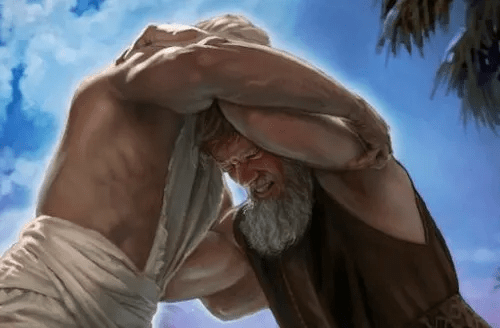
That night, Jacob wrestles all night with God (Genesis 32:24). He’s determined to get a blessing from him. Really? Jacob is on his way home with wives, children, servants and livestock. God has shown him kindness and faithfulness, given him the covenant promises, and dispatched the angel army to protect him. How much blessing will it take to get through to you, Jacob?

The world has taught us not to trust anyone. Anyone. I know most of our email, texts, and phone calls are scams. Stories and images are AI generated. Marketers manipulate me to like, desire, and buy things I don’t need or even really want. I understand completely why Jacob is cautious and has a backup plan.

However, God is relentless. He tirelessly shows us that we can trust him. He displays his faithfulness by fulfilling promise after promise. If there is anyone we can trust, it’s the Lord.

It just takes me people like me and Jacob (and probably you, the reader) a long time to take that truth to heart.

Posted in Through the Bible Devotions

What a ridiculous prayer

Photo by Jack Sharp on Unsplash

How bold are my prayers? Do I pray for what I think God would be willing to give? Or do I go out on a limb with a ridiculous prayer for grace and mercy? Will I go to bat for someone undeserving of anything but his wrath? Am I willing to ask for something I don’t — and never could — deserve?

Abraham prays with boldness and humility in Genesis 18.

Then Abraham spoke up again: “Now that I have been so bold as to speak to the Lord, though I am nothing but dust and ashes, what if the number of the righteous is five less than fifty? Will you destroy the whole city for lack of five people?” (Genesis 18:27,28)

From a place of extreme humility, Abraham isn’t shy about challenging God’s plan to destroy the wicked cities of Sodom and Gomorrah. His bold prayer originates from the dust and ashes of someone just as sinful, just as deserving of God’s wrath. He is not afraid to confront God, negotiate with God, and call God out on matters of justice.

“Maybe there are a few good people there.” Sure, keep dreaming Abraham. I know you care about your nephew Lot. He chose to live in Sin City, remember? His wife will look back and be turned into a pillar of salt. His daughters will use him to bear children who will torment God’s people for generations to come.

50? 45? 30? 20? 10 righteous people? If you can find that many, God will step back. He doesn’t. There wasn’t. God’s judgment is perfect, just, righteous, and appropriate. He knows what’s going on. He knows what he’s doing.

Abraham’s humble yet bold prayers remind me of something Paul wrote in Romans 8:34. There we read that Christ “is at the right hand of God and is also interceding for us.” The one who humbled himself and became a servant boldly goes to bat for us, as deserving of God’s wrath as any sinner in scripture. Forget about fifty righteous or even ten. “There is no one righteous, not even one” (Romans 3:10). We’re only spared because he took the full wrath of God on our behalf, “wounded for our transgressions and crushed for our iniquities” (Isaiah 53:5).

Both Abraham and Christ remind me that humility and boldness in prayer go hand in hand.

Posted in Through the Bible Devotions

Ask hard questions

Photo by Brett Jordan on Unsplash

God took Abram outside and said, “Look up at the sky and count the stars—if indeed you can count them.” Then he said to him, “So shall your offspring be.”

Abram believed the Lord, and he credited it to him as righteousness.

He also said to him, “I am the Lord, who brought you out of Ur of the Chaldeans to give you this land to take possession of it.”

But Abram said, “Sovereign Lord, how can I know that I will gain possession of it?” (Genesis 15:5-8)


So one moment Abram takes God at his word. But the next, he’s got a question: “How can I be sure?”

I think it’s interesting that faith and doubt go hand in hand. Faith doesn’t always displace doubt. Zechariah wanted assurance that an old man could still have a son (Luke 1). Gideon wanted some fleece signs (Judges 6). The apostle Thomas wanted to see the resurrected Christ with his own eyes (John 20). Mary wondered, “How can this be, since I am a virgin” (Luke 1)?

Well, that’s a relief. My questions don’t negate my faith. I can still ask God, “Are you sure?” “How are you going to do that?” “Are you serious?” “You want me to do what?”

Actually, doubts and questions are a wonderful sign of faith. You know God loves you so much you can ask him anything. Anything. He knows. He knows you have questions. He knows you have doubts. He knows his commands and promises are out there. Way out there. He knows it’s not going to be easy to trust him. It doesn’t bother him at all.

Just trust him enough to ask. He wants to hear from you. He wants to hear your questions. He wants to walk with you through your doubts.

Do you trust God enough to ask him hard questions?

After teaching a class, I usually ask, “Any questions?” If there’s silence, I wonder, “Was anyone listening?” I’m not the greatest teacher. And you’re all not ideal students.

Humor me. Just ask.

Posted in faith

Open the eyes of my heart, Lord

“I pray that the eyes of your heart may be enlightened in order that you may know the hope to which he has called you, the riches of his glorious inheritance in his holy people, and his incomparably great power for us who believe” (Ephesians 1:18,19).

I’m intrigued by Paul’s prayer that God would enlighten the eyes of their hearts. Hearts don’t see very well. Hearts don’t have eyes.

So I wonder, what can you see with your heart?

  • When my eyes see someone who looks a little rough around the edges, my heart can see with compassion. That person has a story that I haven’t yet heard.
  • When my eyes see someone sitting alone, my heart might see someone who needs a friend. Or at least acknowledgement that someone notices them.
  • When my eyes see death, my heart sees the living family and friends who will miss them.
  • When my eyes can’t see those who live far away, my mind remembers their faces and voices, and in my heart they seem so close.

Paul’s metaphor refers to those things that are real even if you can’t see them with your eyes. Things like hope, a future, and divine power. So much happens in this world that is completely out of our control. Yet, we have hope, because we know God has a handle on it. The future is so uncertain. Yet, we know God guarantees us a future. We might feel helpless, yet his divine power gives us strength.

Our faith vision — that is, the eyes of our hearts — is 20/20. Christ’s resurrection is a pair of glasses that helps us see a meaningful past, a wonderful future, and a hopeful today.

“Open the Eyes of My Heart, Lord”

Posted in running

Building Spiritual Endurance: Lessons from Marathon Training

“Here is a call for the endurance of the saints” (Revelation 13:10; 14:12).

No matter the meaning of the power and influence of the beasts and the wrath and judgments of God in Revelation, believers are called to endurance. Faithfulness is a marathon, not a sprint. This is going to take a while.

It’s been a while since I ran marathons. In preparation, I ran seventy, eighty, and sometimes ninety miles a week. I didn’t run fast. I just ran long distances for a long time. As a marathon race weekend approached, I would do long runs of sixteen, eighteen, and twenty miles, getting used to running several hours at a stretch. It wasn’t easy. But that’s what you do to be able to finish the twenty-six point two miles of a marathon.

How do we develop spiritual endurance? There are other scriptures that provide insight.

  • “The God of endurance” (Romans 15:5). He’s the source. God is faithful. He keeps going and going and going, faithful to his promises throughout our lives. “The steadfast love of the Lord never ceases; his mercies never come to an end” (Lamentations 3:22).
  • “Being strengthened with all power, according to his glorious might, for all endurance and patience with joy” (Colossians 1:11). Endurance flows from God’s power. While a capacitor provides a quick burst of electrical energy, a battery provides a constant source of power over a longer period of time. God can ramp it up if needed. But he’s also a constant, steady source of power.
  • “Let us run with endurance the race that is set before us, looking to Jesus” (Hebrews 12:2). As I read through the gospels, Jesus was never in a hurry. He traveled on foot. He stopped for those who cried out for mercy. He took time to rest, pray, eat, and teach. In contrast, I’m busy, impatient, rushed, and hate to be interrupted. What if I let him set the pace?
  • “Suffering produces endurance” (Romans 5:3). That’s the one I don’t like. It’s not going to be pleasant. It will be difficult. But you’ll be able to go further next time. You’ll develop endurance.

Do you want to follow Jesus? Are you committed to listening to him, learning from him, and doing what he says? If so, block out some time in your day, because it’s going to take a while to understand, trust, and do what he says. It’s going to take endurance.

Posted in faith

Time’s up: you’re no longer a noob

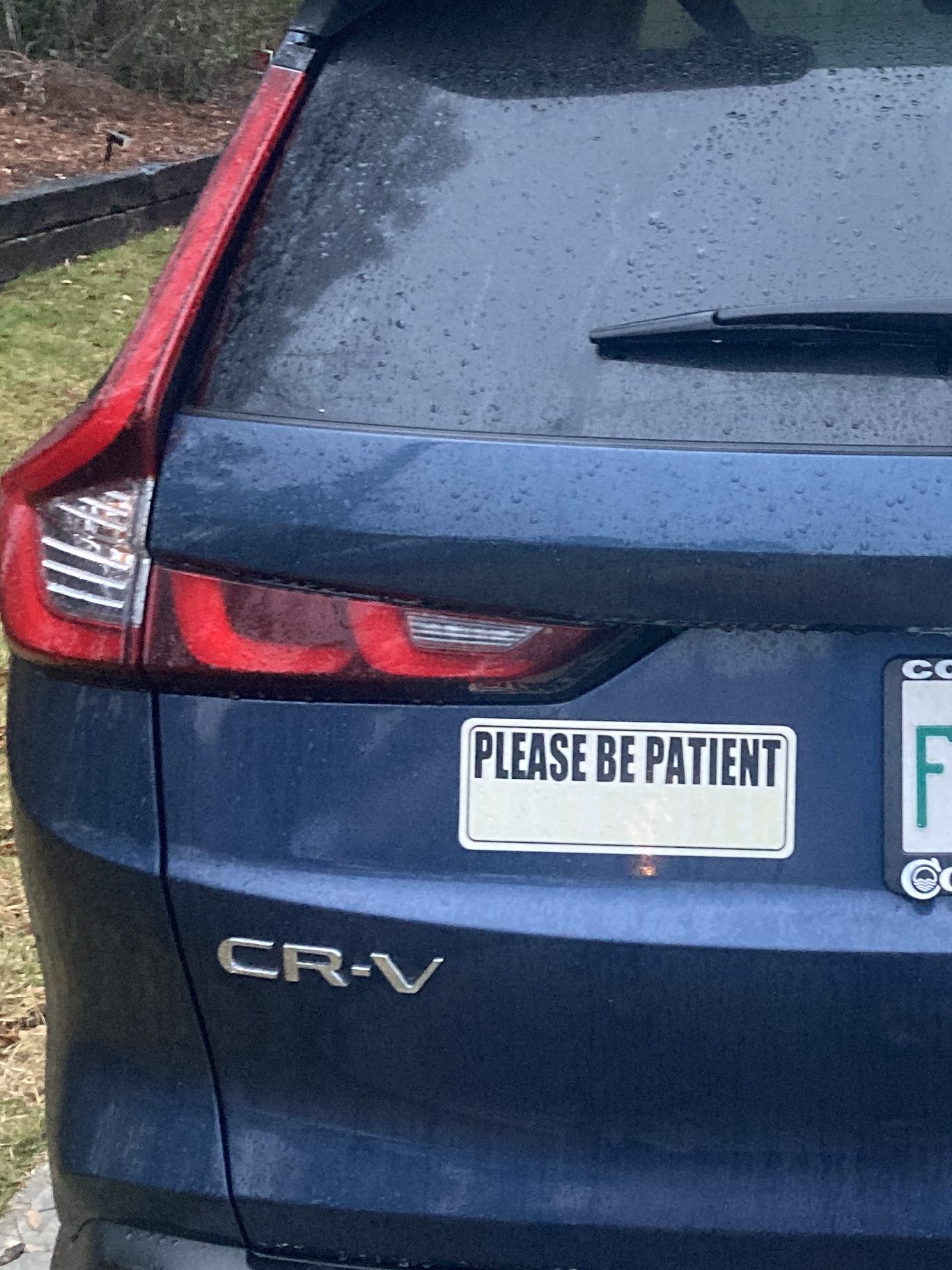
I’ve been walking past this car with a “Please Be Patient: New Driver” magnet sticker for longer than a year. It’s been there so long that the “New Driver” words have completely faded.

How long can someone claim to be a “new driver?” Certainly not a year. Maybe a month at most.

What driving behavior would require my patience? Driving much slower than the speed limit? Cutting corners and hitting curbs while turning right? Lingering at an intersection after the light turns green? Slowing to a crawl on the interstate entrance ramp? Lol. Those are normal driving habits. Experienced drivers do these things all the time.

How long can someone claim to be a rookie? A noob? I meet folks who claim that status after being Christians and church members for over five years. How long can you avoid ministry by stating, “I’m new at this”?

From my experience, the longer I follow Christ, the more questions I have. I feel less qualified and more dependent on grace. I have to trust him more than my own experience or expertise. I no longer say, “I’ve got this,” but rather, “He’s got me.”

It’s more like, “Please be patient: I’ve been doing this a long time.” That’s the perspective of a mature faith.

Posted in Through the Bible Devotions

A moment of silence

Photo by Kristina Flour on Unsplash

Some “through the bible” thoughts from Revelation 8.

“When the Lamb opened the seventh seal, there was silence in heaven for about half an hour” (Revelation 8:1).

That silence stands in contrast with the unending praises of the six-winged creatures in Revelation 4:8. They are joined by the twenty-four elders, myriads of myriads of angels, and every creature in heaven and earth and under the earth and in the sea (Rev. 5:9-10, 12,13. People from every nation, tribe, people, and language who have washed their robes in the blood of the Lamb praise him with loud voices as well (Rev. 7:9-10).

Heaven is a noisy place until the Lamb opens the seventh seal and “there was silence in heaven for about half an hour” (Rev. 8:1).

One of the hardest things to do when teaching a class or facilitating a discussion is to ask a question and then be quiet. If no one says anything for fifteen seconds, it’s tempting to speak. A full minute of quiet seems like an hour.

Quiet is important. People are thinking. Pondering the question. Forming their thoughts.

Quiet is important when the baby is sleeping. I disconnected the doorbell so that a well-meaning delivery person didn’t push the button, ring the bell, make the dog bark, and wake the child.

Quiet is important in music. A rest means don’t play. Don’t sing a note.

Quiet is important when you’re playing hide-and-seek. Don’t giggle. Don’t breathe heavy. Don’t give away your hiding place.

Quiet is important in golf. Spectators are warned not to make a sound when a player is lining up a perfectly still ball for a drive or putt. Same for a tennis serve.

On the other hand, when a batter is trying to hit a 90 mile-per-hour fast ball, fifty-thousand people are yelling at the top of their lungs. When a basketball player lines up for a free throw, fans of the opposing team will be anything but silent.

How entertaining is it when an adult’s whispered, “Shut up!” is louder than the noise a wriggling child makes in church?

Or when a moment of silence is interrupted by the ring tone of a cell phone in someone’s purse or pocket?

In that half-hour of silence, the prayers of the saints reach the ears of God. The cacophony of heaven’s praises cannot drown out the asking, seeking, and knocking of believers.

More importantly, the roar of heaven’s worship will never drown out your prayers. They rise up to God like the smoke of incense (8:3-4). Your whispered prayers for his help, mercy, and presence sweetly disrupt heaven’s silence, moving God to respond with the thunder, rumblings, lightning, and earthquakes of his presence (8:5).

Let’s make some noise. Let’s pray!

Posted in Through the Bible Devotions

A roll of the dice?

Some “through the bible” thoughts from Acts 1.

“And they cast lots for them, and the lot fell on Matthias, and he was numbered with the eleven apostles” (Acts 1:26).

So basically, the eleven chose the twelfth apostle by rolling the dice. The only qualifications? Being there from the baptism of John and a witness of the resurrection? Education? Don’t care. Education? Whatever. Speaking ability? Who cares? Good looking? Not an issue. Experience? We’ll train you.

Is that any way to choose an apostle? I don’t know. Jesus chose fishermen, a tax collector, and seven other guys without checking resumes or references.

How does your church choose a pastor? You pick through their resume, watch countless online sermons, interview them (on Zoom), and even pray. We make it a beauty pageant, don’t we? No one wants to admit it, but it’s true.

Is it all random? Or is it all God ordained? It depends. I believe God is behind it all. Not all would agree.

So much of life seems random. No rhyme or reason. Not true. He’s behind it all. Even if I think I’m in control. Or when I’ve done my homework and believe I have it all figured out.

God knows me (and you). He knows how we think and how we choose. He’s not surprised. He works through us anyway.

Posted in Through the Bible Devotions

Is that true?

Photo by Brett Jordan on Unsplash

Some “through the bible” thoughts from John 18.

I laugh out loud at pictures and videos of people, places, and things that fill my social media feeds. After filling his wheelbarrow at the buffet, a morbidly obese man crashes through the floor and capsizes the cruise ship. A buck with a chain saw fells a tree in which a hunter in waiting in a deer stand. Stephen Hawking and Queen Elizabeth II go MMA in the octagon.

Of course, none of this is real. It’s all AI generated. But it looks real enough to capture your attention long enough to ensure the algorithm will send more.

An email tells me I’ve purchased expensive anti-virus software. A text alerts me about an undeliverable package waiting for me at the post office. A message warns that I am about to go to prison for an unpaid highway toll.

Of course, none of that is legit. But they look real enough that someone somewhere will click on the link.

A door-to-door alarm system salesman tells me about all the break-ins in my neighborhood. Lightning flashes and thunder’s not far behind as the meteorologist predicts a nice, sunny afternoon. An advertisement announces today’s the last day of the sale.

We’ve learned to take it all with a grain of salt.

Not much has changed since Pilate asked, “What is truth?” (John 18:38). The priests claimed Jesus was a criminal. Others said he was a king. Jesus insisted that his testimony was the truth.

Pilate had learned to take it all with a grain of salt, too.

But what if truth is a person? In the upper room, before his arrest in the garden of Gethsemane, Jesus said, “I am the truth.”

Like it or not, you and I have to deal with deception. Every day. Some days, we’ll be duped. Other days, we’ll see right through it.

But we’ll never have to doubt the veracity of Jesus.