Posted in retirement

Letting go, fading away, and free to be

In her Medium article “Retirement: The Benefit of Letting Go” Marlane Ainsworth wrote that in retirement, we start to fade away. No one waits for our arrival before things start happening. We are no longer needed for meetings, planning, permission, or consultation. Previous significance wanes with alarming speed.

I know, that sounds a little depressing. Until you consider the positive side. It’s freeing. In retirement, I’ve shed expectations, assumptions, and demands like a snake sloughing off its skin. Something happens when you are no long defined by a job description. When you are less insignificant in the work world, a different part of you emerges.

Anyway, her story made me think about things things I did as a pastor simply because they were part of the job description and expected of me. If that surprises you, let me assure you, it surprised me too. Yes, it’s a calling. But it’s also an occupation.

  • Going to visit the same homebound person for sixty months in a row gets old after a while. I think that was my record. One person was on my visiting list when I arrived at my church in Connecticut, and I was still going to their home when I took a call to the next church five years later.
  • No one explained how many meetings I would have to go to. My calendar was full of them. Few were short. Few were productive. No, I do not miss them, not even a little bit.
  • Conference and convention attendance was mandatory. While I enjoyed spending time with other clergy from around the country, the agendas were filled with boring speakers addressing irrelevant topics. When asked, “Why do you keep going to those things?” I had to confess, “I have no idea.”
  • The experts told us annual stewardship messages would increase giving. These were my least favorite sermons. No matter how you dress up the appeal, you aren’t fooling anyone. It’s the big yearly ask. I was so glad when each campaign was over.
  • Part of the job was tracking down people who hadn’t been coming to church. I hated that. For some reason I didn’t like seeking out unhappy people to find out why they were unhappy. And I couldn’t simply ask, “Where the h*** have you been?” I had to be nice to them. I just wasn’t very good at looking for wandering sheep.

Okay. Enough of that. Don’t get me wrong. I loved going to seminary and I loved being a pastor. I loved teaching, preaching, and leading worship. I loved the music, ancient and new. I loved holding the babies, sitting on the floor with children, and running around with the youth. The stuff I loved doing far outweighed the burdens. But to do the things you love, you have to do the other stuff, too.

But not anymore. Having stepped out of that world and into retirement, that part of me starts to fade and other parts of me surface. Ainsworth wrote, “Letting go of things lets a part of us out that we kept corralled for a long time.” Keep in mind, I’m only eighteen months into this, so I am still discovering those parts.

I write more, read more books (mostly mysteries), take more walks (usually with dogs), get to know more of my neighbors, bake sourdough bread, practice music, attend bible studies (as a student), take trips, do some yard work, and constantly work towards a minimal-ish life. Along the way, I often reflect on my years in the ministry as well as these away from it. I may be fading, but the memories aren’t. Not yet.

Posted in dogs

I didn’t realize how noisy a morning could be

Photo by Marcus Saylor on Unsplash

A gentle rain began to fall about a quarter mile into our morning walk. It was just enough to warrant a head-to-toe shake from the dogs every ten minutes.

As we walked, the pup (Willow, our fourth-month-old Great Dane) paused in her tracks, perked up her ears, and turned towards every little noise. For her, every sound is a new experience, and this morning was full of them.

  • Rain hitting the garbage bags lining the street, waiting for pickup.
  • A truck gently splashing through a puddle.
  • The staccato of raindrops hitting a sunroom’s metal roof.
  • The mmreep of a frog hiding in a drainage swale.
  • Heavier drops of rain hitting the ground when the breeze kicked up.
  • The drip of a leaky gutter.

I didn’t notice any of these sounds until she slightly tilted her head and wrinkled her brow, trying to figure out each one. What I thought was a nice quiet morning turned out to be filled with fascinating noise.

Posted in garden

Open-minded yard decorations

So just imagine you’re walking through the garden section of your favorite big box store. You’ve already got a few seasonal plants in your cart. All you need are a few planters.

There are so many to choose from! Plain terracotta, glazed pottery, plastic that looks like terracotta or glazed pottery, barrels cut in half, and…wait a minute. “What do you think of these?”

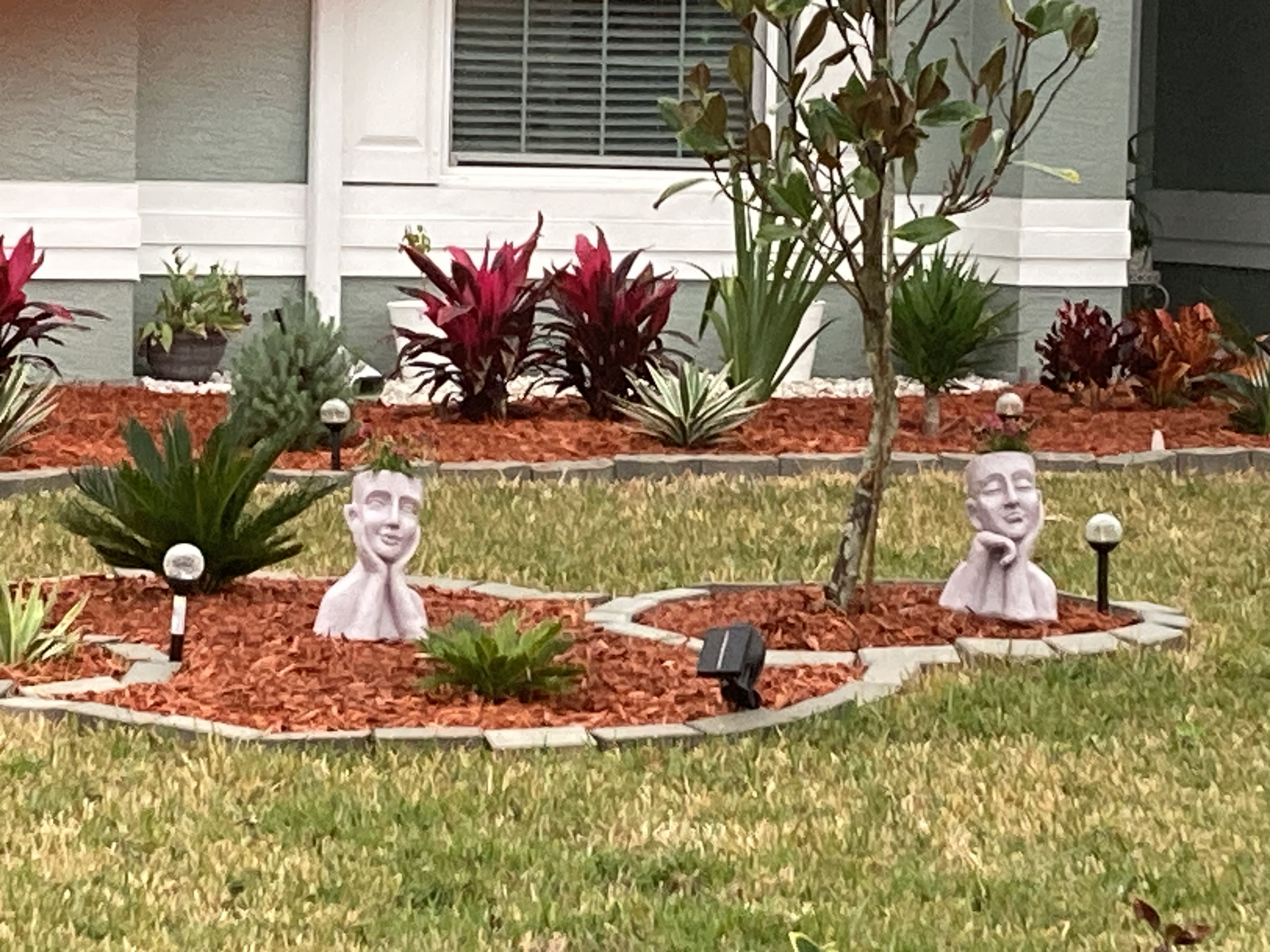
Some are shaped like half-people rising from the ground in peaceful meditation, their heads sliced open for blooming annuals. When I see them, I think of the skulls opened up to serve chilled monkey brains in Indiana Jones and the Temple of Doom. The other planters look like the Moai, the big stone guys on Easter Island. Or the emoji used to indicate strength or determination. “Perfect. Grab a couple of each.”

The house where I saw these is brand new. The planters are unique and attention-grabbing. I know they wouldn’t last a day in my front yard. But as they say, there’s no accounting for taste. Who knows? Maybe the residents are from Polynesia. Maybe these are reminders of a home they may never visit again.

I always smile (and sometimes chuckle) when the dogs and I walk by this house. Don’t we need more of that in life?

Posted in dying, Life

One more time: visiting a friend in hospice

Photo by Annie Spratt on Unsplash

I went to visit some old friends the other day. They are living in a beautiful assisted living facility just a few miles from my home. He’s been getting some physical therapy and is getting around really well. She is receiving hospice care, and her family told me she only had a day or two left to live.

Hoping that she would be lucid, I went to visit her right after I spoke with her daughter. Though confined to a bed, she was awake, comfortable, conversant, witty, and all smiles. She had every reason to be. She had all four of her daughters there with her. When I walked in, they were singing one of her favorite hymns, “For All the Saints.” Her two sons had been there the week before. I was thankful I had this chance to sit and talk with her for a while.

That was five days ago. Death isn’t an exact science. It’s inevitable, but it’s not predicable. We’ll just have to extend grace to the hospice folks when they answer the question, “How long does she have?” She’s not conscious anymore, but she’s comfortable and listening to all the conversations going on around her.

Whenever I’ve asked people about the best way to die, I often get the answer, “In my sleep.” On the one hand, that sounds like a great way to go. But on the other hand, you might miss out on all those precious moments you get to spend with friends and family. When death comes unexpectedly or accidentally, many wish they could have seen or talked to them one more time. A few days in hospice provides a lot of “one more times.”

My dad was in and out of hospice care the last few years of his life. My brother, sister, and I had a lot of “one more times” with him as he flirted with death but kept bouncing back. I think he enjoyed the attention and company when it looked like his time was up.

I like going to visit someone who’s in hospice care. When the finish line is in sight, the conversations are meaningful, the desire for life is powerful, and every moment is precious.

Posted in Life, memories

What are you going to do with all those journals?

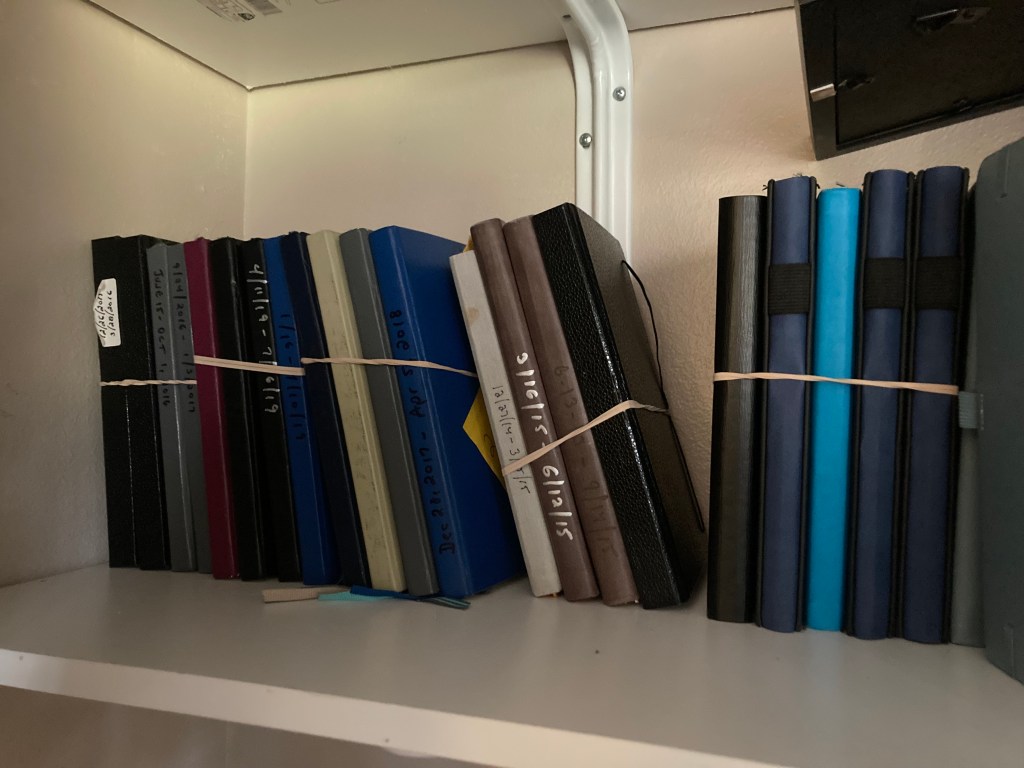
Just a few of many journals I’ve filled up.

I began journaling in earnest in 1989. When I started, I used 8-1/2 by 11 inch spiral notebooks. I filled up approximately four per year. In 2010 I started journaling in 5×8 inch hardcover journals. I’ve used all kinds of different ones from Moleskins to Leuchtturm 1917 to my current favorite EMSHOI with 120 gram paper that was a great deal ($11.95) on Amazon. I’ve written on blank pages, dotted pages, and currently use lined journals.

What do I write about? I start by writing about the scripture I’ve read that day, draw a picture illustrating something in that passage, summarize what I did yesterday, what I need to do today, and then come up with ten ideas I could write about. I jot down books I want to read and projects to work on. In the back I have a prayer list. It’s easy to fill up two or three pages a day. A typical journal will last me three months.

So let’s do the math. Four journals a year for thirty four years totals 136 journals. I had them all in two big boxes, prompting the question, “What are you going to do with those?”

That’s a very good question. I doubt that anyone is going to sit down and read these. My handwriting is such that I don’t know if anyone could. I have been sifting through them to put together a timeline of important events in our lives. Without them, I would have forgotten many places we’ve gone and things we’ve done. So I’m not just going to toss them.

Before I retired, I used the duplicator in the church office to scan the pages from the spiral bound notebooks. Once I cut out the metal spiral, I could feed the whole stack into the machine, which would email a file to me of all the pages. That took care of about fifty of them.

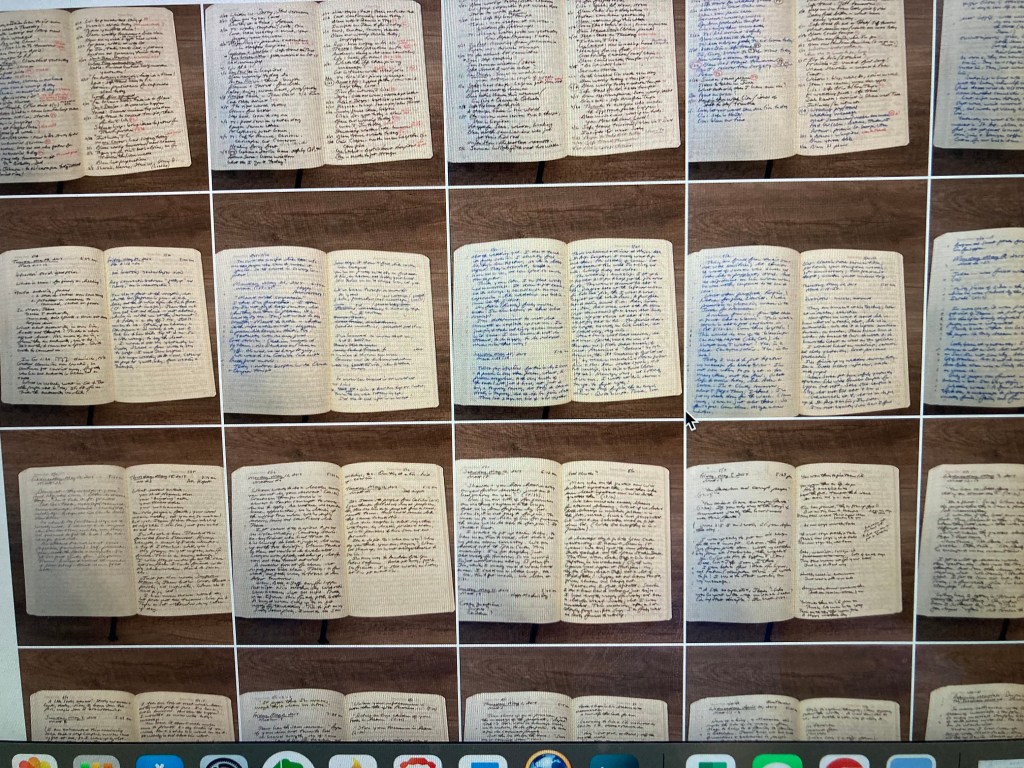
It’s not so easy to take apart a bound volume though. So one book at a time, I’ve been taking a photo of each page, uploading the group to my Amazon photos, where I can gather them into an album. It’s tedious work. But I am making progress.

Journals and letters from hundreds of years ago have helped historians write books about the past. Who knows? Maybe my notes and doodles and lists will be needed for a historical record someday.

Posted in faith

Does anyone really worry about the end times anymore?

I seem to remember past decades when the idea of the end times and the second coming of Christ was a big deal. In the 1980s, it seems like everyone was reading The Late Great Planet Earth and Left Behind. The creative blend of current events and biblical prophecy made you feel like judgment day was just around the corner. At the very least the world would come to an end before the Y2K turn of the century.

That was then. Thirty years ago. Is anyone worried about the end of the world anymore?

It occasionally comes up in Christian conversation. But I hear more talk about AI, climate change, immigration, gender identity, social media, and the next iPhone. Our big concerns are homeowners insurance, the price of gasoline, electric vehicles, identity theft, recalled bacteria-contaminated food, and the upcoming elections. In other words, we know Jesus is coming again, but we’ve got all this other stuff on the front burner.

So if your approach to witnessing is warning someone about eternal damnation, your words will most likely fall on deaf ears. It’s hard to get exited (or terrified) about eternity when some stranger is using your credit card, your insurance company has cancelled your homeowner’s policy, a roofing nail means you have another flat tire to fix, and one of the kids is sick (again).

Maybe your best witness is to just be there. Be there today. Be there now. Send the message that we’re not alone and we’ve got help for today, not just post-mortem. A little personal mercy, kindness, and grace goes a long way towards showing people that this Jesus-stuff is real. And if it’s real today, if it’s real now, it’ll be real later on, too, like when Jesus returns.

Posted in Food, Ministry

Sometimes the kingdom of heaven really is like a banquet

While walking the dogs the other day (we take them out about twice a day), my mind wandered to some of the meals I ate while visiting new members and homebound folks. Coffee and cookies were pretty common. Sometimes good. Sometimes not. Sometimes out of a package. Sometimes homemade.

And sometimes I got a meal. Kathy was one I visited many times, while she was taking care of her father at home and then later when she couldn’t get out and around. But she could cook.

On one occasion, I had a vicar (pastoral intern) in tow when we went to visit her at lunch time. She roasted two whole chickens for us. These were surrounded by mashed potatoes, green beans, salad, and rolls. All this was followed by a Klondike bar for dessert. She always had six or seven varieties of Kondike bars in her freezer. That’s why you couldn’t find many in the store. It was enough food for a dozen people.

Pastoral ministry tip: just take a little bit of everything. Pace yourself. When pressured to get seconds, take even smaller spoonfuls. And, of course, leave room for dessert.

The day would come when Kathy couldn’t prepare meals for me. So she would have me take her out for lunch. We hit Olive Garden, Red Lobster, Alfie’s (on the beach in Ormond Beach, FL), TGI Fridays. She always paid, even though she was living off an impossibly small monthly income. She never ate much, but took home leftovers for the rest of the week. She also took home all the packs of butter on the table to go with the rolls.

When Kathy couldn’t physically get in and out of my car, she would have me stop and bring lunch. Her favorite was Chinese take out. While I would get General Tso’s chicken and fried rice, she would always request a large container of egg drop soup. When I arrived, she would drop a whole stick of butter into the soup container, and stir it until it all melted. I know, I little rich for me, too.

She also got meals on wheels each week. I got to try one of those meals. The microwavable meal was some kind of meat (the label didn’t specify), green beans, mashed turnips, and a roll. As I ate the meal she graciously shared with me, I remembered that I had eaten goat in Haiti, and banana soup and ugali in Kenya. I’ll live.

When she could no longer cook, Kathy offered me a pork roast out of the bottom of her freezer, underneath all the Klondike bars. When I asked how long it had been in there, she said, “I think it’s from last year.” It was over a year old.

That I said, “No thank you.” I wasn’t sure I’d live through that. One needs both faith and wisdom to survive in this world.

Another member I went to visit, S., had grown up in Cambodia. She escaped in the 1980’s, found refuge through a church in Michigan, and there met her husband. For my visit, she prepared enough food for twenty people. She deep fried two-dozen homemade spring rolls over a small backyard burner. To this she added multiple vegetable, noodle, and sesame seed side dishes. All for me. She didn’t even eat. She just watched me. I brought home a nice container of leftovers from her house.

And then there are many visits to ninety-eight year old B., who lived with her daughter, B2. Before Covid, B. would be awake most of the night and sleep late into the day, so she didn’t make church very often. It was a three-hour event when I came to visit. B2 always prepared a wonderful meal. I had chicken parmesan, tilapia, short ribs, meat loaf, pork loin chops. The sides were all kinds of vegetables, potatoes, rice, and bread. And of course, a dessert, most often some kind of cake or pie, with a scoop of ice cream. B. and B2. had lived in Bolivia back in the seventies, and had an arsenal of South American cuisine to draw from. Yes, it was always delicious. But it was also enough food for eight to ten people. I never had to worry about supper on the days I went to visit this family.

Every once in a great while, I would visit a family who offered me a beer. One such family thought I was German, so I had a choice of six imports that day. I only had one, since I still had to work that day and I also had to drive home.

P. who was a non-drinker, had the most extensive selection of beer and liquor in town. Whenever I visited him after his wife died, he always offered me a “bump and boost.” I think he meant a shot and a beer.

For me, the coffee (strong and black, please) was the best part. Caffeine is an essential part of an afternoon visit, if you catch my drift.

If I think of more snack and meal reviews from my time in ministry, I’ll be back to write a sequel.

Posted in Home improvement

This dishwasher has a mind of its own

Photo by Nathan Dumlao on Unsplash

Dee-do-do-deedle-dee.

What was that? Is that the dishwasher? That’s the dishwasher start up tune. I didn’t start the dishwasher. In fact, it’s empty right now. It’s starting up all on it’s own?

I checked the display, and it was ready to go, but only a rinse cycle. Strange. Just one of those things, I guess. I hit the power button. Do-dee-do-dee-do-do. If you have a Samsung appliance, you’ll recognize the tune.

But it wasn’t just one of those things. I heard the music about once a day. Sometimes in the morning. Or the afternoon. Even after I went to sleep at night.

Oh, boy. I know what that means. I’ll bet I need to replace the control board in the door. Aw, man. I did that about two years ago. But it was under warranty. Now it’s not.

I can do it. I watched the guy. It took him about five minutes to take out the screws, plug in a new board, and put it all back together. I can do that.

But it doesn’t malfunction all the time. Only once in a while. It never starts on it own. But it thinks about it. Sometimes auto-cycle. Other times, “normal.” Sometimes a 15 minute rinse.

One of these days, our appliances will be sentient. They will think on their own and start up independently. Other than producing dirty dishes, we (humans) will be unnecessary.

I know, scary. But I think this all started when I began using a one-, two-, or three-hour start up delay. Why not let the dishwasher do his/her thing while you’re sleeping? Lol, because they don’t want to up at night either. And they let you know.

I cleaned out some filters and turned the power on and off, and everything seems to work just fine. For now.

We picked the suite of appliances for our remodeled kitchen because we liked the look. Next time around, we may look to those manufacturers who mainly make kitchen applicances rather than TVs.

Posted in faith

A deeper trust in God

Photo by Bobbi Wu on Unsplash

A few weeks ago at a men’s bible study, the guys around my table were sharing prayer requests. One of the guys at my table, I’ll call him Tom, said, “I just want to be in deeper communion with Christ.” He had been paying attention to Sunday morning preaching, in which the pastor had encouraged everyone, no matter where we were in our walk with Christ, to take a step deeper. Tom has been a believer for a long time, teaches our men’s group, and has a daily devotional discipline.

So I asked, “What do you mean by that?” (BTW, that’s always a good first response. Get them to tell more of the story.)

Tom replied, “I want a deeper connection. I want a conscious connection with the Lord all day long. I read and pray in the morning, and then I get to work, not really thinking much about him. I want to do better.”

That’s a noble goal. But is it possible? Is it possible to consciously have God on the front burner of your heart, mind and soul twenty-four seven? Isn’t what monks attempted to do? Didn’t they removed themselves from all worldly distractions so that they could pray throughout their waking hours?

Well, I’ll tell you right now, I can’t do it. And neither can you. And that’s okay. Really it is. Let me explain why.

Let’s use the model of sheep and a shepherd. The sheep know the voice of the shepherd and follow him. They follow him to pasture, to water, and back to the sheep pen before evening. In the meantime, they eat. They bleat. They wander around the pasture. They make lambs. And through it all, I’ll bet they don’t think much about the shepherd.

But the shepherd thinks about them. The shepherd leads them, watches them, and protects them. He’s the shepherd. That’s his job. And if he’s doing his job, then the sheep can be…sheep.

Get it? If God is on duty twenty-four seven, if God never slumbers nor sleeps, if the Lord is our shepherd, then we can be his sheep. We can trust him so deeply that we can eat, drink, and enjoy our work without a care in the world. (Ecclesiastes 5:18).

You know what? That’s deep.