Posted in bible, faith

The lights aren’t on, but someone is home

Photo by Kajetan Sumila on Unsplash

When my friend Bedan from Kenya entered the Zoom last week, his box was black, as if he didn’t have his camera turned on. As he greeted the other guys in the group he explained that he had no power and therefore, no lights. His cell service was okay, so he used his phone as his camera and joined us for bible study. A few minutes later he turned on a flashlight. Now he could see his study notes and we could see him.

Our Bible Study Fellowship (BSF) group meets at noon my time, but that means it’s 7:00 pm in Kenya. Bedan really wanted to be there that day. In fact, I don’t think he’s ever missed a meeting. I’m grateful for his commitment and faithfulness to our group. He’s also our oldest member, so he brings a lifetime of wisdom and faith to our discussions.

Some BSF groups are local and meet in person. Virtual groups bring together people from all over the United States and other countries. The mixture of cultures and experiences is a reminder of the size and diversity of the church.

Posted in bible

Mystery: a bag of dirt?

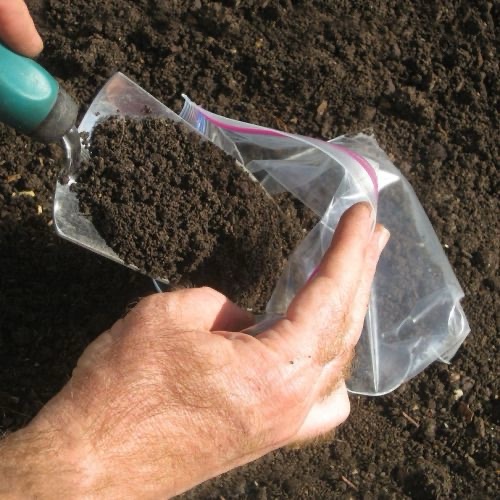
“So, what’s with the bag of dirt?”

I answered, “What are you talking about?”

My son went on, “The little bag of dirt in the front cover of the Bible.”

Forty years ago my mom gave my wife and I a super-sized King James family Bible as a wedding gift. I was never quite sure what to do with it. She did write in some important family tree information that we didn’t have anywhere rose. But it went unused until Good Friday came along and I needed a hefty volume to slam in the darkness, reminding us of the closing of the tomb after Jesus died and was buried.

When I retired, I gave the Bible to my son, also a pastor. After dozens of slams, it was showing its age. But it still made the congregation jump as he slammed it against the pulpit.

But while getting ready for Holy Week, he found a small sandwich bag containing a couple tablespoons of dirt. You would think it would have flown out during one of many slams. It doesn’t appear to be anyone’s remains. No one in our family has been cremated (including pets).

Mom’s been gone nineteen years now. Dad died five years ago. So we can’t ask them. All we can do is guess where it came from.

I had a little brother who died when I was only a year old. Could it be soil from his burial plot? What about dirt from one of the places where we lived? A memento from one of dad’s gardens?

We could send it off to a lab that can tell where it came from. For now, it’s a mystery.

Posted in bible, faith

All-you-can-eat all-the-time?

Photo by Jill Sauve on Unsplash

Is it possible to do too much bible study? At first, it seems the answer would be, “Of course not!” How could anyone get too much of God’s Word?

I’ve discovered that you can overdo it. More is not always better.

A few weeks ago, I feel I overdid. First, I attended a Sunday morning bible class before worship. On Tuesday, I prepared for and participated in a Bible Study Fellowship zoom group discussion. That same Tuesday night, my wife and I gathered with our small group, which included bible study. On Wednesday night, I attended a men’s bible class at our church. In addition, I read scripture devotionally every morning. My wife does all of that too, prompting us to say, “It feels like too much.”

The thing is, I really enjoyed all of those moments. I look forward to my morning reading, journaling, and prayer. We’ve made great friends in our small group. The fellowship and support of the men on Wednesday night has been a blessing. Sunday mornings are great, worshiping with a larger group of believers.

But is it too much? Can a person taste and see that the Lord is good and get carried away, putting on a few too many spiritual pounds?

A colleague told me of a time when he invited a neighbor to come to church. His neighbor did, but didn’t return the next Sunday. He didn’t come the week after that, either. When he asked his neighbor, “Why haven’t you come back,” he replied, “I’m still working on all the great stuff I heard in the sermon three weeks ago!”

Perhaps we need time to process, ponder, and practice what we learn before we jump into the next chapter, study, or topic. Let it marinate overnight. Let the dough rise. Set it aside and then take a fresh look at whatever you read or listened to. Without that, you’re skimming across the surface of the water without ever considering what’s below. Don’t we need time to consider the “so what” of a passage?

Imagine reading a stack of owner’s manuals without ever driving the car or using the appliance. Imagine reading through a cookbook without ever preparing one of the recipes? That would get old real quick.

In 2011, Thom Rainer and Eric Geiger wrote Simple Church, encouraging Christians to pare down church involvement to one worship gathering, one bible study group, and one mission/service involvement per week. Doing too much church can detract from actually being the church. Good food for thought.

In the Old Testament, unless you were a rabbi or a scribe, you would hear God’s Word once a week in synagogue on the Sabbath. Recited daily prayers were taken from scripture. That was plenty for them. Maybe it’s enough for us, too.

I’m sure that someone can argue that most believers spend far too little time in God’s Word. You’ve got a point. But should we approach it as an all-you-can-eat buffet? That’s doesn’t sound healthy either.

Like many other things in life, it’s all about balance. What about the Goldilocks philosophy? Not too hard and not too soft. Not too hot and not too cold. Not too much and not too little. Just right.


Posted in bible, faith

“The Greek word means…”

I’ve been retired and on the other side of the pulpit for seven months now. as I listen to sermons, my ears perk up when I hear a preacher mention that “the Greek (or Hebrew word) means….” Each time the speaker did it well and in such a way that it deepened my understanding of a passage.

But I did notice that all the listeners simply took that point at face value. Nodding their heads, they dutifully made notes in the margin of their bible. There was no hint of doubt or question about the statement.

Now I was taught at seminary not to do that very often. I learned learned Greek and Hebrew so that I could read, understand, and explain God’s Word from the original language. English translations may not capture all the nuances of an ancient word or phrase. A single word can say so much, and the meaning is worth including in preaching or teaching. But the listener doesn’t need to hear everything that went into preparation. You do not need to see everything that went on in the kitchen to enjoy a wonderful meal.

So I’ve been thinking, “What happens when you preface a thought or application with ‘The Greek (or Hebrew) word means…'”

I think it causes people to assume you know what you’re talking about, whether you do or not. It gives credence to your applications and sometimes your opinions. Are you manipulating the audience? Maybe.

When I hear those words, I pull out my phone and open up a bible app. “Accordance” is an app which displays a text in English as well as the original language. A built in lexicon gives you definitions and other uses in scripture, which often helps us understand a word or thought. I especially look up the word if it’s a definition I don’t remember hearing before.

When someone says, “The Greek word means…” you should ask some questions. Where did the speaker get that information? From a commentary? From an online source? From his or her own study of the language? Where were they educated?

Better yet, go home and read more about it own your own. Be like the church in Berea who went home and examined the scriptures after hearing the apostle Paul speak (Acts 17:11). They were eager to hear what he had to say. But they also made sure that’s what the scriptures really said.

We should be that noble, too. (That’s how Luke described the Jews in Berea.)

Posted in bible, Ministry, questions

No more ________.

Every Thursday morning between ten and twenty men from our church gather for breakfast and bible study at a local restaurant. This group has been meeting for close to thirty years, longer than I’ve been the pastor at our church. I’m not going to mention the name of the restaurant, unless I feel kind of snarky a little later in this post.

Within the past year, the franchise has eliminated certain items from the menu. The first item to go: raisins. Raisins were no longer available for the guys who ordered oatmeal for breakfast. Dried cranberries, yes. Raisins? Nope. Next, no more Tabasco. OK, I realize this is a niche market. And they did offer a cheap imitation hot sauce. But if you want the good stuff, too bad. One day, we were told, “No more English muffins.” You could choose from white, wheat, sour dough, or rye bread. Or a couple of pancakes. Biscuits? Yes. All of a sudden though, one day English muffins reappeared in our choice of breads. Nice.

So I’ve been wondering, “Who makes these decisions?” I doubt that the franchise owner is fretting about dried fruit or bread. But at the corporate level, in some office somewhere, someone is pondering, “What can we do to increase our profits? Where can we cut the fat?”

Last week, one group member lamented a local Subway’s decision to eliminate Swiss cheese from the menu. Really? Cheese with holes is a staple of deli sandwiches. What happened? Tariffs on imported Swiss? Shortages and price spikes? Who knows.

I’m just curious. Who makes these decisions? And why? I’m no dummy. I know it’s the bottom line. Follow the money. Some bean counter somewhere decided that millions could be made with a simple adjustment to the menu. Whatever. We can always bring our own Tabasco. Or get our subs from a different fast food restaurant. Or boycott until they meet our demands.

So far we can still bring our bibles. That’s the important thing.

Posted in bible

The pros and cons of reading an analog Bible

img_9267.jpgBy analog, I mean a Bible printed on paper rather than the (digital) bible app on my phone or computer. I’m thankful for each. I also thankful for having the Bible at my fingertips in any of its forms. Remember, just five hundred or so years ago, virtually no one read the Bible. Until the Reformation and the invention of the printing press, few actually had one.

On my phone, I usually read from my Accordance app. On the computer, I also have Accordance, and I’ll often go to Biblegateway.com.

Anyway, here are the pros of an analog bible:

  • You can underline, circle, highlight, make notes, and draw pictures on the page for future reference. I can’t do nearly as much marking on my phone.
  • It’s easier to catch the context with a couple of pages right there in front of you. Scrolling through the text on my phone is more difficult.
  • Spill coffee? No problem with the printed version. Panic time with a phone. With an analog bible, it’s a badge of honor. Yep, I was up reading my bible this morning while I was drinking my coffee.
  • It’s easier to focus. My analog bible never interrupts my reading with texts, weather alerts, or phone calls. Yes, I could turn all those off, but I rarely do.
  • It slows you down a little. It’s good to slow down and think about what I’m reading. I can read much faster on my phone. I set the font larger, so there are fewer words on the page, and I can really zip along as I scroll through a passage or book.
  • I can actually look up passages more quickly with a printed bible.
  • No one has a problem with someone paging through a bible in church. Everyone is suspicious if you claim you are using your phone’s bible app in church!
  • Battery life is never an issue with an analog bible!

The cons of using the analog bible are also the strengths of the digital form:

  • It’s slower. I can read on my phone much faster. When I want to, I can really cruise through scripture.
  • With a printed bible, I don’t have the resources at my fingertips that are on my phone or computer. In the digital world, I can immediately see a word in the original language, read a passage in another translation, find a word or phrase in other verses, read a commentary, find out where a place is, or find out who a person is. I can find all that info in some books I have, but it takes a lot longer. A study Bible is helpful, but I can’t fit it into my pocket.
  • I like a larger print bible now, and they aren’t as easy to find as the ones with minuscule font on extremely thin paper. The footnotes and cross references are even smaller. On my phone, I can really ramp up the text size so I almost don’t need my glasses.
  • After a while, all the pages are marked up, stained, folded, torn here and there, and falling out. Some pens and highlighters bleed through the pages. It takes a while, but it eventually happens to all my bibles. I never have to duct tape the binding of a digital bible.

So, for me, it’s a tossup. It depends what I am doing. I always use an analog bible for preaching, teaching and visits. I always use a digital form for preparing sermons and bible classes. I use both for my daily devotional reading.

That’s one of the things that has changed in ministry. When I started, everything was in a book. Now just about everything is online. In act, I can even have Alexa or Siri read the bible to me! Pretty cool.


Posted in bible, questions

Did a medium really conjure up the spirit of Samuel?

jose-antonio-gallego-vazquez-431522-unsplash (1)
Photo by Jose Antonio Gallego Vázquez on Unsplash

Our men’s Thursday morning bible study was deep into our study of 1 Samuel when we got to the account of Saul finding a medium to conjure up the spirit of the prophet Samuel who had died (1 Samuel 28:3-19).

Saul is in a bad spot. The Philistines have gathered to attack. Saul has exhausted every way he knows to contact the Lord, to no avail. Now what? He tells his servants to find a medium, so he can contact the departed spirit of Samuel and find out what’s going to happen.

Even though Saul has eradicated all the mediums and “fortune-tellers” from the land, his servants find a medium in Endor. According to the text, she conjures up the spirit of Samuel, who gives Saul the bad news: Israel is going to lose the battle to the Philistines, and you and your sons will die.

Here’s my question: did the medium really get in contact with the spirit of Samuel? Is that even possible? What is really going on here?

First of all, this is not a permissible practice. In Deuteronomy 18:9-14 God commands his people not to do this. They are not to consult mediums or spiritualists (Leviticus 19::31).

But it seems that the medium had indeed summoned the spirit of Samuel. Saul recognized Samuel. And the spirit’s prediction came true: Israel was defeated and Saul was killed. So God allowed this to happen? It seems so.

Well, that opens up a can of worms. Are spirits real? Are mediums real? Is there validity to those who read palms and gaze into crystal balls? In just about every town I’ve ever been to you can find a fortune-teller who is able to afford a storefront from those who pay for this kind of information. Is this real? A scam? Just business?

Here are a few things I’ve learned and concluded:

  • The spirit world is real. Satan’s minions were ejected from heaven when they lost their battle to Michael and the angels. Jesus dealt with demons in his ministry. They may be on a short leash, but they are real.
  • God has a handle on our future. When I surveyed the class, asking, “Would you want to know the day of your death?” all answered, “No.” Who wants to live in the shadow of their death? It’s better not to ask.
  • God wants us to trust him. Nothing can separate us from his love, so what else do you need to know. Just enjoy the ride. You may be surprised. You may scream. You may throw up. You might just love it. But it’s worth it. You were made for this.

When it come to the occult, I am very quickly over my head. Not a place I want to be. I’ll trust God with my future, thank you very much.

Posted in bible, family, Ministry

My Good Friday Bible

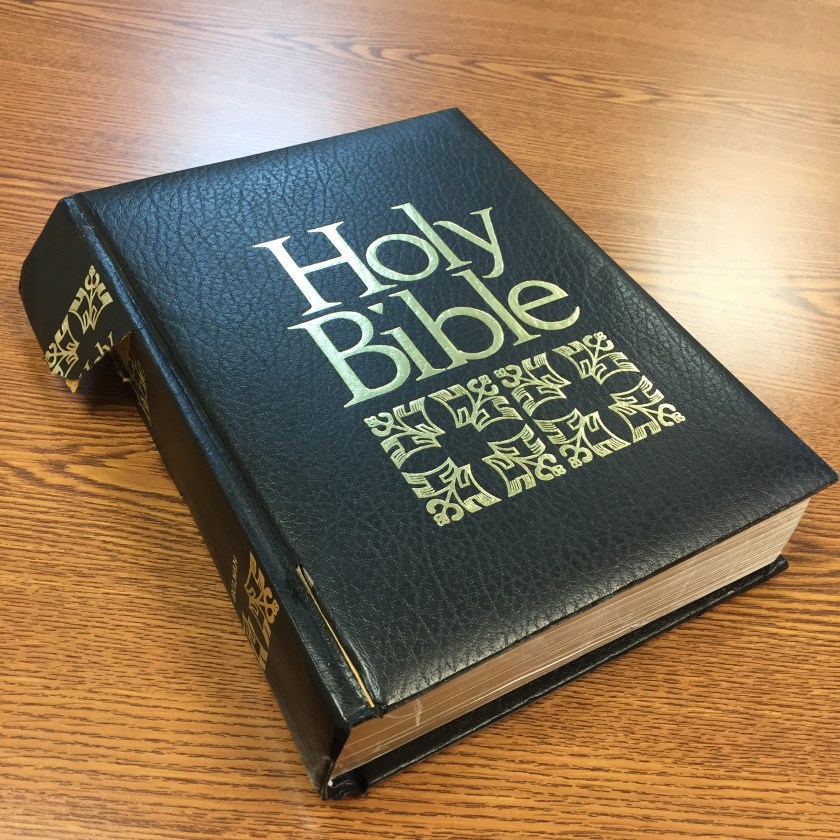
Today, I dusted off what I call my “Good Friday” bible and took it into the sanctuary in preparation for tonight’s Tenebrae (darkness) worship service. I call it my “Good Friday” bible because that is the one day a year when I use this massive volume. It measures about 12″x9″x3″ and weighs about 8 pounds, easily the largest book on my shelves. It has more than enough power for the end of the worship service when in complete darkness I slam it on the altar, reminding us of the closing up of Jesus’ tomb.

I received this bible from my mom and dad on my wedding day, nearly thirty-four years ago. They, too had a large bible like this at home that had been given to them. I don’t remember ever reading from it much. We had plenty of other bibles that we used for our personal and family devotions. The large bible contained a little bit of family tree names and dates, plus a couple of inspirational bookmarks.

I have slammed this bible on the altar thirty-two times, the number of years I have been a pastor and led worship on Good Friday. You can tell from the cracked binding that this book was only designed to be slammed about twenty-five times.

As I opened it up, I saw the dedication page written by my mom, with the reference to Psalm 18:30-36 and her blessing and prayer, “May your children give you as much joy as you have me.”

This psalm reference contains one of her favorite scriptural images, “He maketh my feet like hinds’ feet, and setteth me upon my high places” (Psalm 18:33 KJV). One of my mom’s favorite books was Hannah Hurnard’s Hinds’ Feet on High Places, “a timeless allegory dramatizing the yearning of God’s children to be led to new heights of love, joy, and victory” (Amazon.com). She purchased and gave away dozens of those books. She knew well the difficult life in the trenches as a mom, wife and nurse. But she also knew joy. She knew the thrill of skipping sure-footedly across the mountains of God’s promises to see the past, present and future from a whole new perspective. I am thankful that she passed that thrill along to me.

By grace, God heard and answered her prayer many times over. My children and now my grandchildren continue to fill my life with so much joy! Thirty-four years later, I understand what mom was talking about.


Posted in bible

Why is it so hard to understand?

aaron-burden-287555
Photo by Aaron Burden on Unsplash

Throughout the Bible, whenever God speak to people, they understand him. Adam: “Where are you?” Noah: “Build a boat.” Abram: “Leave…go…a great nation.” All the prophets. God spoke in their language. They may not have liked it, but they got it.

But now, we have to translate God’s word into the language of the people, so they can understand. Why is that? At Pentecost, everyone from all over the world heard and understood the word spoken by the disciples. After that, it gets more complicated.

It took a long time, and a lot of sweat and tears to learn Greek and Hebrew, so I could read, hear and understand God in the original languages.  But even with a wide variety of English translations, I still struggle to figure out what God is talking about. Why is it so hard now?

Some possibilities: God spoke to fewer people back then. Like one at a time. God spoke to one nation. Israel. God spoke through one person: Jesus. Now, since Pentecost, the word has been unleashed in the world and for the world and for me.

It’s worth the effort.