As soon as people began to worship God, worship began to separate people. Cain and Able both brought an offering to God in Genesis 4. But their style of worship was different. Cain brought produce from the farm; Abel brought something from his flock. Because God had regard for Abel’s offering but not for Cain’s, there is post-worship anger, gloom, assault, and murder (Genesis 4:8).
Not much has changed. Worship styles vary from church to church. There is gloom, despair, and agony when some congregations grow and others shrink. Worshipers openly criticize, discredit, and attack each other. And along the way, someone usually gets hurt. That’s what happens when “people [begin] to call upon the name of the Lord” (Genesis 4:26).
Jesus himself got caught up in a worship system that had plenty of room for laws, sacrifices, rituals, and priests, but little room for God. He was the one who ended up getting hurt and ultimately killed.
But that changes everything. The Lamb who was slain is on the throne in Revelation where everyone is on the same page, giving him “blessing, honor, and glory” (Rev. 5:13).
I suppose there’s a lesson to be learned here. Rather than focusing on what someone else is doing for worship, put the blinders on and let the Lord be in the spotlight. Listen to his word, receive his gifts of grace, and respond as someone who has been abundantly loved by loving others.
In the men’s bible class I attended last night, we worked through Mark 14 and in to part of chapter 15. I know, that’s way too much ground to cover in a night, so we couldn’t spend too much time on any one scene of Mark’s account of the passion of Christ.
We did spend a few minutes discussing the woman who anointed Jesus’ head with expensive perfume (Mark 14:3-9). This scene appears in all the gospels but with enough variation to say that Jesus was anointed three different times. Matthew’s account is almost the same as Mark’s. In Luke’s account (Luke 7:36-50), the woman pours perfume on Jesus’s feet and Jesus includes a parable about love and forgiveness. In John’s gospel (John 12:1-8), Jesus is at Lazarus’s house, the woman who pours the perfume on Jesus’s feet is Lazarus’s sister Mary.
Whether or not we harmonize the accounts, the reactions are the same. Jesus loves it and calls it a beautiful expression of faith. The disciples think it’s a waste of a precious resource. For us, it begs the question, “What place, if any, does extravagance have in our worship?”
The heading for these verses is “Jesus anointed…” This moment is not just a random act of kindness but a proclamation of who Jesus is. The label Messiah means “anointed one.” Who is anointed in the Old Testament? Kings, priests, and prophets. This jar of fragrant perfume is properly applied to Jesus, the king of kings, our great high priest, and the Word made flesh.
Jesus is also the promised anointed servant of God (Isaiah 61:1; Luke 4:18). This servant comes to suffer for his people, to die, and then be raised on the third day. The aroma filling the room proclaims that truth.
We Christians use a variety of labels to describe ourselves: followers, disciples, ambassadors, witnesses. No matter which one you choose, you know that it will cost you something. The time and resources we spend in worship, prayer, devotion, witness, and service is worth it, right?
But what if it becomes extravagant?
Jesus made a point of making sure his disciples noticed the woman who only put two small coins in the offering gave more than everyone else. She gave everything she had. Isn’t that extravagant?
A widow in Zarephath used everything she had, a handful of flour and a bit of oil, to make one last small cake for the prophet, herself, and her son. In that time of severe famine, isn’t that extravagant?
When a man assured Jesus he had kept every commandment necessary for life, Jesus told him to sell everything he had, give to the poor, and follow him. Isn’t that extravagant?
When the ark of the covenant returned to Israel, David danced with all his might (2 Samuel 6:14). He held nothing back that day, much to the dismay of his wife.
And if Jesus empties himself of his divinity, takes the form of a servant, and goes to the cross, couldn’t you say that he spent everything, his very life, on us? I would call that extravagant.
When Jesus’s disciples objected to the woman’s, it was because it could have been sold and the proceeds used to feed the poor. That’s a good point, but that’s not what the disciples did with their money. They had some money before Jesus fed the five thousand. They had a money bag that Judas stole from. They didn’t give it all away to help the poor or anyone else. Nice try, guys.
When you think about it, a lot of money has been spent feeding the hungry. And yet there are still hungry people. A lot of resources have been poured into the homeless, and there are still homeless. We’ve invested a lot of money into church buildings, and there are more unbelievers than ever. The economics of God’s kingdom aren’t simple, are they?
So I’m not going to pretend to have this all figured out. It’s one of those things we all have to figure out along the way. Extravagance looks a little different for each person, on any given day, in any number of circumstances. Plus, whatever looks extravagant to us is minuscule compared to what God gives.
Extravagance that feeds our own passions makes it hard to follow God. No one can serve two masters. Extravagance that expresses faith and love preaches a powerful message about Jesus. Extravagance can make us feel guilty, lull us into complacency, or tempt us to feel self-sufficient. It can also be worship, witness, and sacrificial love.
In a sense, the notion of extravagance goes away if your eyes are on Jesus. Whatever you do in word or deed won’t be too much or too little, but an expression of gratitude for his inexpressible (and extravagant) love for us.
In our congregation, we celebrate Holy Communion at just about every worship service. Following the words of institution, I say, “The peace of the Lord be with you always,” and then encourage the congregation to share our Lord’s peace with those around them.
In addition to the traditional, “Peace be with you…” “…and also with you,” I’ll witness worshipers embracing, exchanging a kiss, shaking hands, waving and other assorted greetings. Some folks are a little uncomfortable with the moment, unwilling to share germs or give up valuable personal space. Many, I am sure, are not even aware of why we do this. So a member encouraged me to write about this part of the liturgy.
The sharing of the peace is intended to be a powerful reminder of the evening on the first day of the week when the disciples were hiding behind locked doors. Some had seen the empty tomb. Some had seen the risen Christ himself. Suddenly, Jesus is standing there among them and says, “Peace be with you” (John 20:19). Powerful words. Through Christ, God has reconciled us to himself. Our sins are forgiven, the relationship has been healed, and we have peace with God.
The real presence of our Lord in the sacrament also brings the peace of the Lord to us, which means we have also received the ministry of reconciliation (2 Corinthians 5:18). We bring the salt and light of a new relationship with God into our world. God also enables us to pursue and be at peace with one another before we approach his altar (Matthew 5:23,24).
Conflict is inevitable. Relationships are fragile. Feelings are easily hurt. But forgiveness is real. Reconciliation overcomes separation. Love covers a multitude of sins. And as we participate in the body and blood of Christ, we have a lot in common. We are all members of one another. We are his church!
Keep that in mind each time we share our Lord’s peace with one another.
Ants may be some of God’s smallest creatures, but it doesn’t take many of them to cause a major panic in the house of the Lord, especially when they are crawling around on the communion rail during worship service. I didn’t witness them, but I sure heard about their invasion into sacred space!
OK, I’ll grant that it would break my concentration and meditation to feel insects crawling up my arm as I knelt at the altar. I don’t like gnats flying into my ears or buzzing around my eyes, either. Yes, just a few little bitty guys like that can ruin a whole worship service.
Where in the world did they come from? We saw no obvious line marching in from a crack or a window. Fortunately they weren’t fire ants. But then an astute pest control professional/member noticed a stream of the insects from the Advent wreath stand, which had been brought into the chancel for the first Sunday in Advent. The stand had been stored for a whole year in a rear entryway near an exit door. A perfect place to hide away for a while. Until December, when the ants found themselves just a few meters of drops of wine and crumbs of bread. Of course they’re going to go and see what’s going on out there.
But only for a day. We quickly cleaned out their adopted home, the rail and the chancel. Just like the spider we once found crawling up the trays of wine or the lizard who scampered across the altar, we persuaded them to worship outdoors, where they could be just as close to their Creator.
Why are you cast down, O my soul, and why are you in turmoil within me? (Psalm 42:5)
As a deer pants for flowing streams, so pants my soul for you, O God. My soul thirsts for God, for the living God. (Psalm 42:1,2)
The psalmist puts his finger on the problem when the symptom is discouragement. When you are discouraged, that is, when you soul is “cast down,” you’re thirsty. Your soul is thirsty for God.
Who hasn’t felt discouraged? You might be discouraged because you tried your hardest but failed. Or someone let you down. Someone you thought you could depend on. Discouragement can arise when reality is far less than your dreams. Or when you feel like you’re the only one who cares. I am sure there are a hundred other things that could make you wonder, “Why are you cast down, O my soul?”
In this psalm, we learn that discouragement is a manifestation of spiritual thirst. You know what physical thirst feels like. Dry mouth, scratchy throat, and a craving for anything liquid. Spiritual thirst feels like a horrible terrible no good very bad day.
Here’s the thing: a wonderful successful tremendous very good day will not quench that thirst. Only God can. A soul that thirsts is a soul that thirst for God. Why? Because we screw up and wander so far from Him. Because we forget his promises, take his gifts for granted, trust in horses, chariots and our own strength, and neglect to pray.
So where do you go to get a nice long tall drink of God for your soul? His Word. Prayer. Worship. He’s right there when we gather in His name. He faithfully touches our hearts with His Word. He loves to engage us in conversational prayer. He reminds us of that cooler of water dumped over our head in baptism.
When I’ve had it “up to here,” I just need to stop. Stop trying, stop blaming, stop justifying and stop pretending. Stop and listen to Him. Alone, or with a few, or with the church. Open my Bible and open my heart. What a joy and what a game-changer to drink from His well!
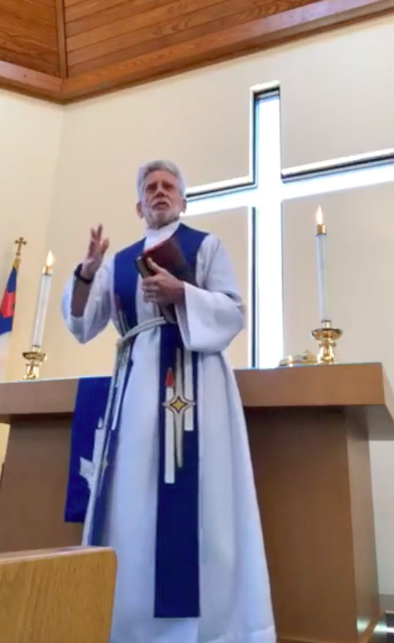
This past Advent and Christmas, I experimented with setting my iPhone in front of the church so that the service and sermon could be on Facebook live. It certainly wasn’t an elegant solution, just easy. Those watching only saw me during the sermon, but they could hear the rest of the service. I figured there is always someone who can’t get out, who can watch and listen and worship with us. They can even watch later since the video is saved indefinitely.
Right after the first of the year, I did a memorial service in our chapel. Some who would have attended couldn’t, so I set up my phone and they got to join us virtually.
So I started setting my phone out on Sunday mornings, too. I discovered that I had an audience. Some were former members who had moved to Wisconsin. Other viewers’ worship service had been cancelled due to a big winter storm in the Midwest. There were some who were sick and stayed home to rest.
I’ve been to churches that had multiple television cameras in the sanctuary to broadcast their worship services. I never thought something like that would be possible with the phone I usually keep in my pocket. Yet here we are, broadcasting live.
A local fitness center closed its doors last week without any advance warning to employees or clients. Just a note on the door saying informing all they were out of business.
This got me thinking. What if you arrived at church one Sunday morning and found a note like that on the locked front doors? I’m not in any way suggesting that’s going to happen. I’m just curious. What would you do? What would I do?
Would you call someone? Who would you call? The pastor? Your elder (you know who your elder is, right?) The president of the congregation? The friends you usually sit with?
Would you stick around and wait for others to arrive? Maybe someone else will know what’s going on.
Would you find another worship service to attend that day? Or would you just shrug your shoulders and go to breakfast? I know that’s sounds kind of harsh. I’m just working through some of the possibilities, even the absurd ones.
Would you make an effort to find out what happened? Did something happen to the pastor? What happened to all the money? Would you contact the district or the synod offices to ask if they knew anything?
What would you do in the weeks or months to come? Would you find another church to attend? Would you band together with other members to reopen that ministry? Or would you feel betrayed and just give up on church altogether?
Even though the gates of hell cannot prevail against the church of Jesus Christ, local congregations do close. And I’ll bet some of them close suddenly, permanently and without notice. And we never even find out why. If you search the internet for info on church closings, you’ll learn that about 100 close their doors every week in our nation.
We all take it for granted each Sunday morning that when we arrive, we’ll walk through the doors and everything will be prepared for us to worship. Have you ever thought about your role in that reality? Or do you leave that for someone else to worry about? What part do you play in making sure that sign is never taped to the front door of your church?
“Do not be conformed to this world, but be transformed by the renewal of your mind” (Romans 12:2).
This morning was a little different for me. Rather than two morning worship services, we had just one focused on God’s grace, especially for veterans and local heroes from our fire and sheriff’s departments. It was at a later time, so my Sunday morning began a little later than usual. We had a special guest preacher, too, so I didn’t have to worry about a sermon. I had a rare chance to simply sit and listen, reflect and renew my mind.
Paul’s words in Romans 12 are familiar, but I don’t know that I ever really put my finger on how to renew my mind. But that’s exactly what happened today. In a few moments of quiet, I jotted down a few ways that my mind was renewed today.
Since last Tuesday, much of the news in Florida was about the election results and now recounts because the contests were so close. There are a lot of strong feelings on both sides and will continue to be as official results are announced later this week. But worship today reminded me that the Lord is still on the throne. Always has been. Always will be. No recounts. No contest. That truth puts my mind at ease. One less thing to wonder about when I fall asleep tonight.
Worship also reorients my thinking from guilt to grace. The pressure to be better and do more comes from within myself as well as those around me. But when we gather as a church family, it’s all about how good Christ is and how much he’s done. It’s a lot easier and refreshing to be myself when the spotlight is on him.
The final benediction reminds me that God looks at me with approval. In his eyes I’m not just OK, I’m righteous. That reality helps me think of myself differently, with a renewed mind.
I don’t get that anywhere else. For me, that’s reason enough to want to be with the church each Sunday.
It has happened in schools and movie theaters, on military bases and college campuses, in nightclubs and churches. Someone walks in and opens fire, killing and wounding innocent people.
Yes, it’s happened churches. How has this reality changed the dynamic of going to church? As the pastor of a Lutheran church, I never worried about it very much till a few years ago. Our church doors are still open every Sunday and we still welcome anyone and everyone who wants to worship. But somethings have changed. Here are a few of my observations:
More worshipers are carrying weapons
I don’t know who all is carrying on a Sunday morning, but I know that the number has grown over the last year. With holsters or purses designed to be inconspicuous, the person sitting next to you in church may well have a permit and a handgun with them. I have mixed feelings about that. On the one hand, I feel good knowing that these folks have taken steps to protect themselves and the congregation. On the other hand, I pray that they have taken some classes and know how to use the weapon safely.
We now have an emergency plan
A few of our members who have been police officers, military or security have sat down and developed an emergency plan, should a threat arise. The plan includes dealing with medical, fire and storm emergencies, as well as violence. They make a conscious effort to keep an eye on the room where we gather for worship, taking note of anything out of the ordinary. I’m thankful for those who bring that training and experience to the table.
Such times are not without precedent in the bible. When Nehemiah was overseeing the rebuilding of the walls of Jerusalem after the return from Babylonian exile, half of the workers did construction, and half held the spears, shields, bows, and coats of mail. Some of the workers held a tool in one hand and a weapon in the other (Nehemiah 4:16,17).
We are better at welcoming guests
Things have calmed down recently, but for a few months we were on edge. We carefully watch anyone arriving for worship whom we don’t recognize. I know that sounds a little unfriendly, but it actually enhanced our welcome. We make a concerted effort to welcome and get to know our guests.
One morning a young many with a backpack arrived for worship on a bicycle. After entering the church, he left his backpack in the back row while he went out to lock up his bike. The pulse of the sopranos and altos began to race as they watched this happen from the front row of the choir loft. The gentleman returned to his seat and worshiped with us without any incident.
We have a remote alert system
We’ve installed what some have called a “panic button.” It’s really just a way for me to alert the elder and ushers to something going on. From the front of the church, I can see everything happening in the room, while most of the worshipers are facing the altar. If I see someone come in late who needs help or see something out of the ordinary in the entryway, I can push a button, a small light flashes in front of them, and I have their attention. I have not had to actually use this yet, and I’d be fine never having to use it.
We are more thankful than ever for the freedom to worship
Along with the uncertainty of what might happen on any given day, we enjoy a freedom to worship that is still one of God’s greatest blessings. We ought never take that for granted.
It has not always been this way. Early Christians met in secret to worship, knowing that if they were caught they could be put to death. Conditions were much the same not that long ago in the Soviet Union and China.
I have worshiped in inner city churches where iron gates at the front door were locked when worship began and did not open until it was time to go home. The shadow of similar iron bars could be seen through the stained-glass windows. Yes, it was that kind of a neighborhood.
I have worshiped in other countries, where every gas station was protected by armed attendants and an armed guard accompanied us to church where the ushers all had nine millimeter handguns on their belts. The worship – in a language I didn’t know – was vibrant, Spirit-filled, heart-felt, and well-guarded.
My greatest fear
Having said all that, my greatest fear has nothing to do with weapons or shooters. The greatest danger we face is that parents do not bring their children to church. For a wide variety of reasons, so many mothers and fathers do not regularly avail themselves of our freedom to worship, teaching the next generation that it is not important. If we do not raise our children in the fear and knowledge of the Lord, will religious freedom mean anything to them? If that freedom is threatened, limited, or taken away, will they even care? Or will it have no effect on their lifestyle at all?







 Waite for it...