Posted in Devotions, Grace, Through the Bible Devotions

I don’t think the flood solved the problem

A “through the bible” devotion from Genesis 6-9.

As I read about the flood in Genesis 6-9, it occurred to me that the flood didn’t solve the problem. Before the flood, God saw that “Every intent of the thoughts of their hearts were only evil continually” (Genesis 6:5). After? God said, “The intent of man’s heart is evil from his youth” (Genesis 8:21). Doesn’t sound like much changed at all.

That’s the way life is, isn’t it? Clothing gets dirty and has to be laundered over and over again. You have to dust the furniture, clean the bathroom, wash the dishes, and bathe the kids again and again. Everything keeps getting messy, including hearts.

So why wipe out life with a flood? Why save a few people who are just going to get into trouble again?

You have to admit that forty days and night of rain is a powerful message of God’s judgment. By the same token, an ark big enough to ride out the storm and preserve life is a dramatic illustration of God’s grace. The flood is a picture of law and gospel, justice and mercy, and power and love.

Along with David, we pray, “Create in me a clean heart, O God, and renew a right spirit within me” (Psalm 51:10). God promises, “I will give you a new heart and put a new spirit within you” (Ezekiel 36:26). What a difference it makes when Christ dwells in our hearts by faith (Eph. 3:17)!

I’m going to get in trouble again. So are you. Just don’t forget about that big boat of grace.

Posted in church, Devotions, Through the Bible Devotions, worship

Why does someone have to get hurt?

Photo by Tom Jur on Unsplash

A “through the bible” devotion from Genesis 4.

As soon as people began to worship God, worship began to separate people. Cain and Able both brought an offering to God in Genesis 4. But their style of worship was different. Cain brought produce from the farm; Abel brought something from his flock. Because God had regard for Abel’s offering but not for Cain’s, there is post-worship anger, gloom, assault, and murder (Genesis 4:8).

Not much has changed. Worship styles vary from church to church. There is gloom, despair, and agony when some congregations grow and others shrink. Worshipers openly criticize, discredit, and attack each other. And along the way, someone usually gets hurt. That’s what happens when “people [begin] to call upon the name of the Lord” (Genesis 4:26).

Jesus himself got caught up in a worship system that had plenty of room for laws, sacrifices, rituals, and priests, but little room for God. He was the one who ended up getting hurt and ultimately killed.

But that changes everything. The Lamb who was slain is on the throne in Revelation where everyone is on the same page, giving him “blessing, honor, and glory” (Rev. 5:13).

I suppose there’s a lesson to be learned here. Rather than focusing on what someone else is doing for worship, put the blinders on and let the Lord be in the spotlight. Listen to his word, receive his gifts of grace, and respond as someone who has been abundantly loved by loving others.

Posted in Devotions, Through the Bible Devotions

Nice outfit

Image by StockSnap from Pixabay

A “through the bible” devotion from Genesis 3.

When someone comments, “Hey, nice outfit,” I wonder if it’s a compliment or they’re making fun. Maybe they really like what I’m wearing. Or maybe the plaid shirt with the striped pants wasn’t the best choice.

After the deception, disobedience, shame, and consequences of Genesis 3, God does something really nice for Adam and his wife. He makes garments of skin for them.

So God isn’t angry with them. I don’t hear anger in his voice when he finds them hiding in the bushes. He simply speaks, explaining the consequences of their actions. And then he clothes them (Genesis 3:21).

It’s a good thing he does. I doubt their makeshift fig leaf coverings were very effective. Probably wouldn’t last long, either.

We try hard to cover up our failures and mistakes. We hide behind excuses, blame, and ignorance. None of those are effective. They don’t last long, either.

The good news is that God covers our sin, too. He comes in the flesh (skin) as a Savior who covers up our shame and guilt with his own righteousness. Or as Paul will later put it, “all of you who were baptized into Christ have clothed yourselves with Christ” (Gal. 3:27 NASB).

So I guess you can say that those garments of skin in Genesis 3:21 are a hint of what’s to come: Jesus.

This is the kind of stuff I think makes the Old Testament so much fun to read. I love finding the footprints of Jesus in those pages long before he walked on the earth.


As I take another trip through the bible, I’m going to write devotionally along the way and share what I find. This year I’m reading the 2020 edition of the New American Standard Bible. If you’re blessed by any of this, feel free to share it with a friend!

Posted in bible

Mystery: a bag of dirt?

“So, what’s with the bag of dirt?”

I answered, “What are you talking about?”

My son went on, “The little bag of dirt in the front cover of the Bible.”

Forty years ago my mom gave my wife and I a super-sized King James family Bible as a wedding gift. I was never quite sure what to do with it. She did write in some important family tree information that we didn’t have anywhere rose. But it went unused until Good Friday came along and I needed a hefty volume to slam in the darkness, reminding us of the closing of the tomb after Jesus died and was buried.

When I retired, I gave the Bible to my son, also a pastor. After dozens of slams, it was showing its age. But it still made the congregation jump as he slammed it against the pulpit.

But while getting ready for Holy Week, he found a small sandwich bag containing a couple tablespoons of dirt. You would think it would have flown out during one of many slams. It doesn’t appear to be anyone’s remains. No one in our family has been cremated (including pets).

Mom’s been gone nineteen years now. Dad died five years ago. So we can’t ask them. All we can do is guess where it came from.

I had a little brother who died when I was only a year old. Could it be soil from his burial plot? What about dirt from one of the places where we lived? A memento from one of dad’s gardens?

We could send it off to a lab that can tell where it came from. For now, it’s a mystery.

Posted in bible

The pros and cons of reading an analog Bible

img_9267.jpgBy analog, I mean a Bible printed on paper rather than the (digital) bible app on my phone or computer. I’m thankful for each. I also thankful for having the Bible at my fingertips in any of its forms. Remember, just five hundred or so years ago, virtually no one read the Bible. Until the Reformation and the invention of the printing press, few actually had one.

On my phone, I usually read from my Accordance app. On the computer, I also have Accordance, and I’ll often go to Biblegateway.com.

Anyway, here are the pros of an analog bible:

  • You can underline, circle, highlight, make notes, and draw pictures on the page for future reference. I can’t do nearly as much marking on my phone.
  • It’s easier to catch the context with a couple of pages right there in front of you. Scrolling through the text on my phone is more difficult.
  • Spill coffee? No problem with the printed version. Panic time with a phone. With an analog bible, it’s a badge of honor. Yep, I was up reading my bible this morning while I was drinking my coffee.
  • It’s easier to focus. My analog bible never interrupts my reading with texts, weather alerts, or phone calls. Yes, I could turn all those off, but I rarely do.
  • It slows you down a little. It’s good to slow down and think about what I’m reading. I can read much faster on my phone. I set the font larger, so there are fewer words on the page, and I can really zip along as I scroll through a passage or book.
  • I can actually look up passages more quickly with a printed bible.
  • No one has a problem with someone paging through a bible in church. Everyone is suspicious if you claim you are using your phone’s bible app in church!
  • Battery life is never an issue with an analog bible!

The cons of using the analog bible are also the strengths of the digital form:

  • It’s slower. I can read on my phone much faster. When I want to, I can really cruise through scripture.
  • With a printed bible, I don’t have the resources at my fingertips that are on my phone or computer. In the digital world, I can immediately see a word in the original language, read a passage in another translation, find a word or phrase in other verses, read a commentary, find out where a place is, or find out who a person is. I can find all that info in some books I have, but it takes a lot longer. A study Bible is helpful, but I can’t fit it into my pocket.
  • I like a larger print bible now, and they aren’t as easy to find as the ones with minuscule font on extremely thin paper. The footnotes and cross references are even smaller. On my phone, I can really ramp up the text size so I almost don’t need my glasses.
  • After a while, all the pages are marked up, stained, folded, torn here and there, and falling out. Some pens and highlighters bleed through the pages. It takes a while, but it eventually happens to all my bibles. I never have to duct tape the binding of a digital bible.

So, for me, it’s a tossup. It depends what I am doing. I always use an analog bible for preaching, teaching and visits. I always use a digital form for preparing sermons and bible classes. I use both for my daily devotional reading.

That’s one of the things that has changed in ministry. When I started, everything was in a book. Now just about everything is online. In act, I can even have Alexa or Siri read the bible to me! Pretty cool.


Posted in bible, family, Ministry

My Good Friday Bible

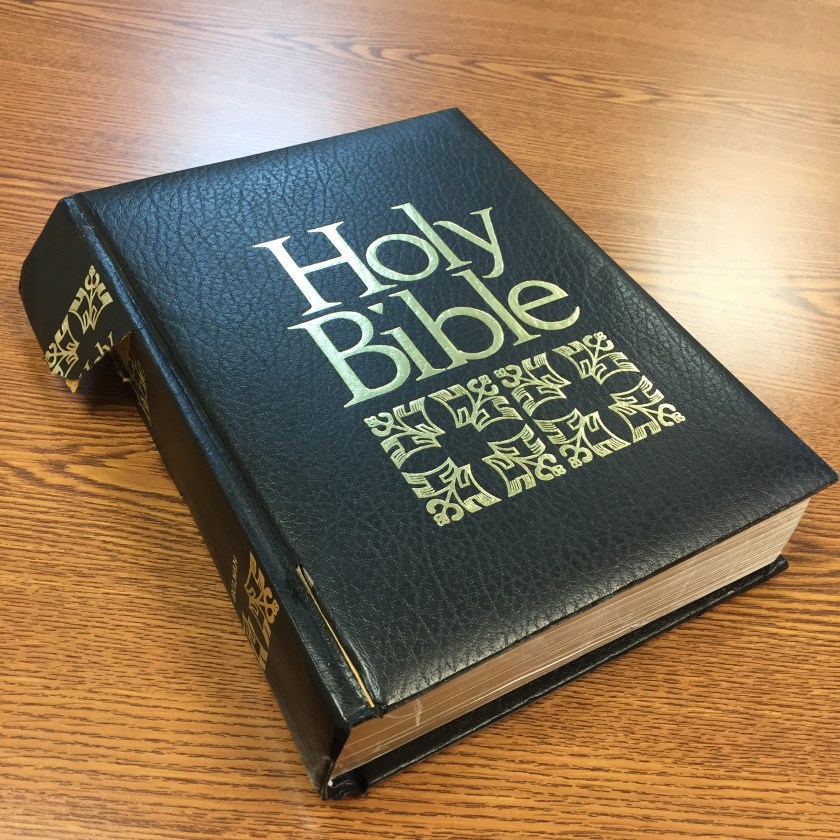
Today, I dusted off what I call my “Good Friday” bible and took it into the sanctuary in preparation for tonight’s Tenebrae (darkness) worship service. I call it my “Good Friday” bible because that is the one day a year when I use this massive volume. It measures about 12″x9″x3″ and weighs about 8 pounds, easily the largest book on my shelves. It has more than enough power for the end of the worship service when in complete darkness I slam it on the altar, reminding us of the closing up of Jesus’ tomb.

I received this bible from my mom and dad on my wedding day, nearly thirty-four years ago. They, too had a large bible like this at home that had been given to them. I don’t remember ever reading from it much. We had plenty of other bibles that we used for our personal and family devotions. The large bible contained a little bit of family tree names and dates, plus a couple of inspirational bookmarks.

I have slammed this bible on the altar thirty-two times, the number of years I have been a pastor and led worship on Good Friday. You can tell from the cracked binding that this book was only designed to be slammed about twenty-five times.

As I opened it up, I saw the dedication page written by my mom, with the reference to Psalm 18:30-36 and her blessing and prayer, “May your children give you as much joy as you have me.”

This psalm reference contains one of her favorite scriptural images, “He maketh my feet like hinds’ feet, and setteth me upon my high places” (Psalm 18:33 KJV). One of my mom’s favorite books was Hannah Hurnard’s Hinds’ Feet on High Places, “a timeless allegory dramatizing the yearning of God’s children to be led to new heights of love, joy, and victory” (Amazon.com). She purchased and gave away dozens of those books. She knew well the difficult life in the trenches as a mom, wife and nurse. But she also knew joy. She knew the thrill of skipping sure-footedly across the mountains of God’s promises to see the past, present and future from a whole new perspective. I am thankful that she passed that thrill along to me.

By grace, God heard and answered her prayer many times over. My children and now my grandchildren continue to fill my life with so much joy! Thirty-four years later, I understand what mom was talking about.


Posted in bible

Why is it so hard to understand?

aaron-burden-287555
Photo by Aaron Burden on Unsplash

Throughout the Bible, whenever God speak to people, they understand him. Adam: “Where are you?” Noah: “Build a boat.” Abram: “Leave…go…a great nation.” All the prophets. God spoke in their language. They may not have liked it, but they got it.

But now, we have to translate God’s word into the language of the people, so they can understand. Why is that? At Pentecost, everyone from all over the world heard and understood the word spoken by the disciples. After that, it gets more complicated.

It took a long time, and a lot of sweat and tears to learn Greek and Hebrew, so I could read, hear and understand God in the original languages.  But even with a wide variety of English translations, I still struggle to figure out what God is talking about. Why is it so hard now?

Some possibilities: God spoke to fewer people back then. Like one at a time. God spoke to one nation. Israel. God spoke through one person: Jesus. Now, since Pentecost, the word has been unleashed in the world and for the world and for me.

It’s worth the effort.

Posted in Life, Ministry

“I didn’t know that.”

At asuhyeon-choi-184102 recent regional pastor’s conference, the guest speaker, Mark Wood, made me aware of a segment of the population who identify as Christian, but know little if anything about the faith.

Mark shared a story of an airplane conversation with someone who identified as a Christian, but was surprised and even shocked by what Jesus had to say on a number of issues. Someone had witnessed to them, they said a prayer that asked Jesus to be their Savior, but that was it. They weren’t baptized, didn’t go to church, and were functionally biblically illiterate.

I’ll bet they aren’t alone. I’ll bet there are plenty of people attending church who know little of what God says in His Word. In fact, I’ll bet a good percentage of the church fits this profile.

I’m glad they’re saved. But there is so much more! Not only do we have something to look forward to in the next life, but we’ve been transformed to live new lives now. Lives of mercy, forgiveness, and truth.

Wouldn’t that be different than some of the usual suspicion, fear and lies that fill our news and conversation?

How’s your biblical literacy? More importantly, what are you going to do about it?

Posted in Ministry, sermon

Sola scriptura

Transcription of Sunday, September 17, 2017 sermon. 

Sept 17 cover pic

October 31, 1517 Martin Luther posted 95 theses against indulgences in Wittenberg, at All Saints Church. That day is thought of as the beginning of the Reformation. As we get ready to celebrate the 500th anniversary of the Reformation in just a few weeks, we’re going to look at some of the phrases that grew out of that moment, which started a movement. All of those phrases include the word alone, or the Latin word sola. Like scripture alone, faith alone, grace alone, Christ alone, to God alone be the glory. Sola scriptura, sola fide, sola gratia, solus Christus, soli Deo gloria. We’re going to start with scripture alone, or sola scriptura.

As we’re talking about the Reformation, I know you’re going to have a lot of questions. It’s impossible to go as deep as we need in this short time we have on a Sunday morning. There’s a lot of history involved, a lot of politics involved, it happened a long time ago so the world was much different than today. It involved theology as well as economics. It can be a challenge to understand. But there’s good news. We’re going to start a new class on October 1, on Sunday mornings. An adult bible class where we’re going to unpack, unwrap these things so you ask questions. So sign up for my class. I already signed up. I was the first one on the list. I have to get ready anyway because I’m the teacher. But you’re all invited to come to my class about a Man Named Martin.

A good place to begin is why Luther posted these things to be debated in the first place. the answer is: he was very concerned about poor pastoral care going on in the parishes and churches in Germany. By poor pastoral care I mean that parish pastors or priests were not only encouraging but were profiting from the sale of indulgences. This is a simplified definition of indulgences. Basically an indulgence was a certificate of forgiveness you could receive for a donation to your church. It evolved into something you could receive for yourself or a loved one or even for a loved one who had already died, to make it possible for God’s grace to be applied to them. Basically, what was happening was that the pastors were selling forgiveness for contributions. This was approved and encouraged by the church. From Luther’s point of view, he just couldn’t make that line up with what he found in the bible.

In hindsight, as we look back we understand exactly what issues Luther had. In Hebrews chapter 10 the writers quotes the Old Testament prophet Jeremiah and talks about the covenant God makes with his people, “I will remember their sins and their lawless deeds no more.”  God’s promises to his people that he won’t consider their sins, they’re off the table, they aren’t an issue any more.

John 19, Jesus is hanging from the cross, suffering and dying, and its dark, everyone has abandoned him. Jesus says, “It is finished.” Sin has been paid for. The work of salvation is complete. It’s done.

The apostle Paul wrote to the Philippians about a righteousness that didn’t come from the law but came through faith in Christ, a righteousness from God that depends on faith (Philippians 3:19).

So all of these things in scripture make those indulgences unnecessary. But to say anything about that is to go up against the authority and hierarchy of the church which had tremendous power over people’s lives. The church had political, economic, and social power. To go up against that would take a lot of courage.

Eventually, Martin Luther finds himself standing before the emperor at the Diet of Worms in 1521, saying that his conscience was bound by scripture. What was in God’s Word had to be taken seriously and that every authority in the church was subject to what the scripture said. This would be the only rule faith and practice. Not traditions. Everything had to be measured against the scriptures. That’s where the phrase comes from. Scripture alone. Sola scriprura.

This is no shock for us, especially for those of you who grew up Lutheran or have been around the Lutheran church for a while. We’re familiar with the words of the epistle today where we read that “all scripture is inspired by God and is profitable for reproof, for correction, for training in righteousness, that the person of God may be complete, complete, equipped for every good work. Everything you need to know about God and to be God’s people can be found in the scriptures.


You can find out who God is and what he is like and how this world came to be. You can find out who Jesus is and where he was born and how he lived and how he is uniquely the son of a human mother and a divine father. You can find out what Christ did, what he suffered, why he did it. You find out how much God loves you and the future he’s prepared for you and what it means to believe. You faith can be complete just with the bible.

The important thing to remember is that at the time of Luther they didn’t have bibles. They weren’t walking around with bibles. The printing press had just been invented. Some churches didn’t even have a copy of the bible. All of their spiritual information came from their priests, who told them what they wanted them to know. No one could ask any questions, because no one knew any different. That’s why this is so revolutionary to actually have the scriptures and be able to measure everything against them.

From that idea we can ask ourselves the question: what’s your source of spiritual information? Where do you get the teachings that inform your faith?

The answer is amazing. You get spiritual information from me, your pastor, from other pastors you’ve know. From devotional books, bible study guides you use small groups. Maybe you’ve read commentaries, or used study bible, or listened to other preachers on the radio. You’ve watched them on TV. When you have a question you Google it. There are any number of religious information out there. All of this contributes to your faith.

Some have gotten spiritual truths from dreams or visions, or friends, or your family taught you things growing up. Some have consulted the occult, spiritualists or fortune tellers. All of this shapes our faith.

If that’s true, what does the idea of sola scriptura or scripture alone mean to us?

The best way to think about this is to picture all of the sources of information, all of those books, stacked one on top of another, with the bible on top. Everything must come under the authority of the scriptures. Everything is measured against what God’s word says. Scripture alone becomes the rule for our faith and practice. When I’m studying and preparing to preach or teach, I consult commentaries and what others have written. I had other teachers. I’ve had lot of sources of information, too. But they are all filtered through the word of God. Which we know is true. God doesn’t lie. He is faithful. His word informs our faith; it is the final authority.

As you measure everything against the scriptures, keep this in mind. First of all, the bible’s main message is to reveal to you God’s plan of salvation. To reveal to you who Jesus is, why he came, and what he did for you. it’s not just a book about how to live better, have a better life or prosper financially. The purpose is what John said, that you may know that Jesus is the Christ, and that by believing in him, you will have eternal life.

As we read that sometimes we read Law, and sometimes we read Gospel. Sometimes God’s Word shows us very clearly we’re not on the right track. Then it shows us God’s grace and forgiveness to get us back on the right track. That’s the Law and the Gospel.

And as we read these words, remember that we don’t take them out of context. We don’t use them for an agenda. If there is something in scripture you don’t understand, you hold it up against something in the bible that does make sense. We let scripture interpret scripture. We don’t force our own meaning on it. It’s not for private interpretation. The Holy Spirit moved people who wrote the scriptures for us, so that we would know it was coming from God.

What would you do if the bible was all you had? You have no internet, no commentaries, you’re phone’s not working so you can’t call the pastor, you have no bible study guides, nothing else but the bible. What would you do? You would still have everything you need. Here’s what I would do. I certainly wouldn’t go to the parts of the bible I don’t understand. And there are parts of the bible I don’t understand. I would always go back to the places where I hear God speaking words of peace and calm and reassurance and strength. I would always go back to the passage where Jesus says to the storm, “Be still.” I would always go back to the place where Jesus says, “Let the little children come to me,” because I know I’m one of his kids. I would always go back to the place where Jesus teaches me how to pray, so if I don’t know what to say, at least I would have something to say. Where do you go, if this is all you have?

Trust him. He will always have something to say to you. God has revealed everything we need to be his people in the scriptures. Sola scriptura. Scripture alone.