Posted in retirement, teaching

A chance to teach

Photo by Kenny Eliason on Unsplash

It’s been eighteen months, but it felt just like yesterday. I haven’t taught a class since my retirement, but the scheduled teacher was sick, and they asked me to fill in. Why not?

Over the past year, I’ve gotten to know the couple of dozen men who meet to study the bible and pray each Wednesday night. A team of teachers has taken turns leading the group through books of the bible and a few books on prayer and leadership. We’re currently in the gospel of Mark, and my task would be to lead a discussion of chapters eleven and twelve.

That’s a lot of ground to cover. In those two chapters Mark takes the reader from Jesus’s entry into Jerusalem on Palm Sunday to the clearing of the temple to a widow giving her last two coins. Rejected by every religious leader, Jesus’ arrest and crucifixion is just around the corner. There is much to talk about in these few pages.

I promised myself I would take in the moment and reflect upon my ninety minutes in front of a bunch of guys who only know me as Bill. The class was great, with lots of participation, discussion, and questions. Though it’s nice to not have to prepare and teach several times a week year round, I enjoy teaching and am more than glad to fill in from time to time. It helps to know the group, what makes them tick, and what gets them going.

One of the things I’ve enjoyed in retirement is the transition from teacher to learner. True, you learn a lot when you teach. But there is also much to be learned from others equipped with a variety of training and experience.

Posted in children, communication

Learning to communicate

So I’m learning how to communicate with someone who can’t communicate. I’m talking about my three-week old granddaughter. I’m fascinated by one who can’t speak or understand a word, yet can communicate so much.

Her face, cries and body language effectively communicate discomfort, curiosity, recognition, surprise, anger and contentment. She responds to voice, music, touch, motion, a breeze, and a smile. Without speaking a word, we communicate very well with each other!

In contrast, there are many adults I speak with who completely misunderstand my words. Or sometimes as I listen I have no idea what someone is talking about.

So one of my “blessings du jour” is learning to communicate – from someone who herself is just learning how to communicate! My granddaughter reminds me to watch the eyes, the mouth, the hands and the feet. Those parts of the body speak non-verbal volumes. She also reminds me to listen to the pitch, the timbre, and the volume of the voice. Or the silence. When I pick her up and she suddenly calms down, it’s clear that she just needed to be held. Words weren’t necessary. But human touch was. My nose tips me off to what she needs, too. (And you know exactly what I’m talking about!)

Much of my work as a pastor is communication. I preach the word in season and out of season. I proclaim the excellencies of the one who called me out of darkness into his marvelous light. I’m ready to give a reason for the hope I have. I teach. I listen as a person confesses their sin, and then speak absolution. I have ears to hear God’s word. And I not only call upon him in the day of trouble, but I pray, praise and give thanks.

I am still learning how to do all these things, from someone who is also learning to communicate!

Posted in college, Life

I learned a lot in college. (But not necessarily in class.)

collegeI chose my college (Franklin and Marshall College in Lancaster, PA) on the recommendation of my high school physics teacher (Mr. Nicholaus Ignatuk) and the amount of financial aid they offered. Those were the two reasons I chose them over Bucknell and Penn State, from whom I also got acceptances my senior year.

At that time, all I knew is that I wanted to study mathematics. I liked math and was good at math. I really hadn’t thought four years ahead to what I would do with a liberal arts degree in math, but I’d worry about that later. As I think back now, a lot of what I learned at college had nothing to do with academics anyway. Much of what I learned came from outside the classroom.

F&M was a small liberal arts school, about 2,000 undergrads on campus. No graduate programs. Every class was taught by a professor with a Ph.D. Everyone took four classes a semester, and when you got to thirty-two, you graduated. Most of the friends I met were pre-med, pre-law, or accounting majors. Math? Only if they had to. Me? I took as much math as I could.

But there were lots of extracurricular activities. Lots. As I look back, that is where I got most of my education.

For example, the fraternity I joined, Delta Sigma Phi, taught me a lot. Yes, I learned how to drink there. I learned a lot playing intramural sports, from flag football to street hockey to softball. I learned how to play guitar from a brother, learned how to run a kitchen to earn my room and board, and learned a lot about relationships. Some brothers got me interesting in running, and that was a big part of my life for a long time.

I learned a lot from working with the college radio station. I learned how to work the board, how to DJ a show, how to edit and read news, and a lot about music.

I learned a ton in band, too. I was exposed to so much music in marching, concert and jazz band, and I got to play with some incredibly talented musicians. I even got to play a double bell euphonium!

I was a part of the computer club, where I not only spent much time teaching people how to program but also how to hack into the administration’s data base with nothing more than a dial-up modem and a 60 pound “portable” computer terminal.

With my fraternity brothers I learned how to rock climb, how to tap and keg and fill a cup with hardly any foam, how to do the “Time Warp,” how to play hockey, way too much about professional wrestling, and what drinks not to mix together.

I could be way off, but I think we were paying about $5,000 a year to go to college back then. Now? Over $70k to attend F&M. That would be tough for me and my family to afford now. What did I get for my money? The ability to help my daughter with her calculus homework twenty years later. The confidence to work the sound board at church. A little bit about speaking to an audience, teaching a class, and working behind a bar. I can code and I know what a Fourier series is. My undergrad transcript somehow got me some jobs after college and eventually into grad school to get my M.Div. and become a pastor.

I like what I am doing now, so guess that for me, college was worth it!


Posted in church, lessons, teaching

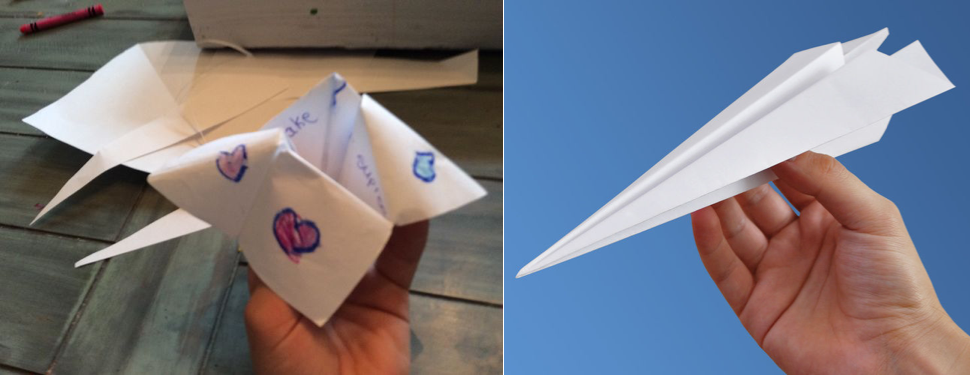
Paper airplane and cootie catchers.

Picture1So here’s what I learned in bible class yesterday. I am teaching a class on Dr. Howard Hendrick’s book Teaching to Change Lives, previously titled The Seven Laws of Teaching. It is part of our ongoing effort to quip our bible class leaders to become better teachers.

Yesterday’s class on “the Law of Education” encouraged teachers to involve students in learning, teaching them how think and learn rather than just simply sitting there hopefully absorbing material. I used a suggested exercise and gave each person a piece of paper and a pen or pencil. Each was to draw a picture on the paper, make something with the paper, or do something with the paper to symbolize the statement “How does a person learn?” I knew it would be a challenging exercise, but I was surprised at how effective a lesson it was.

There were as many creative ideas as there were people in the room, everything from a paper airplane to a “cootie catcher” to stick people learning in some way. The exercise actually primed their creativity for further exercises in the class, and will probably be the thing they most remember about that hour.

So what did I learn? Give my classes more things like that to do! I’ve done it from time to time, but it may be worth adding to every class. One activity per lesson each week is well worth the time spent to encourage discussion, questions and creativity.