Posted in dogs, Life

“Bike ride?”

Our dog Samson is coming up on his thirteenth birthday. He’s a lot mellower than he was in his puppy days. I had forgotten some of those days until our daughter brought her golden retriever Rex over to play. At six months, Rex is a ball of hair and energy, ready and willing to chew on anything moving or inanimate.

Samson’s got some kind of retriever in him, along with some German shepherd and a little who-knows-what for good measure. The veterinarian called him a “Florida Brown Dog.” In his puppy days, I had to make sure he burned lots of energy outdoors. If he didn’t he’d burn lots of energy indoors.

Bike rides are a great way to do this. No, we didn’t teach Sam how to ride a bike. I was the one on the bike. At the mention of a “bike ride,” he was ready. His leash in hand, I hopped on the bike, and he took off like a shot. Seventy-five pounds of pure energy would sprint down the street, pulling me along on two wheels. I didn’t have to pedal at all, just hang on tight.

But not too tightly. In about a quarter of a mile, Sam would suddenly pause at the side of the road for a bathroom break. Those same seventy-five pounds could quickly pull down the bike. So I learned to hold his leash on the handlebars in a way that I could quickly release him when he stopped. I could then circle back, grab the lease, and we could continue our bike ride. Once we were about half a mile in, he settled down, and we completed our circuit around the block.

Before too long, my other daughter got a puppy, a Florida brown dog named Kennedy. Hair. Energy. The complete package. When Kennedy came to visit, I got out the bike. I leveled up to a two-engine craft when I took them both out for a bike ride. With a leash in each hand, I felt like Ben Hur riding a chariot around the coliseum. I had a couple of close calls, but no tumbles off the bike.

By the time we got home, both beasts were panting hard, long tongues hanging out, eager to slurp up water together, and collapse on the cool tile floor. Happy, tired dogs.

But not for long.

“Bike ride?”

Posted in Food, Life

I don’t think this is our food

My wife and I stopped at Starbuck’s after church last Sunday, and since it was already after noon, we each ordered something to eat. She went with her usual egg bites and I decided on an egg and bacon muffin sandwich. The shop wasn’t too busy, but since there weren’t too many table to sit at, I figured most of the business was drive thru and mobile order pickups.

Our coffee was ready first. The food took a little longer. At some point in our conversation, I thought I heard my name, meaning that the food order was up. I went over and quickly looked at the bags and saw what looked like our orders. Upon returning to my table, I took a closer look and saw someone else’s name. The label also stated “mobile order.”

Oops. For a moment I thought that the label had been misprinted. Or maybe those folks had taken ours by mistake. But then I decided to put it back and wait a little longer for my actual order. I’m glad I hadn’t taken a bite before I glanced at the label.

I wonder if that ever happens or how often that happens. The baristas crank out coffee after coffee and out out pastry after pastry. They cannot monitor who picks up what. Mobile orders are ready and sitting out before those folks even get to the restaurant. It’s all based on the honor system. I believe most people are honorable. I’m one of them – you don’t have to worry about me grabbing your food. But I know that not everyone is. And not everyone is paying close attention, either.

How many customers come in only to wonder where their order is? How many customers pick up an order and discover that a bite or a sip is already missing? I’ll bet some of you think that is amazingly disgusting. Yet sometimes I don’t look in the bag. I pull out pieces of lemon cake or a scone, assuming the whole thing is there. I wouldn’t even know. I wouldn’t know if someone took a sip of my latte, realized it had no flavor, and put it back on the counter.

Ew, right?

Posted in bible, faith

“The Greek word means…”

I’ve been retired and on the other side of the pulpit for seven months now. as I listen to sermons, my ears perk up when I hear a preacher mention that “the Greek (or Hebrew word) means….” Each time the speaker did it well and in such a way that it deepened my understanding of a passage.

But I did notice that all the listeners simply took that point at face value. Nodding their heads, they dutifully made notes in the margin of their bible. There was no hint of doubt or question about the statement.

Now I was taught at seminary not to do that very often. I learned learned Greek and Hebrew so that I could read, understand, and explain God’s Word from the original language. English translations may not capture all the nuances of an ancient word or phrase. A single word can say so much, and the meaning is worth including in preaching or teaching. But the listener doesn’t need to hear everything that went into preparation. You do not need to see everything that went on in the kitchen to enjoy a wonderful meal.

So I’ve been thinking, “What happens when you preface a thought or application with ‘The Greek (or Hebrew) word means…'”

I think it causes people to assume you know what you’re talking about, whether you do or not. It gives credence to your applications and sometimes your opinions. Are you manipulating the audience? Maybe.

When I hear those words, I pull out my phone and open up a bible app. “Accordance” is an app which displays a text in English as well as the original language. A built in lexicon gives you definitions and other uses in scripture, which often helps us understand a word or thought. I especially look up the word if it’s a definition I don’t remember hearing before.

When someone says, “The Greek word means…” you should ask some questions. Where did the speaker get that information? From a commentary? From an online source? From his or her own study of the language? Where were they educated?

Better yet, go home and read more about it own your own. Be like the church in Berea who went home and examined the scriptures after hearing the apostle Paul speak (Acts 17:11). They were eager to hear what he had to say. But they also made sure that’s what the scriptures really said.

We should be that noble, too. (That’s how Luke described the Jews in Berea.)

Posted in Life

Long, long lines

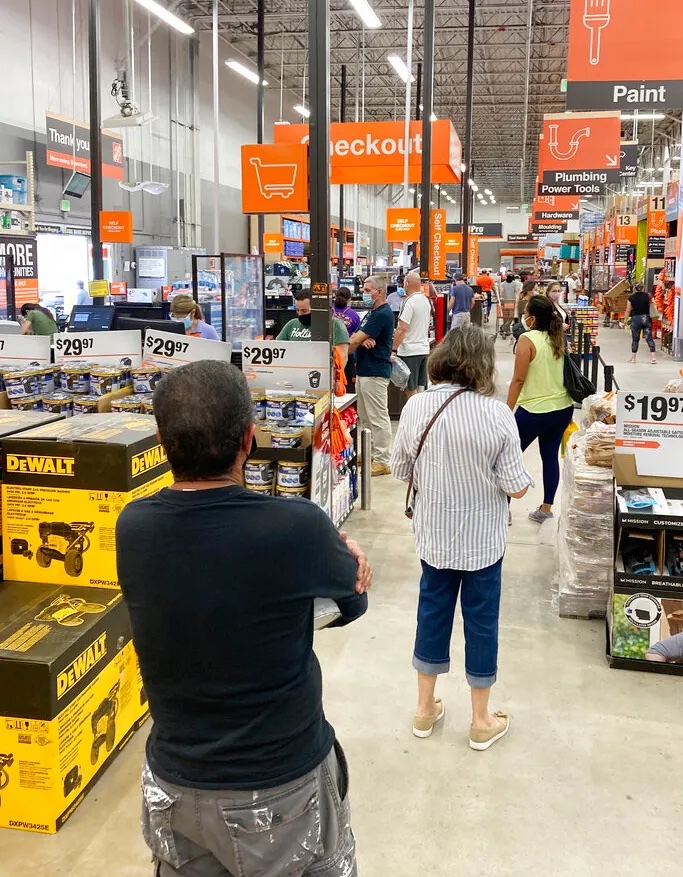
The lines were long at Home Depot. Lots of sales? Lots of people thinking “home improvement?” Lots of busy contractors?

Nope. No one to work the registers.

My Home Depot has six self-checkout registers. Three weren’t working. Station closed. The ten-person line snaked through aisles filled with displays of tools, batteries, plants, and eye protection. Every once in a while, a shopper who didn’t see the line walked right up to a checkout station. Sometimes an irritable person would point out, “The line starts over there!” But not always.

One employee watched over the self-checkout registers. So when an item didn’t scan correctly, or someone was buying a controlled substance like spray paint, the checkout process came to a halt until that one person noticed and came over to punch in their number. Self-checkout lanes are popular with shoppers who don’t seem to have ever used a self-checkout lane, so they wonder, “Now what do I do?” There are so many decisions. Like, do I want the extended service plan for a hammer? Do I need an emailed receipt? Which credit card do I want to use? If it’s a couple, they argue about what to do next.

Two checkout registers were staffed by live employees. One was for contractors only. No line there. That person was very good at getting the pros out the door. The other was operated by someone who must have been pretty new to the job. They summoned a manager for just about every purchase. That line of ten people moved very slowly.

So, while it was easy to find what I wanted, it was hard to find a human or machine that worked. I only had a can of paint. Others maneuvered carts full of long wood, small appliances, rolls of carpet, and sacks of sand through lines at the key-making kiosk, paint counter, and customer service desk. Either way, we were going to be there for a while.

Posted in Food, Life

That’s a lot of jalapeños

As I grabbed a few green and red peppers in the produce aisle, a guy next to me had a big bag of jalapeño peppers. I mean big. He had all of them. There were none left on the shelf. There must have been at least sixty in his bag.

I should have asked, “What are you going to do with those?” But I didn’t, so I can only imagine what someone would do with that many jalapeño peppers.

  • He works at a Mexican restaurant and peppers were missing from most recent the food order. His manager sent him out to get as many as he could.
  • It was contest time. He and his friends argued loud and long about who could eat the most jalapeños. Now it was time to find out. Someone’s going to feel the burn. Twice.
  • Someone lost a bet. Their team lost. They lost at eight ball. They were late. Again. It’s time to pay up.
  • Party food time. Everyone’s coming over for a celebration. “You’ll make your jalapeño poppers, right?” Of course.
  • Salsa time? The pepper shelf was first. Next stop: tomatoes. Onions and cilantro, too.
  • What about resale? If there’s none at the grocery store, you create demand and jack up the price at your roadside stand.
  • Prank time. It’s fun to watch an unsuspecting victim bite into some food with a jalapeño hidden inside.

As I was starting my shift at Subway (a long time ago), my assistant manager was getting ready to head home. We got to take home a footlong after every shift. “Make me a BMT on white.” No problem. Just for fun, I lined up about twenty jalapeño slices between the cheese and the meat and veggies, sliced it in two, wrapped it up, and stuffed it in a bag. The next day, he asked, “Who put all those hot peppers in my sub? I almost died when I took a bite!” Very entertaining.

Much later I found creative ways to hide slices or bits of jalapeño in my youngest daughter’s food. Inside a hamburger patty. Hidden amongst the green beans. Between scoops of ice cream. It was hard to keep a straight face, waiting for the cry of “jalapeño!” Never gets old.

Posted in church

Where do the ashes come from?

Photo by Ahna Ziegler on Unsplash

The tradition of receiving ashes on Ash Wednesday in the shape of a cross on the forehead is a tradition that dates to the 11th century church. They are a visible reminder that the wages of our sin is death, but by Jesus’ death on the cross, we have life. This worship practice kicks off the season of Lent, during which the church focuses on the suffering of Jesus for us.

I don’t remember ever having ashes on Ash Wednesday at the church my family went to when I was growing up. We were always members of a Lutheran Church – Missouri Synod congregation, and in the 1960s, the practice of receiving ashes on your forehead was a Roman Catholic tradition, and therefore one to stay away from.

I am not certain, but I believe the first time I experienced ashes on Ash Wednesday was in 1997 at our church in Florida. That was a time of restoring some ancient traditions in worship. The first time I did it, no one had saved any palms from the previous Palm Sunday. But surrounded by palm trees and palmettos, it was easy to gather up fronds to burn into ashes.

The first time around, I used a pan from the kitchen and set a bunch on fire. I had to throw out the ruined pan I used and the kitchen smelled horrible for a few days, but I had some ashes to use. I began saving the extra palm crosses from Palm Sunday that year. The trick is to remember where you have them stored away to use a year later.

That first year, someone asked me, “Whose ashes are those?” I would always explain where the ashes actually came from as well as their significance.

A colleague suggested baking the palm leaves to dry them out before burning them. Great idea, except the kitchen still smelled bad for a few days. This time, I took them outside to burn on some aluminum foil. This worked much better.

One year, I ordered some online. The ashes were very fine, much finer than I had ever been able to grind them up. This worked well, but I still felt like homemade were better.

The next year, I found the palm crosses, dried them thoroughly, burned them nicely, ground them up into a very fine ash. Best batch ever. Biggest batch ever. A little bit goes a long way. So I saved the ashes in a little jar I kept on my bookshelf. They lasted for years.

So when someone asked, “Where do the Ash Wednesday ashes come from?” I only had to point to the jar and say, “Right there.” But then I would explain the tradition and the process.

After retiring last summer, I didn’t think much about Ash Wednesday ashes until last week, when the church office manager called and asked, “Where did you get ashes? And do you know where the leftover palms are?”

Well, I explained, “if you can find the palm crosses from last year, you’ll need to bake them, burn them, and grind them up. Or you can just order some on Amazon.”

“I think we’ll order some this year.”

Posted in Food

The joy of grilled cheese

“What do you want for lunch today? How about a grilled cheese sandwich?”

My four-year-old grandson exclaimed, “Yes!”

A few minutes later, he bit in and with a giggle, stretched out an eight-inch string of melted Colby-jack cheese. He did this over and over, enjoying every bite and every inch of the cheese.

So I’m wondering, “Why is a grilled cheese sandwich so good?” It is so good that there are restaurants dedicated to nothing but grilled cheese sandwiches.

When one of my daughters was playing high school lacrosse, I volunteered to work the concession stand. My job was to make grilled cheese sandwiches. Equipped with a loaf of white bread, a stack of Velveeta slices, margarine, and a spatula, I was in my glory. These items were very popular on cool spring evenings when fans just couldn’t endure another foil-wrapped hot dog or hamburger. And I quickly learned that a diagonal slice was critical to a successful melt.

Who came up with this idea? Who invented the grilled cheese sandwich?

Melting cheese on bread isn’t a new idea. Some ancient Roman texts refer to it. You can find it in French recipes from the early 1900’s. Navy cooks in World War II melted grated cheese on plenty of slices of bread.

In 1949, Kraft began selling “Kraft Singles,” individually wrapped slices of processed cheese. It was easier than ever to slap a few pieces between bread and cook for a few minutes on each in a frying pan. The sandwich was official called grilled cheese in the 1960’s.1

I like to imagine Moses and the nation of Israel trying to figure out something creative to do with manna about twenty years into the exodus. Maybe someone suggested, “Hey, I know. Take some of that flat bread and try melting goat cheese in the middle. Doesn’t that sound yummy?”

Who knows? All I know is that it’s good to be alive in the age of grilled cheese sandwiches.

1The History of the Grilled Cheese Sandwich

Posted in Life, Stories

Tell me the story

Photo by S O C I A L . C U T on Unsplash

So as I sat and listened to the story, I knew how it would end. I’ve already heard it four times. In fact, I know some of the details they’ve left out in this rendition. I don’t say anything. I try not to roll my eyes. I Io my best to listen, or at least appear to be listening. But in my mind I wonder, “When will I start telling the same story over and over? Do I already do that?”

Too many times, as soon as I recognize the story, my mind shuts off. I stop listening. I’ve already heard this.

To avoid being that guy, I’ll make sure I ask, “Have I told you about…?” Or I begin by saying, “Stop me if I’ve told you this before.”

And yet, there are some stories we enjoy hearing over and over again. As children, we haul out the same book over and over again for mom or dad to read to us. Or we’ll say, “Tell me that story again.”

Every get tired of hearing the Christmas story?

There are some stories I wish I could hear.

  • I wish I could hear the story of how my mom’s mother and father met. She was a nanny who had immigrated from England. He was a Spanish-speaking machinist who grew up in Costa Rica. While I remember her well, I only vaguely remember him. As I look back at pictures, though, I cannot imagine who these two got together. But there is no one left in the family who can tell me that story.
  • I wish I could hear the story about the birth and death of my little brother Robert. He was born just eleven months after me but only lived three months. As far as I know, we only have a birth certificate, a picture of his tombstone, and a vague description of him as a “blue baby.” He was always remembered but never talked about.
  • I wish I could hear more of my dad’s stories from his travels in the South Pacific during World War II. He kept a careful record of every island and atoll he stopped at in 1944 and 45. But like many veterans, he didn’t often share details about those days. All we have are a few of his handwritten letters home.

The people who could tell me those stories have died. They’ve taken their stories with them.

So I remind myself that these are precious moments. I try to pay attention and listen. These voices are leaving stories behind for me to remember and retell.

Tell me the story.

Posted in Life

A private elevator

Photo by Kind and Curious on Unsplash

Our small group was recently hosted in an exclusive, more-than-we-could-ever-afford, gated community. While the couple had previously lived in an ocean-front high-rise, they had recently moved into a townhouse a few blocks from the ocean. When I pulled into the driveway, the owner pointed me to a parking spot in front of one of three two-car garages beneath their unit. I wasn’t where the front door was, so I was glad I could follow him around the front and into the entrance.

Through the front doors, we went down a short hallway to an elevator. That’s when I realized this wasn’t like other townhomes I had been in. Once in the elevator, he pushed three, and in less than a minute the opposite door opened, and I stepped out into his living room. That’s right, he had his own private elevator up to his floor, or should I say, his home. Very nice.

At the end of the evening, members of the group climbed back into the elevator to make their way back to their cars. “Make sure you press ‘L’.” Okay. What happens if you press the ‘2’? You end up in someone else’s home, those who occupy the second floor.

Imagine going there for the first time and not paying attention, pressing ‘2’. When the doors opened, you wouldn’t know you were in the wrong home. So you walk in and make yourself at home. You grab a drink from the refrigerator, go over and look at the ocean, and then sit down to relax.

A stranger walks out of a back bedroom and says, “Oh, hi. Can I help you?”

As you introduce yourself, you suddenly realize they don’t know anything about a small group. They don’t know you and you don’t know them. You stumbled onto the wrong floor!

How nice to have your own personal elevator. Until it’s not working and you have to take the stairs. Or until a stranger makes himself at home on your sofa.